
VisualAD: Language-Free Zero-Shot Anomaly Detection via Vision Transformer
Abstract
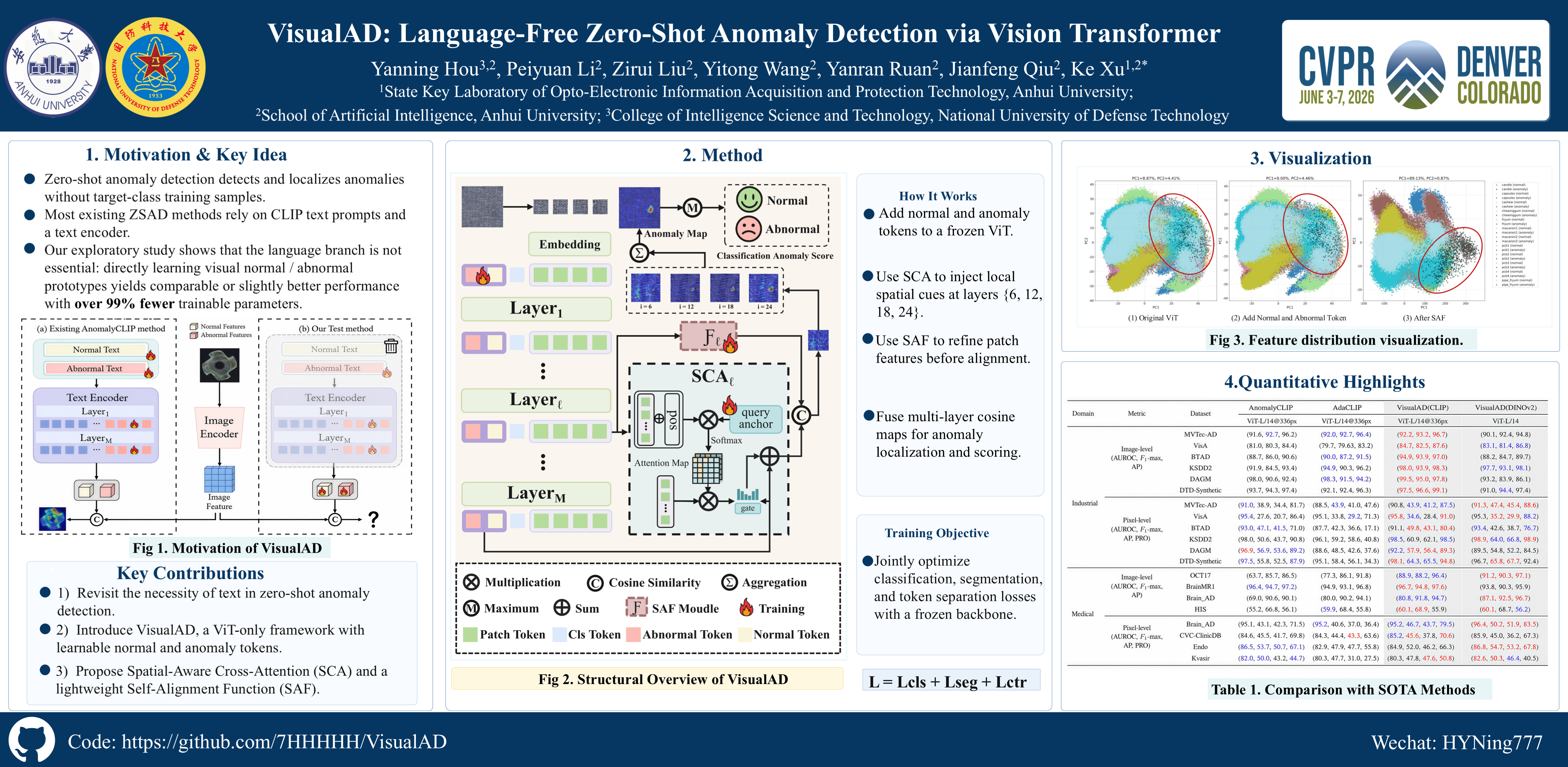
Zero-shot anomaly detection (ZSAD) requires detecting and localizing anomalies without access to target-class anomaly samples. Mainstream methods rely on vision–language models (VLMs) such as CLIP: they build hand-crafted or learned prompt sets for normal and abnormal semantics, then compute image–text similarities for open-set discrimination. While effective, this paradigm depends on a text encoder and cross-modal alignment, which can lead to training instability and parameter redundancy. This work revisits the necessity of the text branch in ZSAD and presents VisualAD, a purely visual framework built on Vision Transformers. We introduce two learnable tokens within a frozen backbone to directly encode normality and abnormality. Through multi-layer self-attention, these tokens interact with patch tokens, gradually acquiring high-level notions of normality and anomaly while guiding patches to highlight anomaly-related cues. Additionally, we incorporate a Spatial-Aware Cross-Attention (SCA) module and a lightweight Self-Alignment Function (SAF): SCA injects fine-grained spatial information into the tokens, and SAF recalibrates patch features before anomaly scoring. VisualAD achieves state-of-the-art performance on 13 zero-shot anomaly detection benchmarks spanning industrial and medical domains, and adapts seamlessly to pretrained vision backbones such as the CLIP image encoder and DINOv2. Our code will be made publicly available.