Honorary General Chairs
Takeo Kanade
CMU
Honorary General Chairs
Shimon Ullman
Weizmann Institute of Science
General Chair
Chandra Kambhamettu
University of South Florida
General Chair
Dimitris Metaxas
Rutgers University
Program Chair
Angela Dai
Technical University of Munich
Program Chair
Adriana Kovashka
University of Pittsburgh
Program Chair
Chen Change Loy
Nanyang Technological University
Program Chair
Vladimir Pavlovic
Rutgers University
Program Chair
Alexander G. Schwing
University of Illinois Urbana-Champaign
Program Chair
Shaoting Zhang
Shanghai Jiao Tong University
Advisor to the Program Committee
David Forsyth
University of Illinois Urbana-Champaign
Tutorial Chair
Boqing Gong
Boston University / Google
Tutorial Chair
Hongsheng Li
The Chinese University of Hong Kong
Tutorial Chair
Paul Schrader
Air Force Research Laboratory
Dr. Paul T. Schrader is a Research Mathematician for the Air Force Research Laboratory's Information Directorate>Information Warfare Division>Information Exploitation Branch (AFRL/RIGC). A non-traditional student originally working for years in the wholesale distribution and welded fabrication industries, he received his BA (2011) and MS (2013) in mathematics from Cleveland State University where he began his studies in topological data analysis (TDA). In 2018 he obtained a PhD in mathematics from Bowling Green State University specializing in non-associative algebras and monoidal/tensor/modular categories. Prior to the AFRL/RI he was a tenure track Assistant Professor of Mathematics at Southern Arkansas University from 2018-2022. With multiple publications and patents pending in a variety of TDA, mathematics, math education, and AI/ML based subjects, his current research includes the applications of TDA and other novel mathematical approaches to modality agnostic data driven information fusion for collaborative/distributive autonomy in: target recognition and continuous custody, arbitrary tactical/strategic sensing grids, systems/materials/high-rate health monitoring and situational/state awareness, battle/natural disaster damage assessment, network/data assurance, human-machine interfacing, wearables, and general dynamic data-driven applications systems/phenomena.
Dr. Paul T. Schrader is a Research Mathematician for the Air Force Research Laboratory's Information Directorate>Information Warfare Division>Information Exploitation Branch (AFRL/RIGC). A non-traditional student originally working for years in the wholesale distribution and welded fabrication industries, he received his BA (2011) and MS (2013) in mathematics from Cleveland State University where he began his studies in topological data analysis (TDA). In 2018 he obtained a PhD in mathematics from Bowling Green State University specializing in non-associative algebras and monoidal/tensor/modular categories. Prior to the AFRL/RI he was a tenure track Assistant Professor of Mathematics at Southern Arkansas University from 2018-2022. With multiple publications and patents pending in a variety of TDA, mathematics, math education, and AI/ML based subjects, his current research includes the applications of TDA and other novel mathematical approaches to modality agnostic data driven information fusion for collaborative/distributive autonomy in: target recognition and continuous custody, arbitrary tactical/strategic sensing grids, systems/materials/high-rate health monitoring and situational/state awareness, battle/natural disaster damage assessment, network/data assurance, human-machine interfacing, wearables, and general dynamic data-driven applications systems/phenomena.
Tutorial Chair
Vitomir Struc
University of Ljubljana
Vitomir Štruc is a Professor at the University of Ljubljana, Slovenia. He received his doctoral degree from the Faculty of Electrical Engineering in Ljubljana in 2010. Vitomir's research interests include problems related to biometrics, computer vision, image processing, pattern recognition and machine learning. He (co-)authored more than 150 research papers for leading international peer reviewed journals and conferences in these and related areas. He served in different capacities on the organizing committees of several top-tier vision conferences, including IEEE Face and Gesture, ICB, WACV, IJCB and CVPR. Vitomir is a Senior Area Editor for the IEEE Transactions on Information Forensics and Security, a Subject Editor for Elsevier’s Signal Processing and an Associate Editor for Pattern Recognition, and IET Biometrics. He served as an Area Chair for WACV 2018, 2019, 2020, ICPR 2018, 2022, Eusipco 2019 and FG 2020, 2021, 2023 and IJCB 2022 and 2024, and as the Program Chair for IJCB 2020, 2025 and IWBF 2022, 2023. Currently, he acts as a Program Co-Chair for FG 2024 and WACV 2025. Dr. Struc is a Senior member of the IEEE, a member of IAPR and EURASIP, Slovenia’s national contact point for the European Association for Biometrics (EAB) and the former president and current executive committee member of the Slovenian Pattern Recognition Society, the Slovenian branch of IAPR. Vitomir is also the current VP Technical Activities for the IEEE Biometrics Council, the secretary of the IAPR Technical Committee on Biometrics (TC4) and a member of the Supervisory Board of the EAB.
Vitomir Štruc is a Professor at the University of Ljubljana, Slovenia. He received his doctoral degree from the Faculty of Electrical Engineering in Ljubljana in 2010. Vitomir's research interests include problems related to biometrics, computer vision, image processing, pattern recognition and machine learning. He (co-)authored more than 150 research papers for leading international peer reviewed journals and conferences in these and related areas. He served in different capacities on the organizing committees of several top-tier vision conferences, including IEEE Face and Gesture, ICB, WACV, IJCB and CVPR. Vitomir is a Senior Area Editor for the IEEE Transactions on Information Forensics and Security, a Subject Editor for Elsevier’s Signal Processing and an Associate Editor for Pattern Recognition, and IET Biometrics. He served as an Area Chair for WACV 2018, 2019, 2020, ICPR 2018, 2022, Eusipco 2019 and FG 2020, 2021, 2023 and IJCB 2022 and 2024, and as the Program Chair for IJCB 2020, 2025 and IWBF 2022, 2023. Currently, he acts as a Program Co-Chair for FG 2024 and WACV 2025. Dr. Struc is a Senior member of the IEEE, a member of IAPR and EURASIP, Slovenia’s national contact point for the European Association for Biometrics (EAB) and the former president and current executive committee member of the Slovenian Pattern Recognition Society, the Slovenian branch of IAPR. Vitomir is also the current VP Technical Activities for the IEEE Biometrics Council, the secretary of the IAPR Technical Committee on Biometrics (TC4) and a member of the Supervisory Board of the EAB.
Workshop Chair
Erik Blasch
AFRL
IEEE Fellow
IEEE Fellow
Workshop Chair
Mei Chen
Dolby
Workshop Chair
Brian Clipp
Motional
Workshop Chair
Sharon X. Huang
Penn State University
Workshop Chair
Andreas Savakis
Rochester Institute of Technology
Workshop Chair
Humphrey Shi
Georgia Tech
Demonstration Chair
Sathyanarayanan N. Aakur
Auburn University
Demonstration Chair
Shu Kong
University of Macau
I am on the faculty of FST, University of Macau, and CSE, Texas A&M University. I lead the Computer Vision Lab. My research lies in Computer Vision, and its interactions with other fields (e.g., machine learning, robotics, NLP, HCI, and graphics), broad applications (e.g., AR/VR, autonomous driving, etc.), and diverse disciplines (e.g., biology, paleoecology, psychology, special education, etc.). My current research focus is on Visual Perception via Learning in the Open World (VPLOW). My recent paper on this topic was recognized for Best Paper / Marr Prize at ICCV 2021. I also actively apply my algorithms to interdisciplinary research including building a high-throughput pollen analysis system, which was featured by the National Science Foundation as that “opens a new era of fossil pollen research”.
I am on the faculty of FST, University of Macau, and CSE, Texas A&M University. I lead the Computer Vision Lab. My research lies in Computer Vision, and its interactions with other fields (e.g., machine learning, robotics, NLP, HCI, and graphics), broad applications (e.g., AR/VR, autonomous driving, etc.), and diverse disciplines (e.g., biology, paleoecology, psychology, special education, etc.). My current research focus is on Visual Perception via Learning in the Open World (VPLOW). My recent paper on this topic was recognized for Best Paper / Marr Prize at ICCV 2021. I also actively apply my algorithms to interdisciplinary research including building a high-throughput pollen analysis system, which was featured by the National Science Foundation as that “opens a new era of fossil pollen research”.
Award Committee
Kristen Grauman
University of Texas at Austin
Award Committee
Derek Hoiem
University of Illinois at Urbana-Champaign
Award Committee
Ko Nishino
Kyoto University
Award Committee
Deqing Sun
Google DeepMind
Award Committee
Tinne Tuytelaars
KU Leuven
Award Committee
Angela Yao
National University of Singapore
Award Committee
Jun-Yan Zhu
Carnegie Mellon University
Publicity Chair
Deblina Bhattacharjee
University of Bath, UK
Dr. Deblina Bhattacharjee (FHEA) is an Assistant Professor in Computer Science at the University of Bath, where her research blends Computer Vision with Cultural Grounding, Ethics, andResponsible AI. She has developed novel AI solutions for preservation, interpretation, and reconfiguration of cultural relics, documents, historical evidences across diverse media. Her technical focus spans generative models, 3D reconstruction, multimodal large language models, depth estimation, visual saliency, and multitask learning. She holds a PhD from EPFL (Swiss Federal Institute of Technology) and has held research roles at Samsung and EPFL as a Postdoctoral Scientist. Her work has been published at top venues including CVPR, ICCV, ECCV, AAAI, TMLR, and WACV with research exploring how AI can ethically and responsibly integrate into society. Beyond research, Deblina is a committed advocate for inclusion in STEM. She organises the Women in Computer Vision Workshop at CVPR and co-chairs publicity for CVPR 2025 and 2026. She chairs her department's Self-Assessment Team (DSAT), sits on the Equality, Diversity & Inclusion Committee, and has supervised PhD students across the UK, US, Switzerland, and China. Prizes she has won include the Perplexity AI Business Fellowship, Fellow of the Higher Education Academy, Google Inside Look Award, and Impact and Knowledge Exchange Fellowship.
Dr. Deblina Bhattacharjee (FHEA) is an Assistant Professor in Computer Science at the University of Bath, where her research blends Computer Vision with Cultural Grounding, Ethics, andResponsible AI. She has developed novel AI solutions for preservation, interpretation, and reconfiguration of cultural relics, documents, historical evidences across diverse media. Her technical focus spans generative models, 3D reconstruction, multimodal large language models, depth estimation, visual saliency, and multitask learning. She holds a PhD from EPFL (Swiss Federal Institute of Technology) and has held research roles at Samsung and EPFL as a Postdoctoral Scientist. Her work has been published at top venues including CVPR, ICCV, ECCV, AAAI, TMLR, and WACV with research exploring how AI can ethically and responsibly integrate into society. Beyond research, Deblina is a committed advocate for inclusion in STEM. She organises the Women in Computer Vision Workshop at CVPR and co-chairs publicity for CVPR 2025 and 2026. She chairs her department's Self-Assessment Team (DSAT), sits on the Equality, Diversity & Inclusion Committee, and has supervised PhD students across the UK, US, Switzerland, and China. Prizes she has won include the Perplexity AI Business Fellowship, Fellow of the Higher Education Academy, Google Inside Look Award, and Impact and Knowledge Exchange Fellowship.
Publicity Chair
Kosta Derpanis
York University
Publicity Chair
Antonino Furnari
University of Catania
Publicity Chair
Zhengzhong Tu
Texas A&M University, UT Austin
Zhengzhong Tu is currently a research engineer at Google Inc. Previously, he received the BS and MS degrees from Fudan University, China, in 2016 and 2018, respectively. He obtained the PhD degree in electrical and computer engineering in University of Texas at Austin, USA, in 2022. His research interests are computer vision, computational photography, and deep learning. He has published more than 20 articles in the related areas. He is the recipient of the CVPR 2022 best paper nomination award. He served as a reviewer multiple times for IEEE-TIP, IEEE-CSVT, IEEE-JSTSP, CVPR, ECCV, WACV, etc.
Zhengzhong Tu is currently a research engineer at Google Inc. Previously, he received the BS and MS degrees from Fudan University, China, in 2016 and 2018, respectively. He obtained the PhD degree in electrical and computer engineering in University of Texas at Austin, USA, in 2022. His research interests are computer vision, computational photography, and deep learning. He has published more than 20 articles in the related areas. He is the recipient of the CVPR 2022 best paper nomination award. He served as a reviewer multiple times for IEEE-TIP, IEEE-CSVT, IEEE-JSTSP, CVPR, ECCV, WACV, etc.
Publicity Chair
Yael Vinker
MIT
Broadening Participation Chair
Naresh Cuntoor
BlueHalo Labs
Broadening Participation Chair
Christopher Funk
Kitware
Broadening Participation Chair
Deepti Ghadiyaram
Boston University
Broadening Participation Chair
Michael C. King
Florida Tech
Broadening Participation Chair
Roni Sengupta
UNC Chapel Hill
Local Chair
Brendan Klare
ROC
Social Chair
Yining Hong
Stanford
Social Chair
Yale Song
Google
Senior PAMI-TC Ombud
David Forsyth
University of Illinois Urbana-Champaign
Senior PAMI-TC Ombud
Linda Shapiro
University of Washington
Linda Shapiro, Professor of Computer Science and Engineering, Professor of Electrical and Computer Engineering, and Adjunct Professor of Biomedical and Informatics and Medical Education, earned a bachelor's degree in mathematics from the University of Illinois in 1970 and master's and Ph.D degrees in computer science from the University of Iowa in 1972 and 1974, respectively. She was a faculty member in Computer Science at Kansas State University from 1974 to 1978 and at Virginia Polytechnic Institute and State University from 1979 to 1984. She then spent two years as Director of Intelligent Systems at Machine Vision International in Ann Arbor, Michigan. She joined the University of Washington Electrical Engineering (now ECE) Department Department in 1986 and the Computer Science and Engineering Department in 1990. Professor Shapiro's research is in computer vision with related interests in image and multimedia database systems, artificial intelligence (search, reasoning, knowledge representation, learning), and applications in medicine and robotics. She has worked heavily in knowledge-based 3D object recognition and has contributed to both the theory of object matching and to the development of experimental machine vision systems. Her current work includes robot vision, cancer biopsy analysis, brain image analysis, and semantic segmentation. Professor Shapiro was the editor-in-chief of Computer Vision, Graphics, and Image Processing for 10 years. She was the 1993-95 chair of the IEEE Computer Society Technical Committee on Pattern Analysis and Machine Intelligence, conference chair of the 1986 IEEE Conference on Computer Vision and Pattern Recognition, co-program chairman of the 1994 conference, and co-chair of the 2008 conference. She was also the co-chair of the Biomedical and Multimedia Applications Track of the International Conference on Pattern Recognition in 2002. She has co-authored a textbook on data structures, a two-volume graduate text on computer and robot vision, and an undergraduate computer vision text. She is a Fellow of the IEEE and of the IAPR.
Linda Shapiro, Professor of Computer Science and Engineering, Professor of Electrical and Computer Engineering, and Adjunct Professor of Biomedical and Informatics and Medical Education, earned a bachelor's degree in mathematics from the University of Illinois in 1970 and master's and Ph.D degrees in computer science from the University of Iowa in 1972 and 1974, respectively. She was a faculty member in Computer Science at Kansas State University from 1974 to 1978 and at Virginia Polytechnic Institute and State University from 1979 to 1984. She then spent two years as Director of Intelligent Systems at Machine Vision International in Ann Arbor, Michigan. She joined the University of Washington Electrical Engineering (now ECE) Department Department in 1986 and the Computer Science and Engineering Department in 1990. Professor Shapiro's research is in computer vision with related interests in image and multimedia database systems, artificial intelligence (search, reasoning, knowledge representation, learning), and applications in medicine and robotics. She has worked heavily in knowledge-based 3D object recognition and has contributed to both the theory of object matching and to the development of experimental machine vision systems. Her current work includes robot vision, cancer biopsy analysis, brain image analysis, and semantic segmentation. Professor Shapiro was the editor-in-chief of Computer Vision, Graphics, and Image Processing for 10 years. She was the 1993-95 chair of the IEEE Computer Society Technical Committee on Pattern Analysis and Machine Intelligence, conference chair of the 1986 IEEE Conference on Computer Vision and Pattern Recognition, co-program chairman of the 1994 conference, and co-chair of the 2008 conference. She was also the co-chair of the Biomedical and Multimedia Applications Track of the International Conference on Pattern Recognition in 2002. She has co-authored a textbook on data structures, a two-volume graduate text on computer and robot vision, and an undergraduate computer vision text. She is a Fellow of the IEEE and of the IAPR.
Doctoral Consortium Chair
Paola Cascante-Bonilla
Stony Brook University
Doctoral Consortium Chair
Abby Stylianou
St. Louis University
Finance Chair
Walter Scheirer
Notre Dame
Compute Reporting Committee Chair
Sourav Bhattacharya
NatWest Group
Compute Reporting Committee Chair
Christopher Funk
Kitware
Compute Reporting Committee Chair
Sasha Luccioni
Hugging Face
Compute Reporting Committee Chair
Farhad Pourkamali
University of Colorado Denver
Compute Reporting Committee Chair
Roy Schwartz
Hebrew University of Jerusalem
Compute Reporting Committee Chair
Emma Strubell
Carnegie Mellon University
AI Art Curator
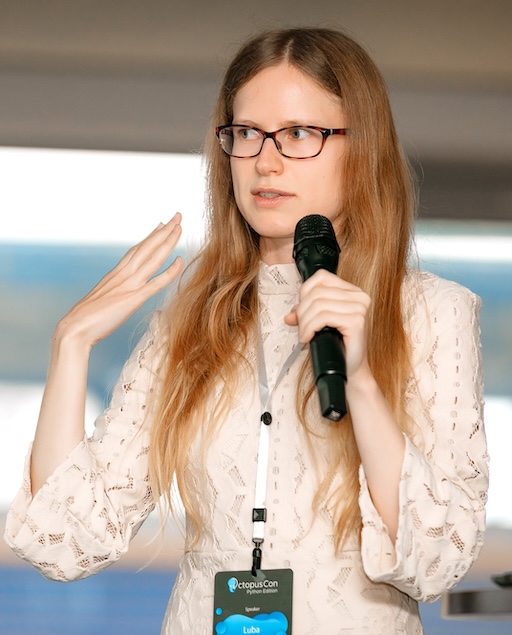
Luba Elliott
Independent Curator
Luba Elliott is a curator and researcher specialising in AI art. She works to educate and engage the broader public about the developments in AI art through talks and exhibitions at venues across the art, business and technology spectrum including The Serpentine Galleries, V&A Museum, Feral File, ZKM Karlsruhe, The Leverhulme Centre for the Future of Intelligence, NeurIPS and ICCV. Her projects include the ART-AI Festival and the galleries aiartonline.com and computervisionart.com. She is an Honorary Senior Research Fellow at the UCL Centre for Artificial Intelligence. Prior to that, she worked in start-ups, including the art collector database Larry's List. She has a degree in Modern Languages from the University of Cambridge.
Luba Elliott is a curator and researcher specialising in AI art. She works to educate and engage the broader public about the developments in AI art through talks and exhibitions at venues across the art, business and technology spectrum including The Serpentine Galleries, V&A Museum, Feral File, ZKM Karlsruhe, The Leverhulme Centre for the Future of Intelligence, NeurIPS and ICCV. Her projects include the ART-AI Festival and the galleries aiartonline.com and computervisionart.com. She is an Honorary Senior Research Fellow at the UCL Centre for Artificial Intelligence. Prior to that, she worked in start-ups, including the art collector database Larry's List. She has a degree in Modern Languages from the University of Cambridge.
Technical Chair
Yoshitomo Matsubara
Yahoo!
Dr. Yoshitomo Matsubara is a Research Scientist at Yahoo! and an ML OSS developer. He completed the Ph.D. program in Computer Science at University of California, Irvine (UCI) and worked on deep learning for resource-constrained edge computing systems with Profs. Marco Levorato, Stephan Mandt, and Sameer Singh. Before UCI, he obtained his Master and Bachelor degrees at University of Hyogo and National Institute of Technology, Akashi College, Japan, respectively.
His main research interests are in machine learning, natural language processing, computer vision, information retrieval, and symbolic regression. For deep learning, his main interests are in knowledge distillation and supervised compression. He is also a developer of ML OSS: torchdistill (PyTorch Ecosystem) and sc2bench.
Dr. Yoshitomo Matsubara is a Research Scientist at Yahoo! and an ML OSS developer. He completed the Ph.D. program in Computer Science at University of California, Irvine (UCI) and worked on deep learning for resource-constrained edge computing systems with Profs. Marco Levorato, Stephan Mandt, and Sameer Singh. Before UCI, he obtained his Master and Bachelor degrees at University of Hyogo and National Institute of Technology, Akashi College, Japan, respectively.
His main research interests are in machine learning, natural language processing, computer vision, information retrieval, and symbolic regression. For deep learning, his main interests are in knowledge distillation and supervised compression. He is also a developer of ML OSS: torchdistill (PyTorch Ecosystem) and sc2bench.
Conference Producer
Nicole Finn
c to c events
Web Developer
Lee Campbell
Bioinformatics
Eventhosts