
Multi-Prototype Compactness and Boundary-Aware Synthesis for Unsupervised Anomaly Detection
Abstract
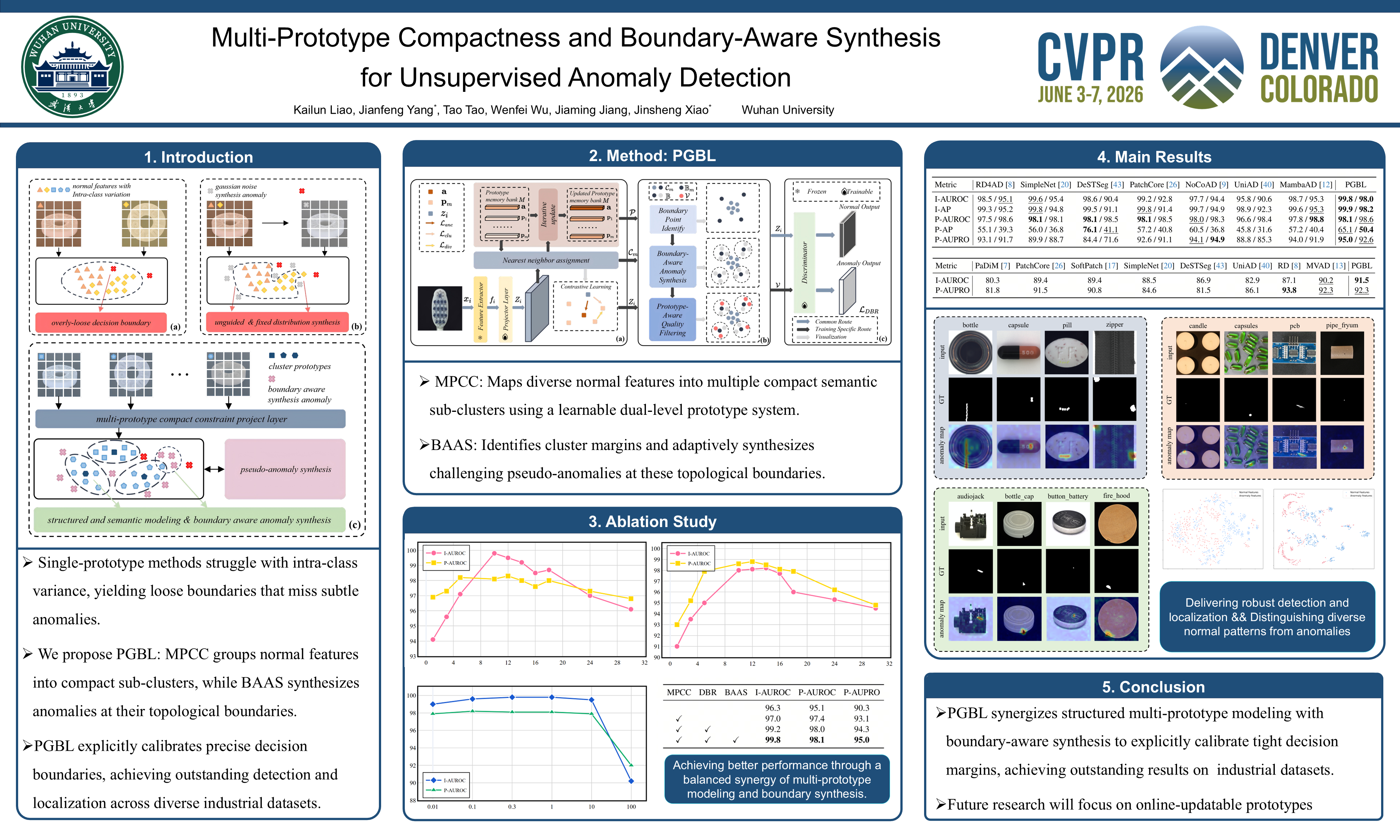
Unsupervised Anomaly Detection (UAD) is crucial for industrial quality control.Many existing embedding-based methods rely on a single-prototype assumption, learning, for instance, a compact hypersphere to enclose all normal features. However, this strategy often fails when confronted with significant intra-class variance caused by factors like illumination, pose, and texture. To accommodate all diverse normal samples, the decision boundary of a single prototype must become overly-general and loose, inevitably causing the model to miss subtle anomalies. To overcome this limitation, we propose PGBL (Prototype-Guided Boundary Learning), a framework that synergizes structured representation learning with targeted anomaly synthesis. First, we introduce the Multi-Prototype Compact Learning (MPCL) module, which explicitly models the complex normal feature distribution as a mixture of multiple semantic prototypes. This allows the model to learn tighter, local representations for each normal sub-pattern instead of a single loose, global boundary. Second, inspired by synthesis methods, we design the Boundary Pseudo-Anomaly Synthesis (BPAS) module. Unlike previous "blind" synthesis strategies, BPAS is a novel targeted strategy that first identifies feature points on the boundaries of the MPCL-defined clusters and then generates high-difficulty pseudo-anomalies only in these critical regions. Finally, a Discriminative Boundary Refiner (DBR) learns to shape the final decision surface by distinguishing between the compact normal clusters and the synthesized boundary anomalies. Extensive experiments demonstrate that PGBL achieves superior anomaly detection performance, significantly outperforming competitors.