
Event Structural Valley: A Unified Theoretical and Practical Framework for Event Camera Autofocus
Abstract
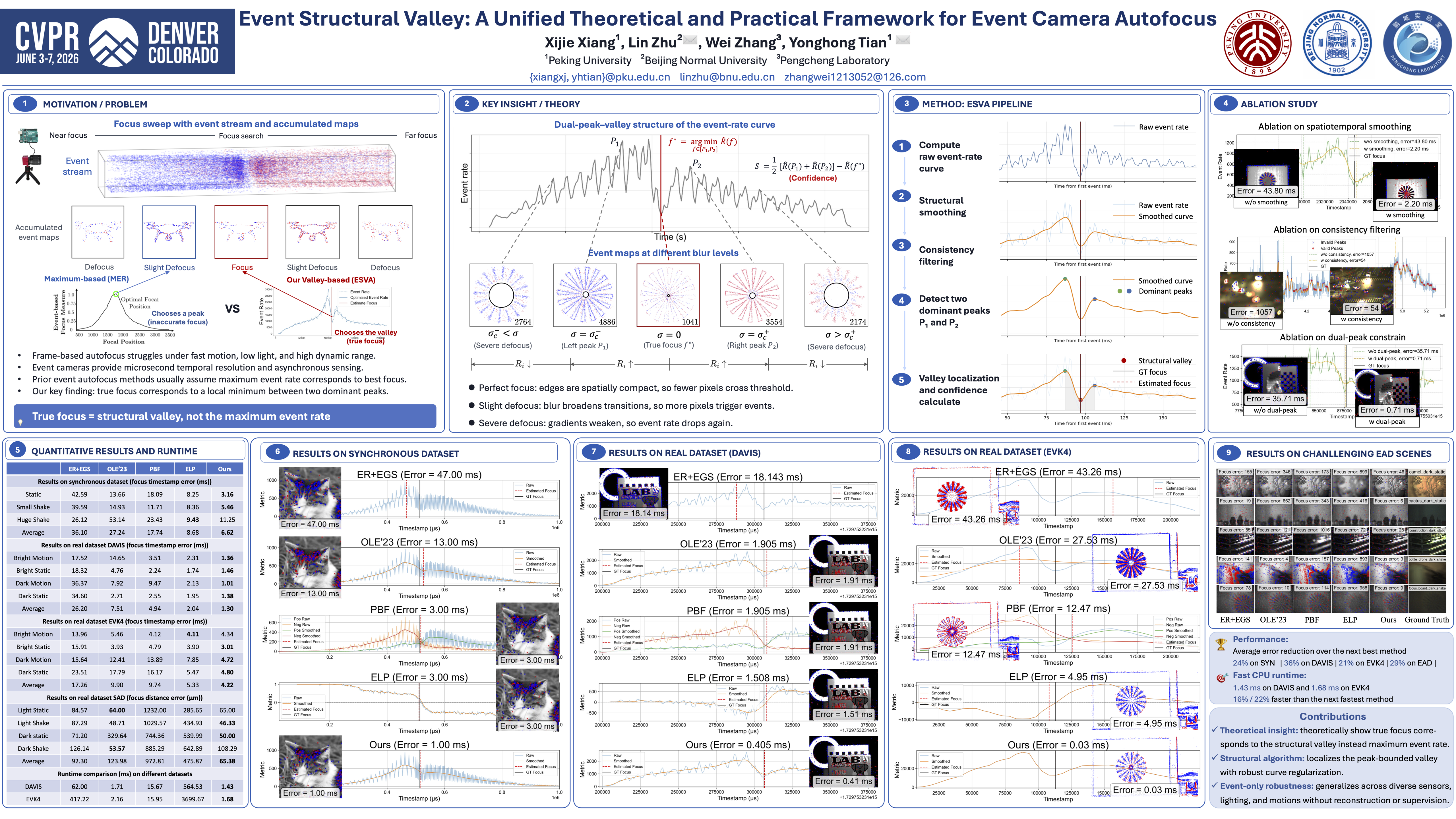
Autofocus in dynamic environments remains challenging for conventional frame-based sensors, which often fail under fast motion, low light, or high dynamic range conditions. Event cameras, with microsecond temporal resolution and asynchronous brightness detection, offer a promising alternative. However, typical event-based autofocus methods assume that the sharpest focus corresponds to the maximum event rate.In this paper, we reveal a counterintuitive yet consistent phenomenon: the true focus actually corresponds to a local minimum in the event-rate curve. We theoretically derive this behavior from the physics of event generation and show that as defocus blur increases, the event rate first rises and then declines, forming a dual-peak-valley structure across focal distances. Based on this insight, we propose an Event Structural Valley-based Autofocus (ESVA) framework that identifies the valley between two dominant peaks as the true focal position. ESVA integrates structural smoothing, consistency filtering, and a dual-peak constraint to robustly recover the valley under noise and motion disturbances. Extensive experiments on multiple synthetic and real datasets demonstrate that ESVA achieves sub-millisecond focusing accuracy and consistently outperforms existing event-only autofocus methods without any image reconstruction or supervision.