
ReAttnCLIP: Training-Free Open-Vocabulary Remote Sensing Image Segmentation via Re-defined Attention in CLIP
 Highlight
Abstract
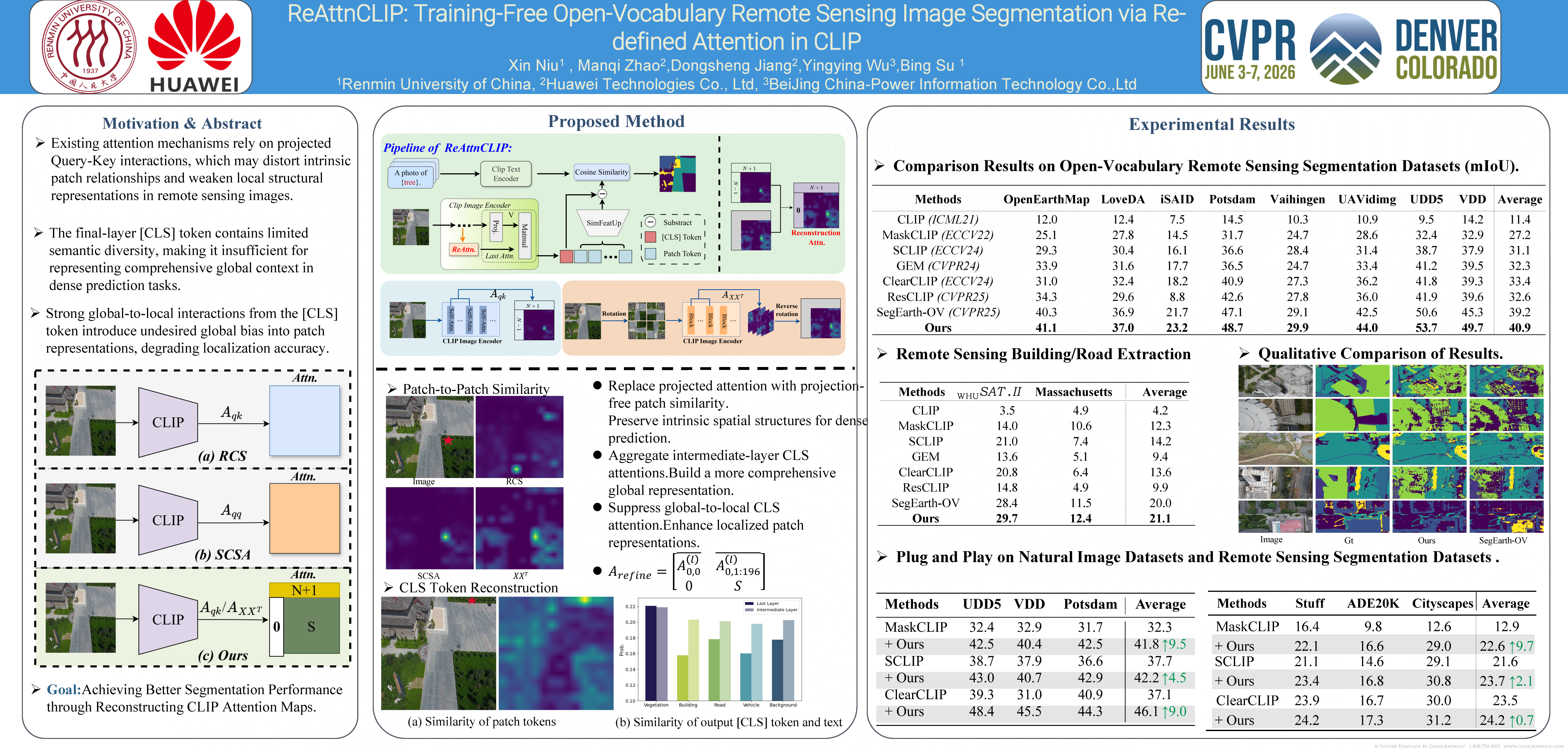
Remote sensing image segmentation is critical for a range of applications, including natural disaster monitoring and precision agriculture. Open-vocabulary segmentation enhances flexibility by removing fixed category constraints, enabling more fine-grained and adaptive scene understanding. Unlike CLIP’s original pretraining objective, which emphasizes global image-text alignment, segmentation tasks require accurate and discriminative patch-level representations to support precise pixel-wise predictions. As a result, the quality of attention maps—particularly those generated in the final transformer layers—plays a pivotal role in guiding inter-region interactions. However, current methods generate suboptimal representations when capturing the complex spatial hierarchies in remote sensing. We address this gap by optimizing CLIP's 197×197 attention matrix through three key modifications: (1) substituting the 196×196 patch-to-patch submatrix with intermediate-layer feature similarities to preserve spatial structures; (2) prioritizing intermediate-layer attention for global-to-local (class-to-patch) token alignment to reduce classification interference; (3) disabling the \texttt{[CLS]} token's self-attention to mitigate bias. Extensive experiments on eight remote sensing benchmarks and two building/road extraction datasets demonstrate that our method achieves state-of-the-art performance among existing training-free approaches.