
TRM-VLA: Temporal-Aware Chain-of-Thought Reasoning and Memorization for Vision-Language-Action Models
Abstract
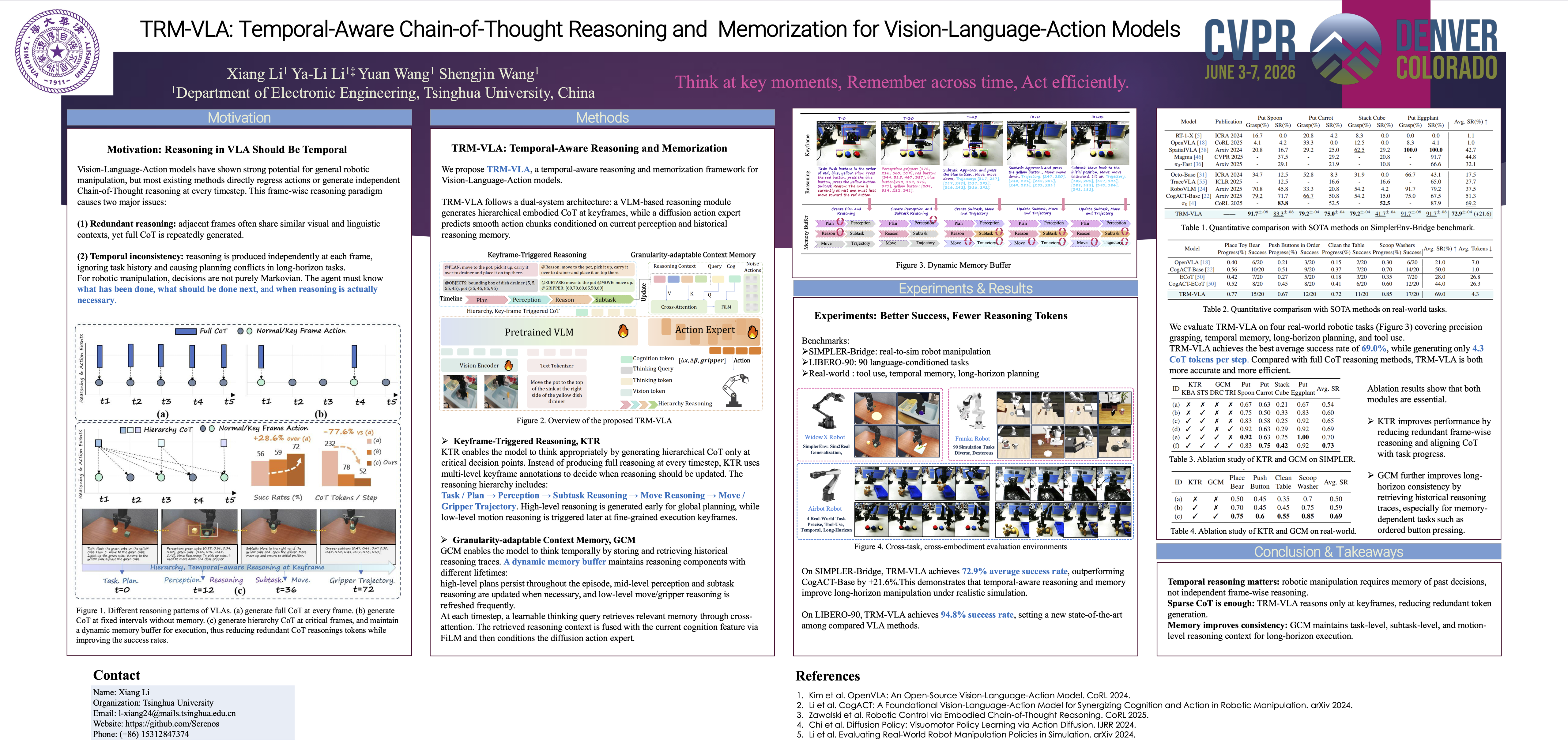
Vision-Language-Action (VLA) models have emerged as a powerful paradigm for general robotic manipulation. However, existing approaches typically omit intermediate reasoning steps and directly regress actions, limiting reasoning interpretability and performance in long-horizon or compositional tasks. Although recent studies introduce Chain-of-Thought (CoT) reasoning into VLA models, their effectiveness remains suboptimal due to two key issues: (1) generating a full reasoning trajectory at every timestep introduces substantial redundancy, thereby hinders real-time deployment and (2) reasoning is performed independently, neglecting temporal consistency, which leads to planning conflicts.We propose TRM-VLA, a temporal-aware reasoning and memorization framework that integrates explicit temporal modeling into the VLA reasoning process. TRM-VLA consists of two core components: (1) Keyframe-Triggered Reasoning (KTR), which identifies task progress and performs hierarchical CoT reasoning only at key decision points to reduce redundant inference; and (2) Granularity-adaptable Context Memory (GCM), which dynamically stores and retrieves historical reasoning trajectories to maintain inter-frame coherence and global context. Built upon a dual-system architecture—combining a multimodal foundation model for slow reasoning (System 2) with a diffusion-based policy for fast execution (System 1)—TRM-VLA learns to plan and act efficiently in a unified manner. Extensive experiments on LIBERO-90, SIMPLER, and four real-world robotic tasks demonstrate that TRM-VLA achieves state-of-the-art performance while improving reasoning efficiency.