
Ghosts in the Point Clouds: De-glaring LiDAR in the Transient Domain
Abstract
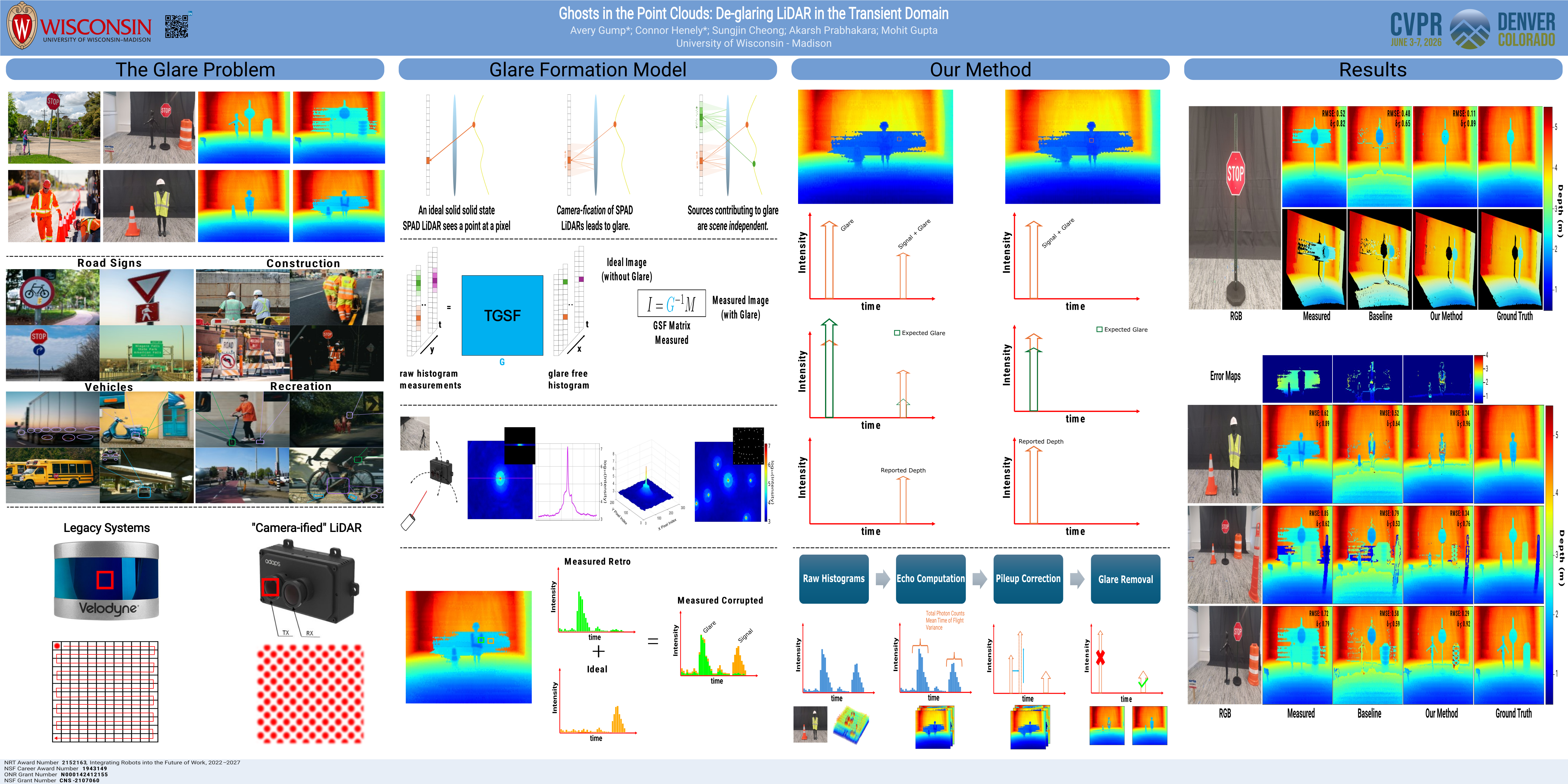
Modern LiDARs are rapidly transitioning from bulky, mechanically scanned systems to ultra-compact, low-cost, solid-state arrays. This miniaturization—while enabling scalability, affordability, and camera-like data structures—introduces a new and severe failure mode: internal-multipath glare. When light from a bright or retroreflective surface reflects and scatters within the LiDAR, light that should reach a single pixel spreads across the pixel array. The resulting artifacts create phantom objects, obscure real ones, and produce safety-critical “ghosts in the point clouds.” This paper introduces a physically-grounded sensing model and algorithmic techniques for addressing this effect. We show that internal glare can be represented as a linear, scene-independent operator—the Transient Glare Spread Function (TGSF)—acting on the raw transient histogram cube. This formulation enables simple, training-free inversion directly in the measurement domain, before nonlinear point-cloud formation. We develop exact and approximate de-glare algorithms that are general, computationally efficient, and compatible with existing LiDAR data-processing pipelines. Using experiments with real single-photon LiDAR hardware, we demonstrate suppression of severe glare artifacts at millisecond latency, establishing de-glare as a practical, lightweight preprocessing step for next-generation LiDAR systems.