
Progressive Neural Architecture Generation
Caiyang Yu ⋅ Chen Huang ⋅ Yun Liu ⋅ Chenwei Tang ⋅ Wei Ju ⋅ Jiancheng Lv
Abstract
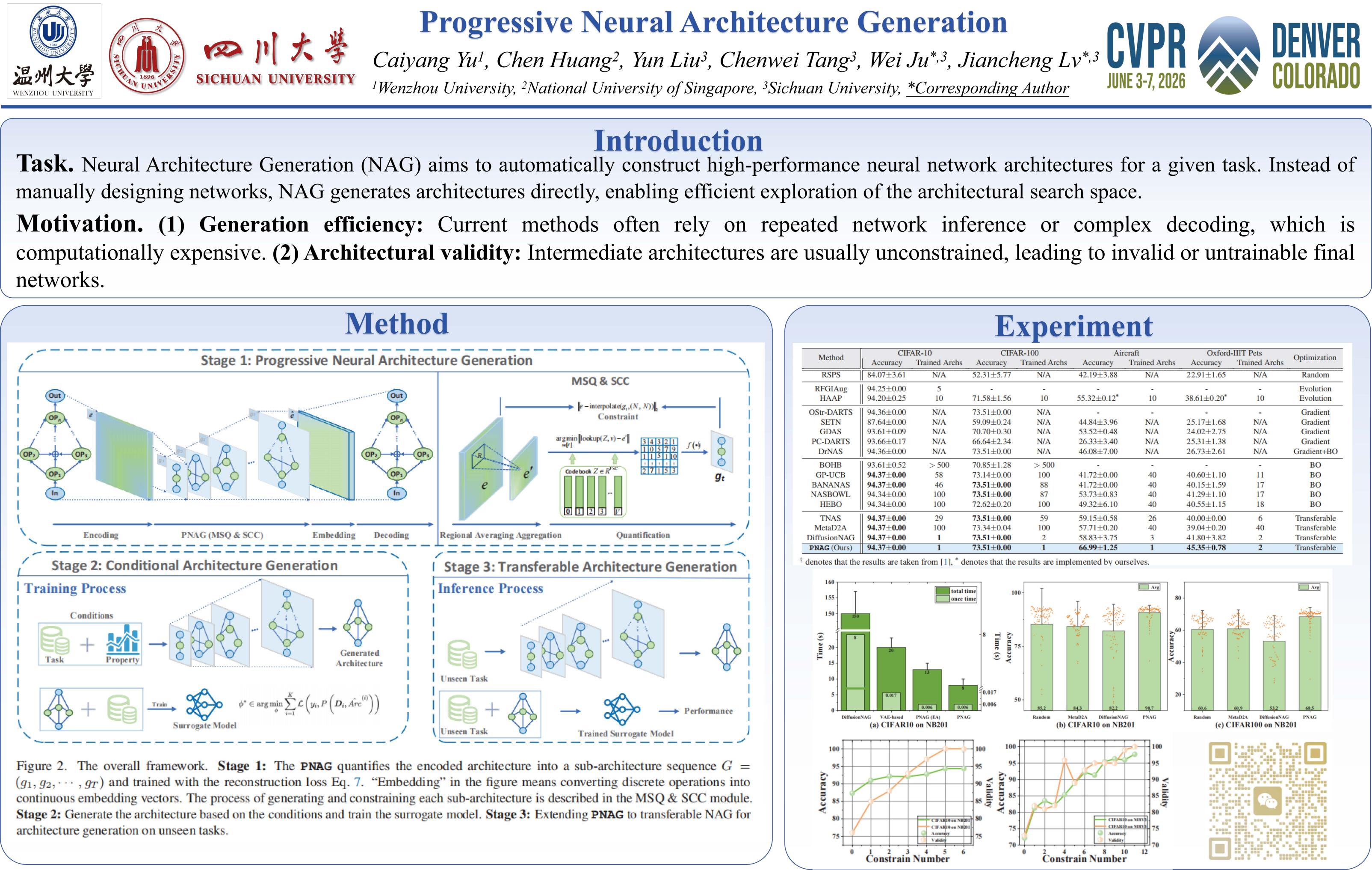
As a representative technique in neural architecture search, neural architecture generation aims to construct high-performance architectures for a given task directly. It is poised to replace the inefficient random exploration components of some search strategies, such as the acquisition strategies in Bayesian optimization. Despite significant research, current architecture generation techniques face problems such as low generation efficiency and insufficient constraints, leading to invalidly generated architectures. To this end, we propose Progressive Neural Architecture Generation (PNAG), which constructs architectures incrementally through coarse-to-fine evolution, enhancing generation efficiency, and incorporates step-wise refinements to ensure the validity of the generated architecture. To achieve this, PNGA involves two modules, multi-scale sub-architecture quantization (MSQ) and step-wise consistency constraint (SCC). Specifically, MSQ constructs sub-architectures using quantization decoding and progressively expands them, transitioning from simple to complex forms. This operation bypasses network inference to enhance efficiency.Complementing MSQ, SCC, implemented through a tailored regularization mechanism, introduces penalties for deviations during sub-architecture generation, guiding the process towards valid target architectures. As such, PNAG establishes a clear generation path, laying the groundwork for generating suitable architectures in downstream tasks. Extensive experiments demonstrate that PNAG not only generates superior architectures for various downstream tasks (+8.43\%/+5.07\%, on average) but also significantly improves generation efficiency, reducing the architecture generation time by 1300$\times$. Furthermore, PNAG demonstrates strong extensibility by successfully generating Transformer-based architectures.
Chat is not available.
Successful Page Load