
Training-Free Open-Vocabulary Camouflaged Object Segmentation via Fine-Grained Object Binding and Adaptive Hybrid Prompt
Abstract
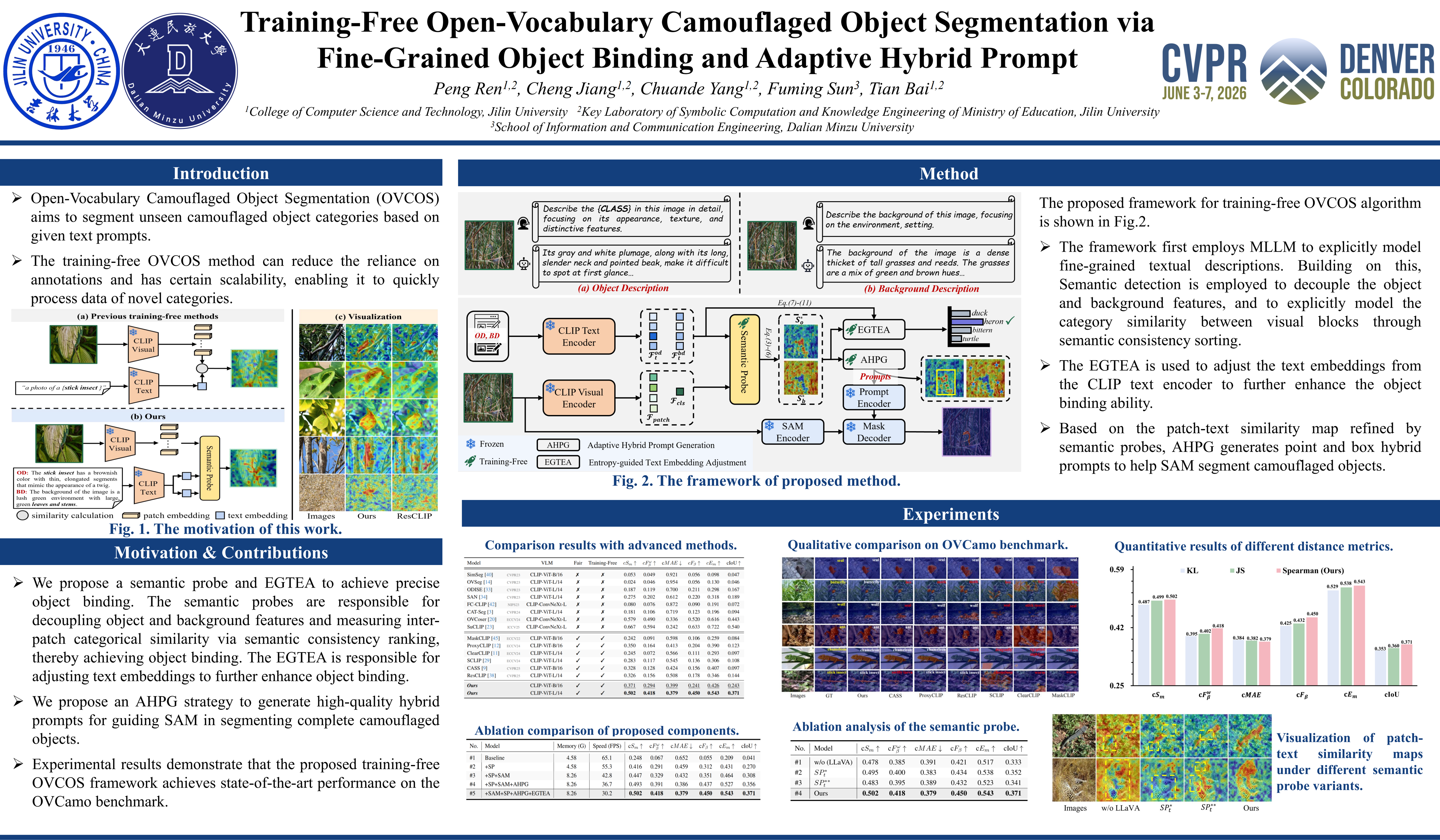
Vision-Language models (e.g., CLIP) facilitate the development of open-vocabulary camouflaged object segmentation (OVCOS), but existing methods still rely on mask annotations for fully-supervised training. In contrast, the training-free paradigm can rapidly process unseen data, representing a highly promising solution. However, in camouflage scenarios, existing training-free methods utilize sparse textual prompts and ignore the category similarity between visual patches, leading to inadequate object binding capability. To alleviate these issues, we propose a fine-grained object binding and adaptive hybrid prompt framework for training-free OVCOS. The framework first employs multimodal large language models (MLLMs) to explicitly model fine-grained textual descriptions of camouflaged objects and background. Building on this, we construct a semantic probe to decouple object and background features and explicitly model category similarity between visual patches via semantic consistency ranking, thereby achieving accurate object binding. Subsequently, we propose an entropy-guided text embedding adjustment strategy to adjust textual embeddings, aiming to further enhance fine-grained object binding. Finally, we utilize an adaptive hybrid prompt generation strategy to generate hybrid prompts, assisting SAM in accurately segmenting camouflaged objects. Experimental results on the OVCamo benchmark demonstrate that our method achieves excellent performance, significantly surpassing the advanced training-free ResCLIP.