
One Layer’s Trash is Another Layer’s Treasure: Adaptive Layer-wise Visual Token Selection in LVLMs
 Highlight
Abstract
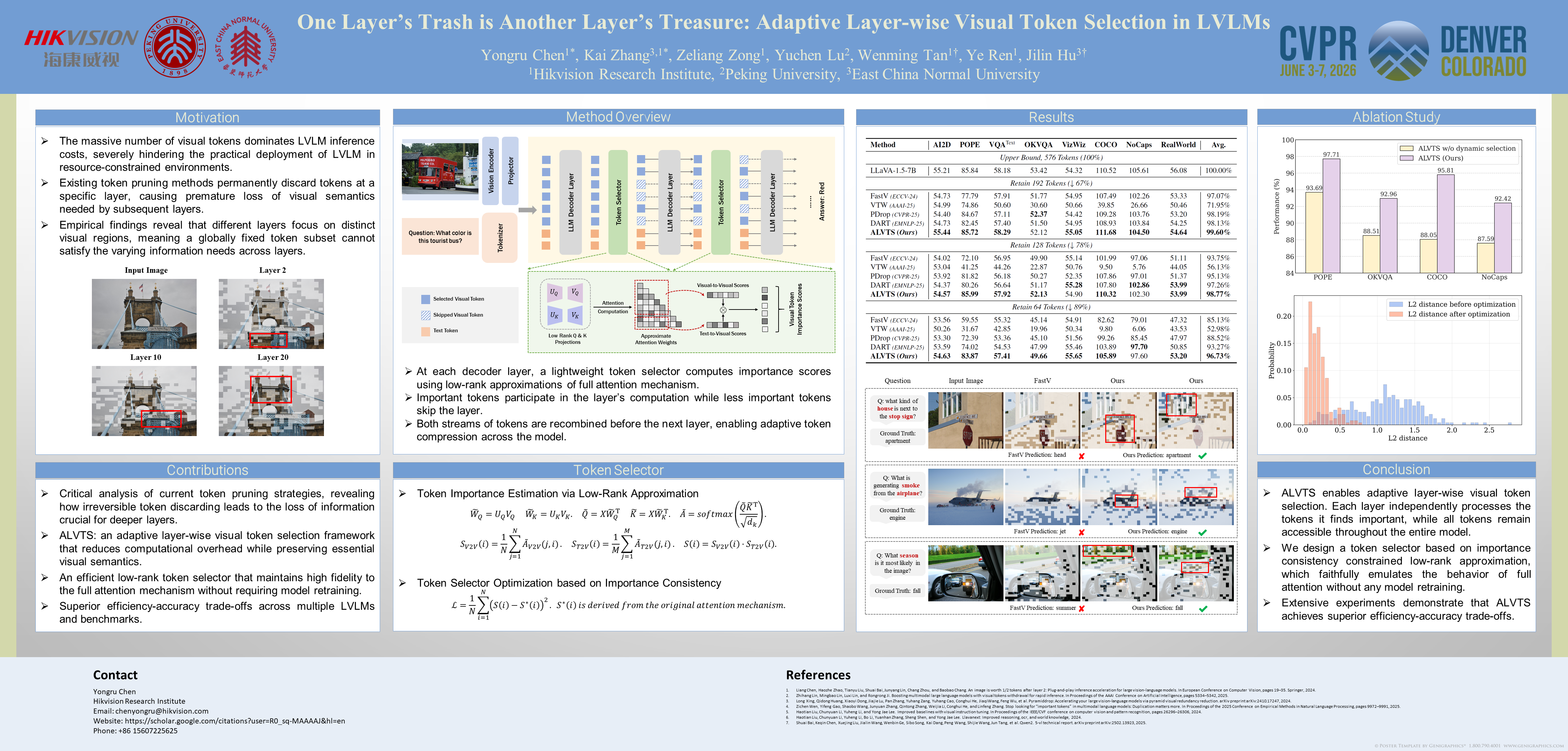
Large Vision-Language Models (LVLMs) have achieved remarkable success across diverse multimodal tasks, yet their practical deployment remains constrained by the computational burden arising from lengthy visual tokens. While visual token pruning has emerged as a promising solution, existing methods suffer from a fundamental limitation: once tokens are pruned at a specific layer, they become inaccessible to all subsequent layers, leading to premature information loss that can compromise model performance. Through empirical studies, we observe that different layers exhibit distinct visual region focus, indicating a varying optimal token subset across layers. Motivated by this insight, we propose Adaptive Layer-wise Visual Token Selection (ALVTS), a novel framework that breaks away from the conventional static token pruning paradigm. ALVTS incorporates a lightweight token selector to identify and route important tokens for further processing, while allowing less important tokens to skip the layer, thus minimizing computational redundancy. These two streams of tokens are seamlessly reintegrated before being fed into subsequent layers, facilitating adaptive compression across the entire model. Grounded in our importance consistency constrained low-rank approximation, the proposed token selection module closely emulates the full attention mechanism, effectively capturing its essential patterns without requiring model retraining. Extensive experiments on LLaVA-1.5, LLaVA-NeXT, and Qwen2.5-VL validate the effectiveness of our method. With an 89% token compression ratio, ALVTS retains 96.7% of the original model's accuracy, achieving a superior efficiency-accuracy trade-off for LVLM inference.