
MAPS: Preserving Vision-Language Representations via Module-Wise Proximity Scheduling for Better Vision-Language-Action Generalization
Abstract
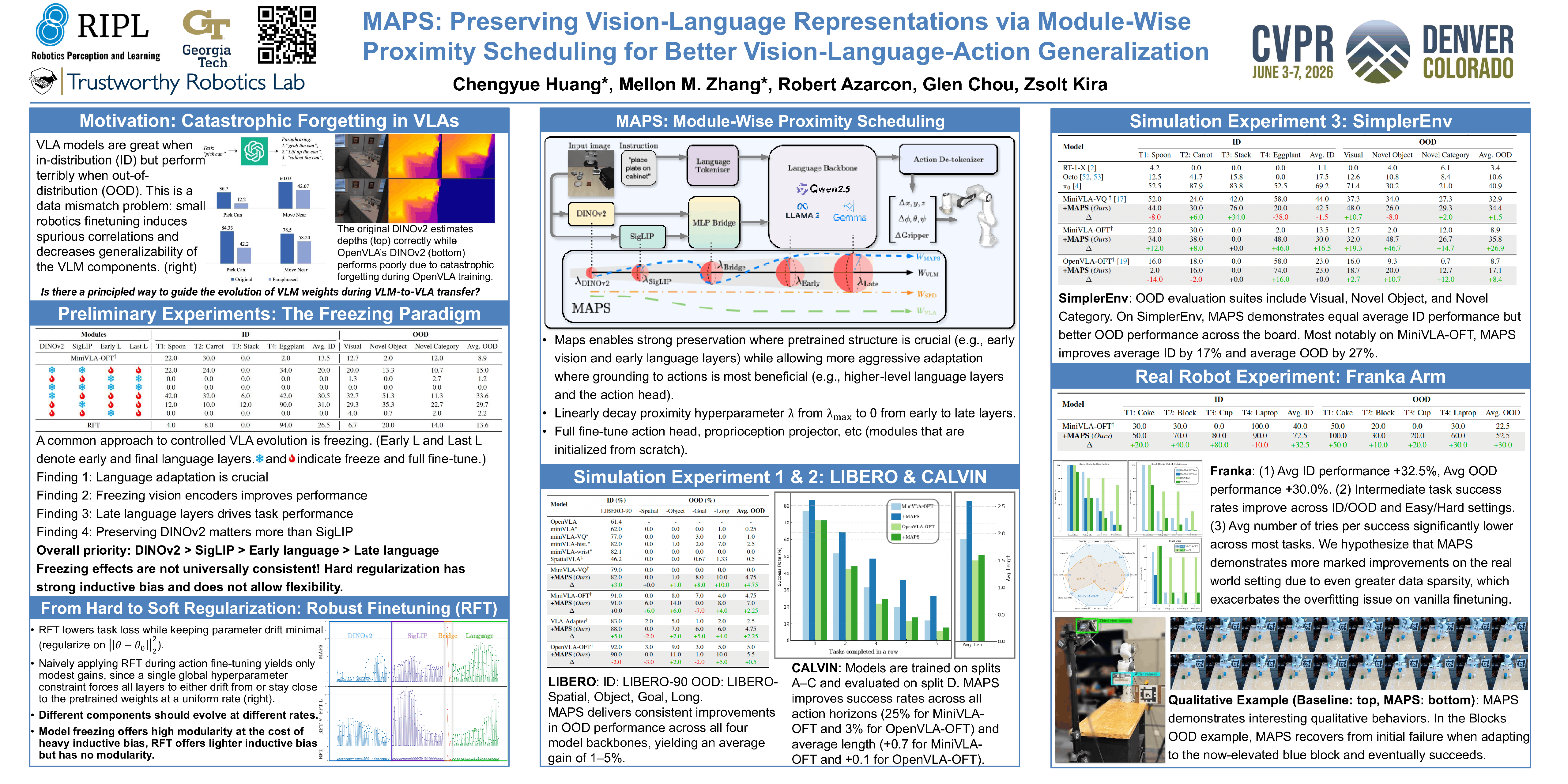
Vision-Language-Action (VLA) models inherit strong priors from pretrained Vision-Language Models (VLMs), but naïve fine-tuning often disrupts these representations and harms generalization. Existing fixes -- freezing modules or applying uniform regularization -- either overconstrain adaptation or ignore the differing roles of VLA components. We present MAPS (Module-Wise Proximity Scheduling), the first robust fine-tuning framework for VLAs. Through systematic analysis, we uncover an empirical order in which proximity constraints should be relaxed to balance stability and flexibility. MAPS linearly schedules this relaxation, enabling visual encoders to stay close to their pretrained priors while action-oriented language layers adapt more freely. MAPS is parameter-free, data-free, and plug-and-play with existing architectures. Across MiniVLA-VQ, MiniVLA-OFT, OpenVLA-OFT, and benchmarks like LIBERO, CALVIN, and SimplerEnv, MAPS boosts both in- and out-of-distribution performance (up to +25\%). Our findings highlight empirically guided proximity to pretrained VLMs as a simple yet powerful principle for scalable VLA adaptation.