
From Infusion to Assimilation Distillation for Medical Image Segmentation
Abstract
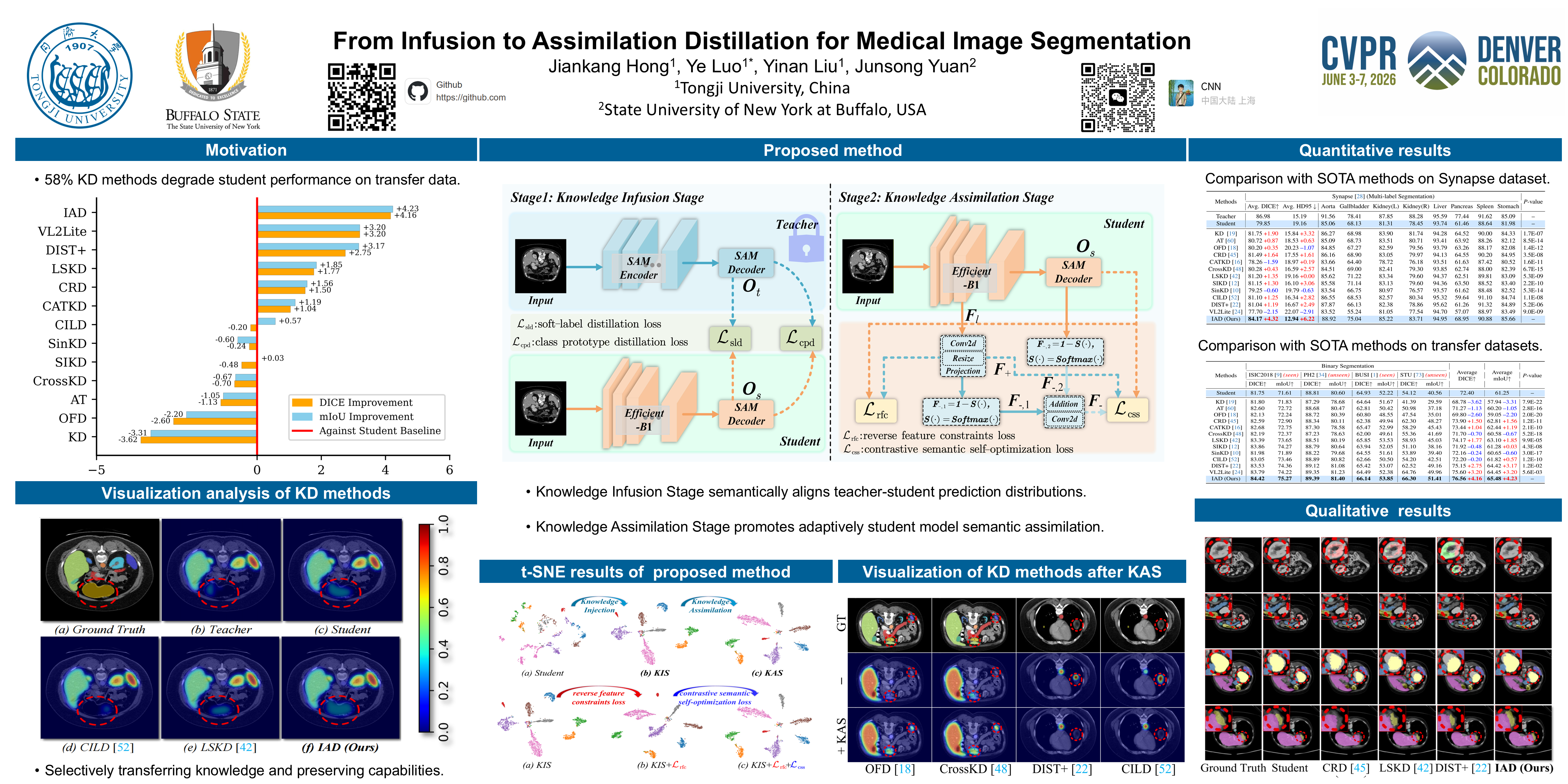
Although foundation models (e.g. SAM) perform remarkably in medical image segmentation, its high computational complexity limits deployment. Knowledge distillation (KD) allows lightweight models to inherit the representational capabilities of large models, thereby mitigating this issue. Existing KD methods enhance student performance, but due to teacher-student different feature advantages, they neglect to internalize and integrate student's semantic information adaptively after knowledge transfer, causing poor knowledge assimilation and limiting gains and generalization. To address this limitation, we propose a novel medical image segmentation framework, which is injection to assimilation distillation (IAD). In Knowledge Injection Stage (KIS), to semantically align teacher-student prediction distributions, soft-label distillation is combined with class-weighted prototype alignment strategy. In Knowledge Assimilation Stage (KAS), to promote adaptively semantic assimilation, a contrastive semantic self-optimization strategy refines student predictions through positive and negative sample pairs and imposes reverse constraints on encoder features to enhance semantic consistency. IAD achieves DICE gains of 4.32\% on Synapse, 1.85\% on ACDC, and 2.42\% on Polyp datasets, and delivers an average 4.16\% generalization gain on ISIC2018, PH2, BUSI, and STU datasets, outperforming mainstream KD methods.