
Boundary-Responsive Differentiable Gating for Superpixel-Based Segmentation
Abstract
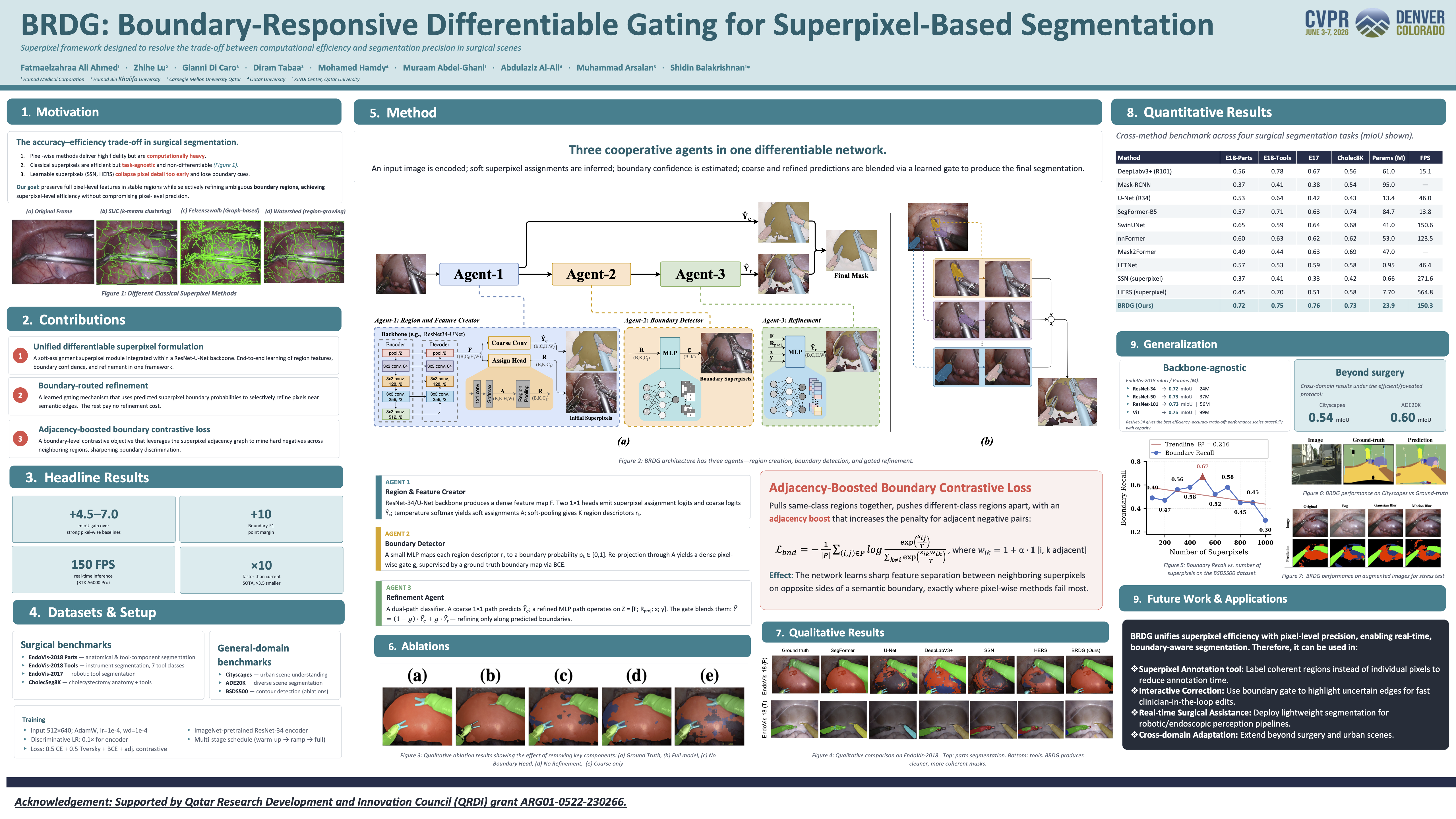
We present BRDG, a boundary-responsive differentiable gating superpixel framework designed to resolve the trade-off between computational efficiency and segmentation precision in surgical scenes. At its core, the architecture is organized into three cooperative agents within a fully differentiable backbone. The Region Creator agent converts dense features into learnable superpixel tokens, jointly learning region descriptors and dense context. The Boundary Detector agent acts as a gating mechanism, estimating boundary confidence from region features to predict where refinement is needed. The refinement agent uses this gate to selectively fuse efficient coarse predictions with a high-fidelity refinement path that restores pixel-level details. To further enhance distinctiveness, an adjacency-boosted contrastive loss mines hard negatives across neighboring regions to improve boundary separation. We evaluate BRDG on three surgical tasks requiring high-precision EndoVis18-parts, EndoVis18-tools, EndoVis17-tools, as well as general domain benchmarks. Our model improves mIoU by substantial margins 4.5-7.0 over strong pixel-wise baselines while raising Boundary-F1 scores by over 10 points. Under the same hardware (RTX-A6000 Pro), it reaches 150.25 FPS with only 24M parameters. This makes it 10 times faster and 3.5 smaller than current state-of-the-art models, effectively resolving the critical accuracy–efficiency trade-off in real-time segmentation.