
Similarity-Consistent Likelihood Diffusion enables Hidden Person Detection from Wall Reflections
Abstract
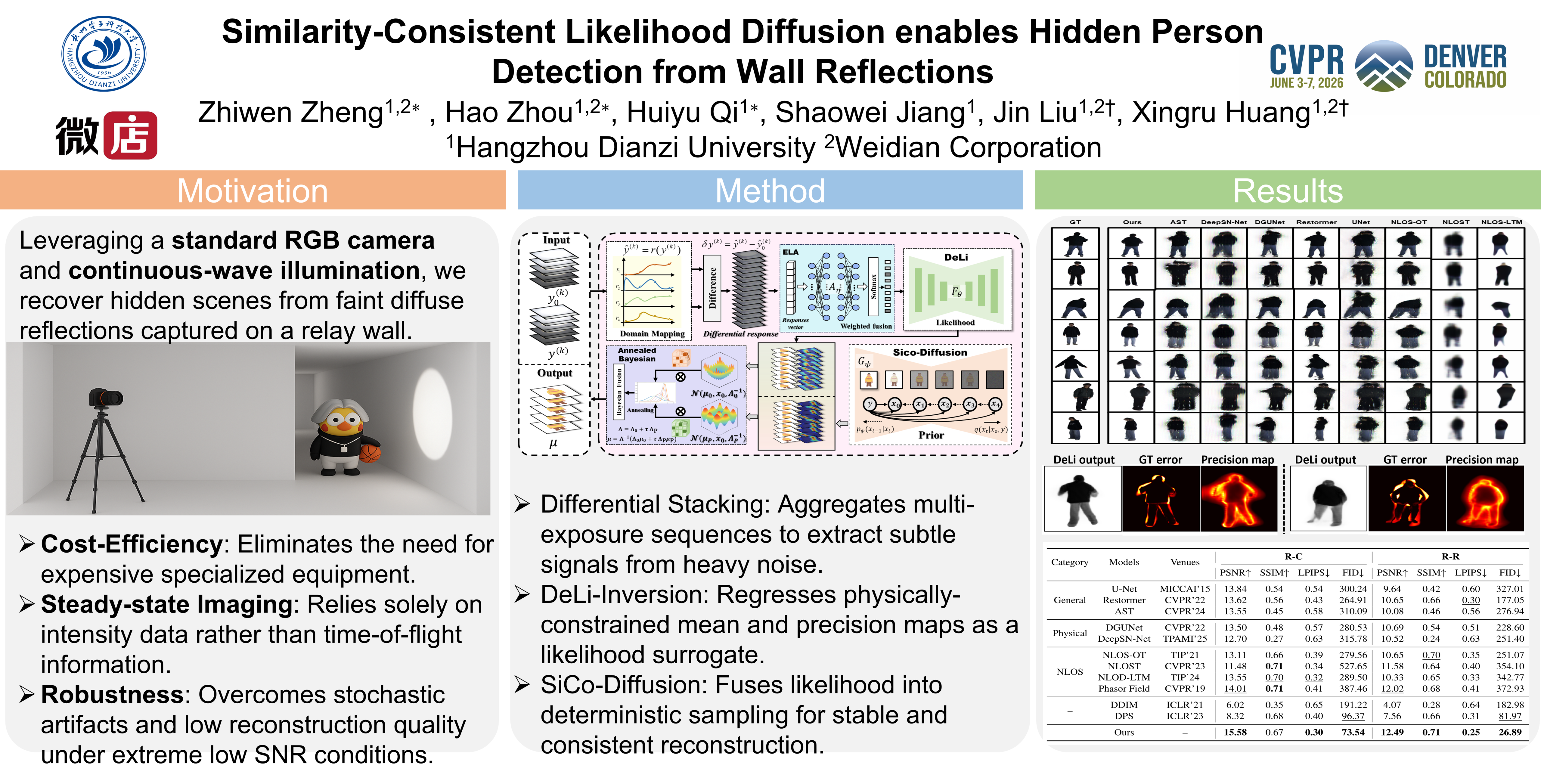
This paper studies passive non-line-of-sight corner-camera detection and human localization using faint indirect reflections on a visible wall. The challenge is twofold: multi-exposure wall observations are unstable and entangled with sensor nonlinearities, and mapping these observations to a hidden-view RGB image is severely underdetermined, making purely discriminative regressors brittle and unconstrained diffusion priors stochastic. To address these challenges, we introduce the Similarity-Likelihood Diffusion Network (SLD-Net), a two-stage framework that produces measurement-consistent, deterministic reconstructions. First, DeLi-Inversion forms an exposure-aware differential representation and jointly predicts an initial reconstruction and a pixel-wise precision map, yielding a heteroscedastic pseudo-likelihood. Second, SiCo-Diffusion injects this likelihood as precision-weighted energy into a deterministic DDIM trajectory and fuses it with the diffusion prior using an annealed Bayesian precision rule, producing a unique reconstruction for fixed observations and schedules. Extensive experiments on two real datasets: Reflect-Corridor and Reflect-Room, demonstrate that the proposed method outperforms generic, physics-inspired, and NLOS-specific baselines across PSNR, SSIM, LPIPS, and FID. In particular, relative to the best-performing baseline, it improves PSNR from 13.84 to 15.58 dB on Reflect-Corridor and from 11.58 to 12.49 dB on Reflect-Room, and reduces FID from 264.91 to 73.54 and from 177.05 to 26.89, respectively, while also achieving the lowest LPIPS on both datasets.