
Towards Knowledge-augmented Bayesian Deep Learning For Computer Vision
Wang Ma ⋅ Hanjing Wang ⋅ Yufei Zhang ⋅ Darsha Udayanga ⋅ Qiang Ji
 Highlight
Abstract
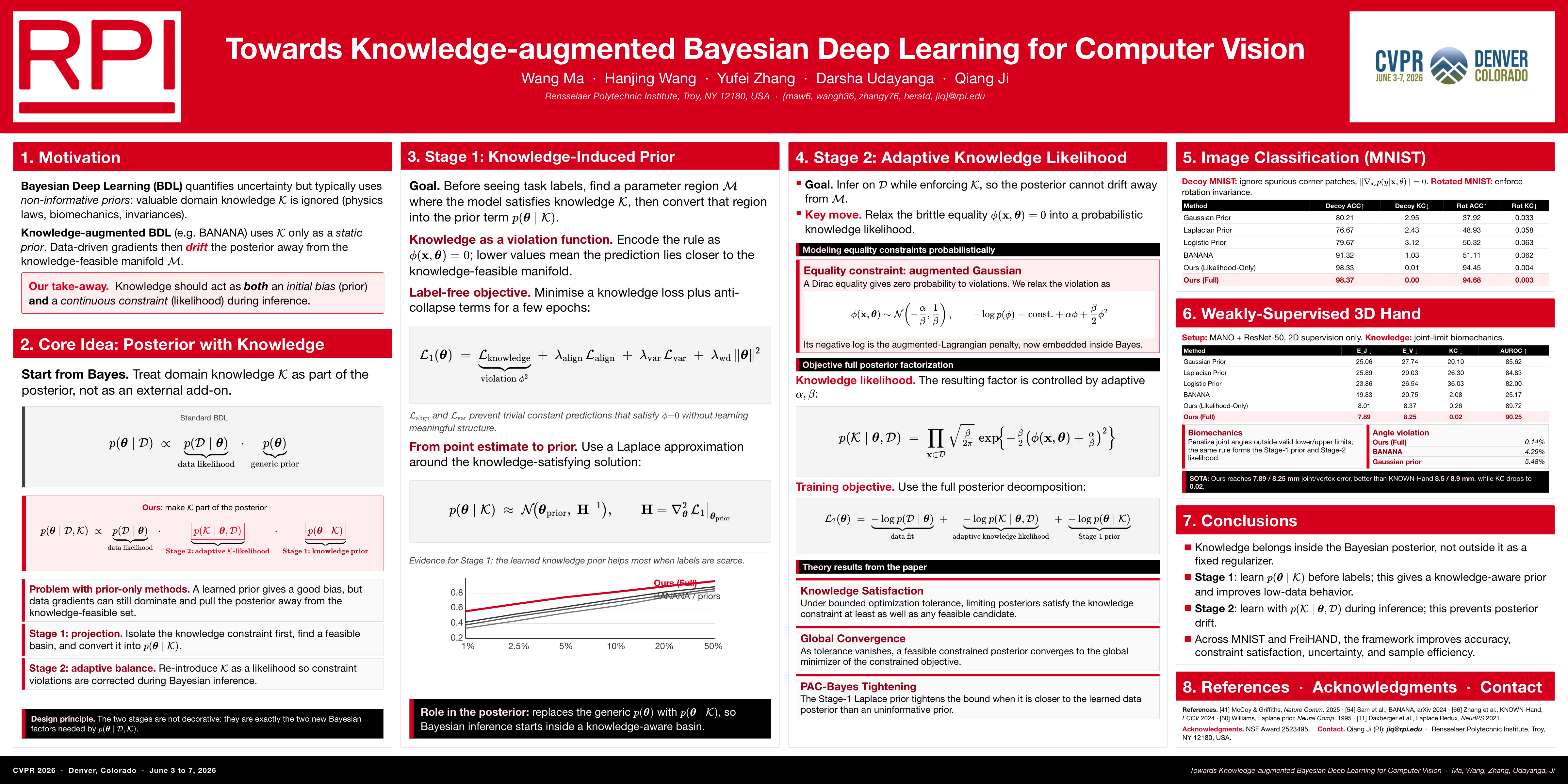
Bayesian deep learning (BDL) integrates Bayesian inference with deep learning, improving predictive performance while enabling principled uncertainty quantification. However, existing BDLs often rely on non-informative random priors, limiting the benefits of Bayesian inference. In contrast, knowledge-augmented deep learning explicitly injects domain knowledge during training, yet lacks a probabilistic foundation. In this paper, we propose a knowledge-augmented BDL framework that integrates domain knowledge both as an informative prior and as an adaptive likelihood under a unified two-stage hybrid formulation. In the first stage, we learn a knowledge-informed prior $p(\theta \mid \mathcal{K})$ by pre-training a model to satisfy domain-specific constraints. In the second stage, we perform Bayesian inference on task data with an adaptive knowledge likelihood $p(\mathcal{K} \mid \theta, \mathcal{D})$, which dynamically enforces these constraints during optimization. This unified framework enables knowledge to guide both initialization and training, significantly improving prediction accuracy, robustness, adaptation and uncertainty estimation. Experiments on various computer vision tasks, including semi-synthetic and real-knowledge scenarios, demonstrate that our two-stage framework consistently outperforms state-of-the-art Bayesian and knowledge-augmented baselines.
Chat is not available.
Successful Page Load