
PointGS: Semantic-Consistent Unsupervised 3D Point Cloud Segmentation with 3D Gaussian Splatting
Abstract
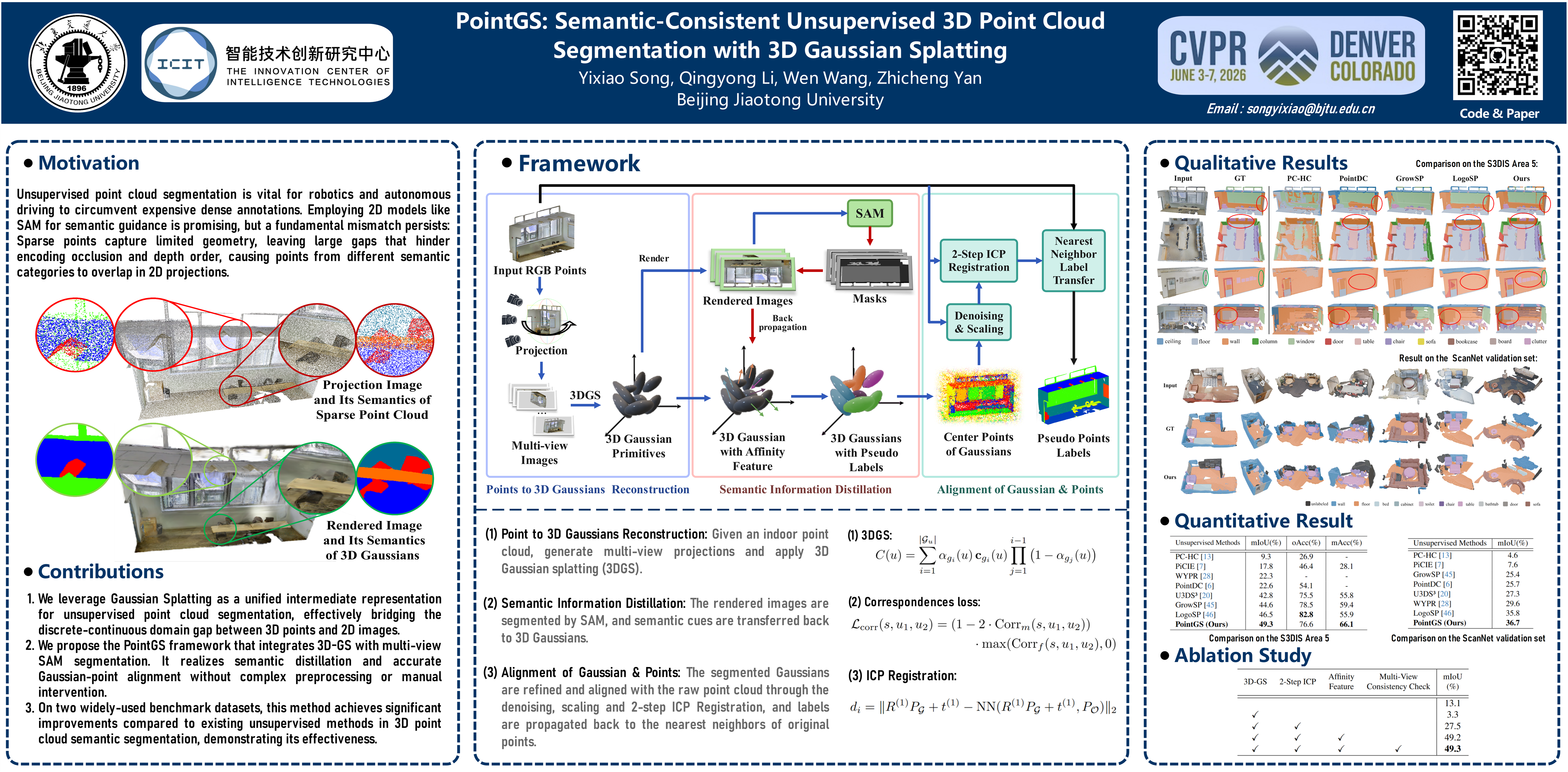
Unsupervised point cloud segmentation is critical for embodied intelligence and autonomous driving, as it mitigates the prohibitive cost of dense point-level annotations required by fully supervised methods. Integrating 2D pre-trained models such as SAM to supplement semantic information is a natural choice, yet this approach faces a fundamental mismatch between discrete 3D points and continuous 2D images. This mismatch leads to inevitable projection overlap and complex modality alignment, resulting in compromised semantic consistency across 2D-3D transfer. To address these limitations and achieve semantic-consistent segmentation, this paper proposes PointGS, a simple yet effective pipeline for unsupervised 3D point cloud segmentation. PointGS leverages 3D Gaussian Splatting as a unified intermediate representation to bridge the discrete-continuous domain gap. Input sparse point clouds are first reconstructed into dense 3D Gaussian spaces via multi-view observations, filling spatial gaps and encoding occlusion relationships to eliminate projection-induced semantic conflation. Multi-view dense images are rendered from the Gaussian space, with 2D semantic masks extracted via SAM, and semantics are distilled to 3D Gaussian primitives through contrastive learning to ensure consistent semantic assignments across different views. The Gaussian space is aligned with the original point cloud via two-step registration, and point semantics are assigned through nearest-neighbor search on labeled Gaussians. Experiments demonstrate that PointGS outperforms state-of-the-art unsupervised methods, achieving +0.9\% mIoU on ScanNet-V2 and +2.8\% mIoU on S3DIS, highlighting its effectiveness in label-free 3D segmentation.