
Linguistic Priors for Visual Decoupling: Towards Symmetric Vision-Brain Alignment
Abstract
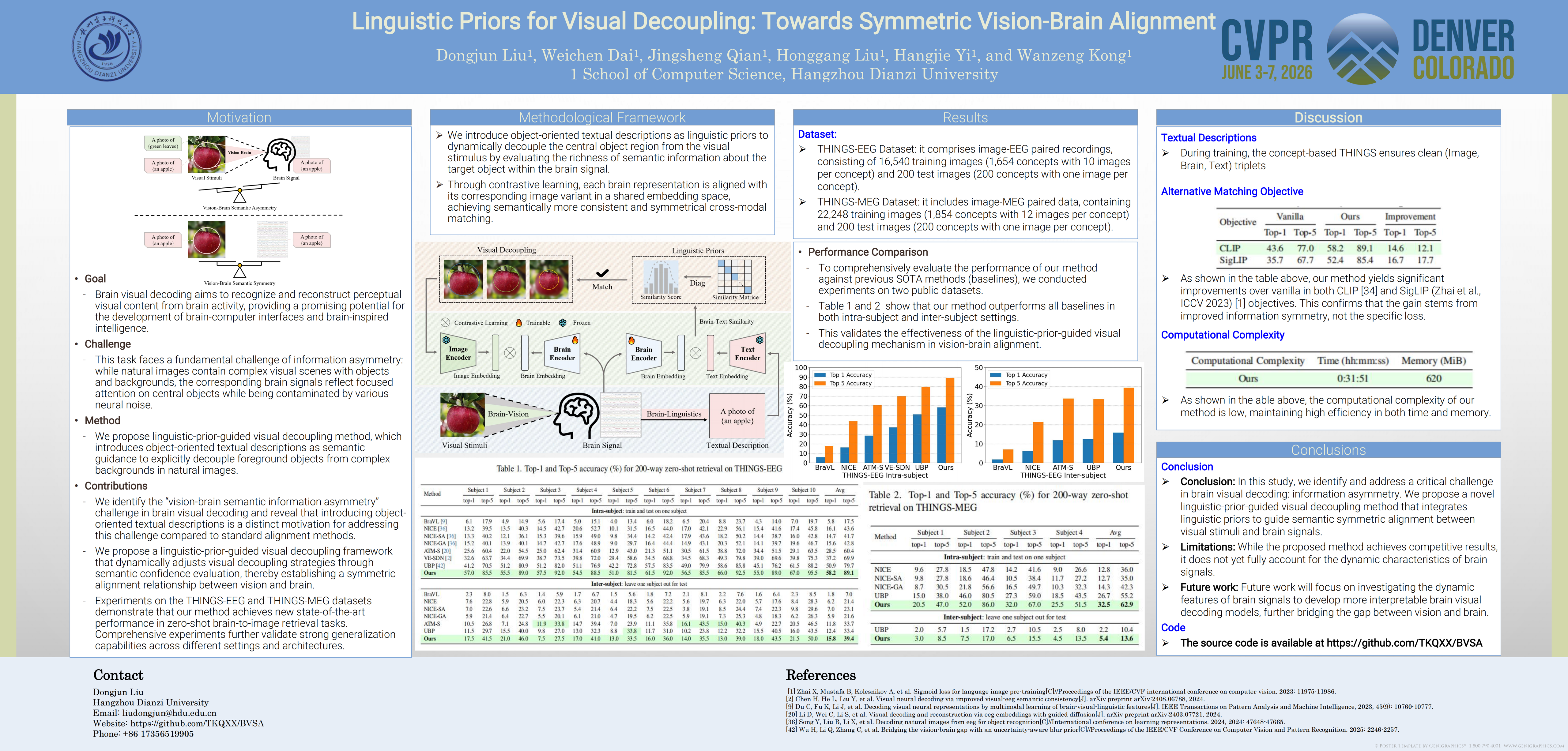
Brain visual decoding aims to recognize and reconstruct perceptual visual content from neural activity, representing a promising avenue for developing brain-computer interfaces and building brain-inspired artificial intelligence. However, this task faces a fundamental challenge of information asymmetry: while natural images contain complex visual scenes with objects and backgrounds, the corresponding brain signals reflect focused attention on central objects while being contaminated by various neural noise. Previous methods that directly align visual and brain representations often overlook this inherent asymmetry, resulting in suboptimal decoding performance. To address this, we propose linguistic-prior-guided visual decoupling method, which introducing object-oriented textual descriptions as semantic guidance to explicitly decouple foreground objects from complex backgrounds in natural images, thereby establishing symmetric vision-brain alignment. This design enables the model to automatically focus on task-relevant visual concepts while effectively filtering out irrelevant neural noise in brain signals, achieving a transition from asymmetric feature alignment to semantic symmetric alignment. Extensive experiments on the THINGS-EEG and THINGS-MEG datasets demonstrate that our method achieves new state-of-the-art performance in the zero-shot brain-to-image retrieval task.