
The Surprising Effectiveness of Noise Pretraining for Implicit Neural Representations
Kushal Vyas ⋅ Alper Kayabasi ⋅ Daniel Kim ⋅ Vishwanath Saragadam ⋅ Ashok Veeraraghavan ⋅ Guha Balakrishnan
Abstract
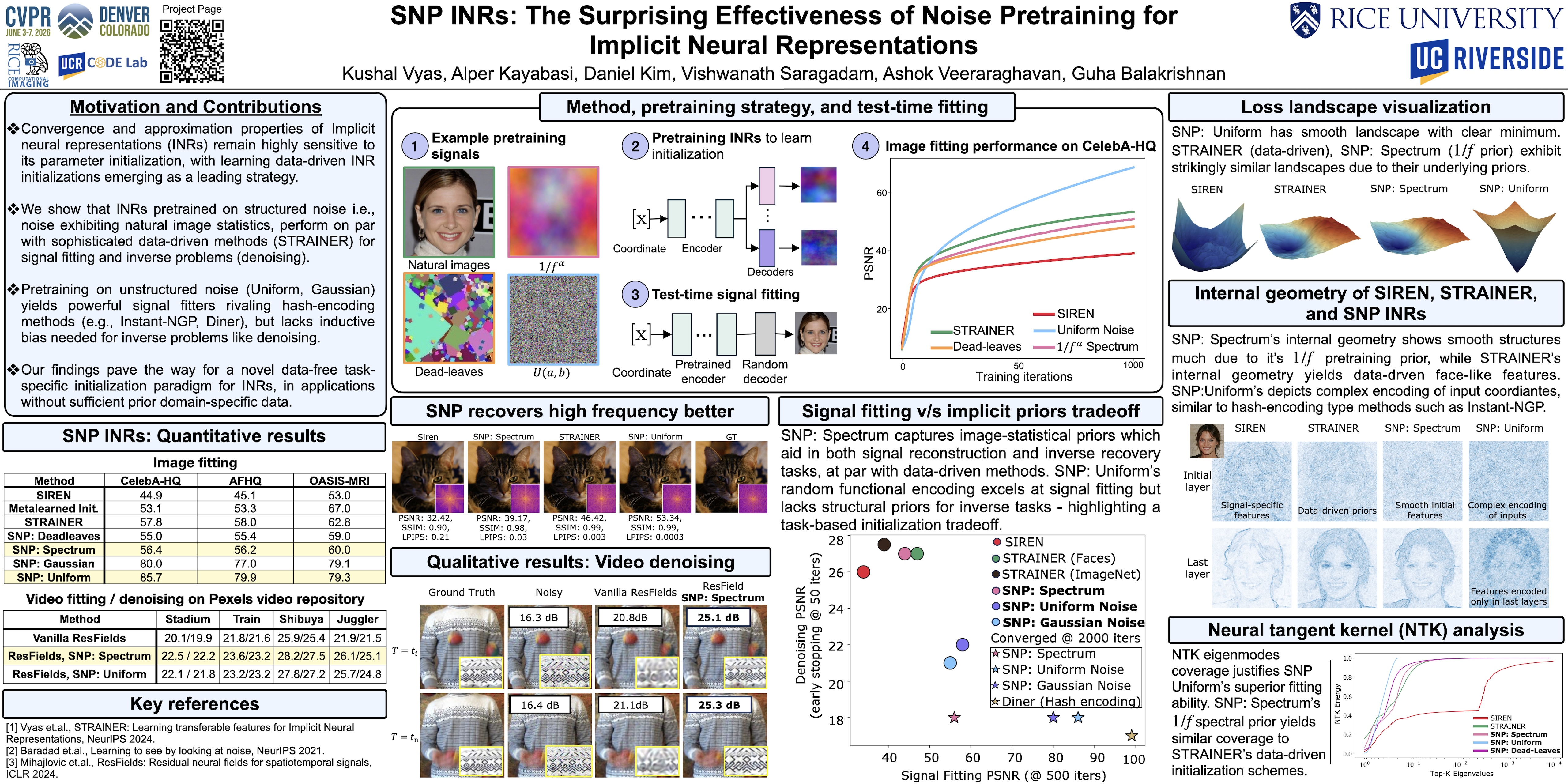
The approximation and convergence properties of implicit neural representations (INRs) are known to be highly sensitive to parameter initialization strategies. Several data-driven INR parameter initialization methods demonstrate significant improvement over standard random sampling, but the reason for their successes -- whether they encode classical statistical signal priors or something more sophisticated -- is not well understood. In this study, we explore this topic with a series of experimental analyses leveraging noise pretraining. In particular, we pretrain INRs on noise signals of different classes (e.g., Gaussian, Dead Leaves, Spectral), and measure their abilities at both fitting unseen signals and encoding priors for an inverse imaging task (denoising). Our analyses on image and video data reveal the highly surprising finding that simply pretraining on unstructured noise (Uniform, Gaussian) results in a dramatic improvement in signal fitting capacity compared to all other baselines. However, unstructured noise also yields poor deep image priors for denoising. In contrast, noise with the classic $1/|f^\alpha|$ spectral structure of natural images yields an excellent balance of both signal fitting and inverse imaging capabilities on par with the best data-driven initialization methods. This finding can enable more efficient training of INRs in applications without sufficient prior domain-specific data.
Chat is not available.
Successful Page Load