
Batman: Benign Knowledge Alignment Through Malicious Null Space in Federated Backdoor Attack
 Highlight
Abstract
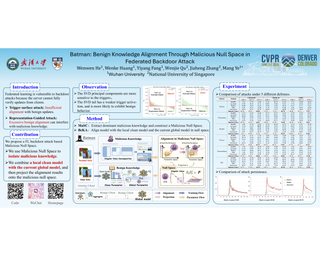
Federated Learning (FL), a distributed learning paradigm that enables local training on user-held data across decentralized devices, is vulnerable to backdoor attacks due to limited visibility into client updates. Exploiting this opacity, adversaries induce targeted misbehavior on trigger inputs without affecting overall performance, thereby compromising the trust and integrity of collaborative training in federated learning systems. Existing federated backdoor attacks mainly concentrate on benign knowledge alignment on trigger-surface design or representation guidance to evade defense mechanisms. However, trigger-surface attacks suffer from insufficient alignment, leaving malicious knowledge distinguishable from benign updates. In contrast, representation-guided attacks attempt to obscure the boundary between benign and malicious behaviors. Nevertheless, excessive incorporation of benign knowledge within a shared parameter space leads to over-alignment, ultimately degrading attack effectiveness. To overcome shared parameter space dilemma in backdoor attack, we propose Batman, a novel backdoor attack that aligns benign knowledge within the malicious null space, which effectively decouples malicious space from shared parameter space and enables benign alignment in an orthogonal direction of this space that does not interfere with the attack effectiveness. To further enhance stealthiness, we combine both clean and global models to guide the alignment perturbation within this null space to evade detection. Experiments on four benchmark datasets demonstrate that Batman consistently achieves strong backdoor performance while remaining stealthy under various defenses.