
ReAlign: Generalizable Image Forgery Detection via Reasoning-Aligned Representation
Abstract
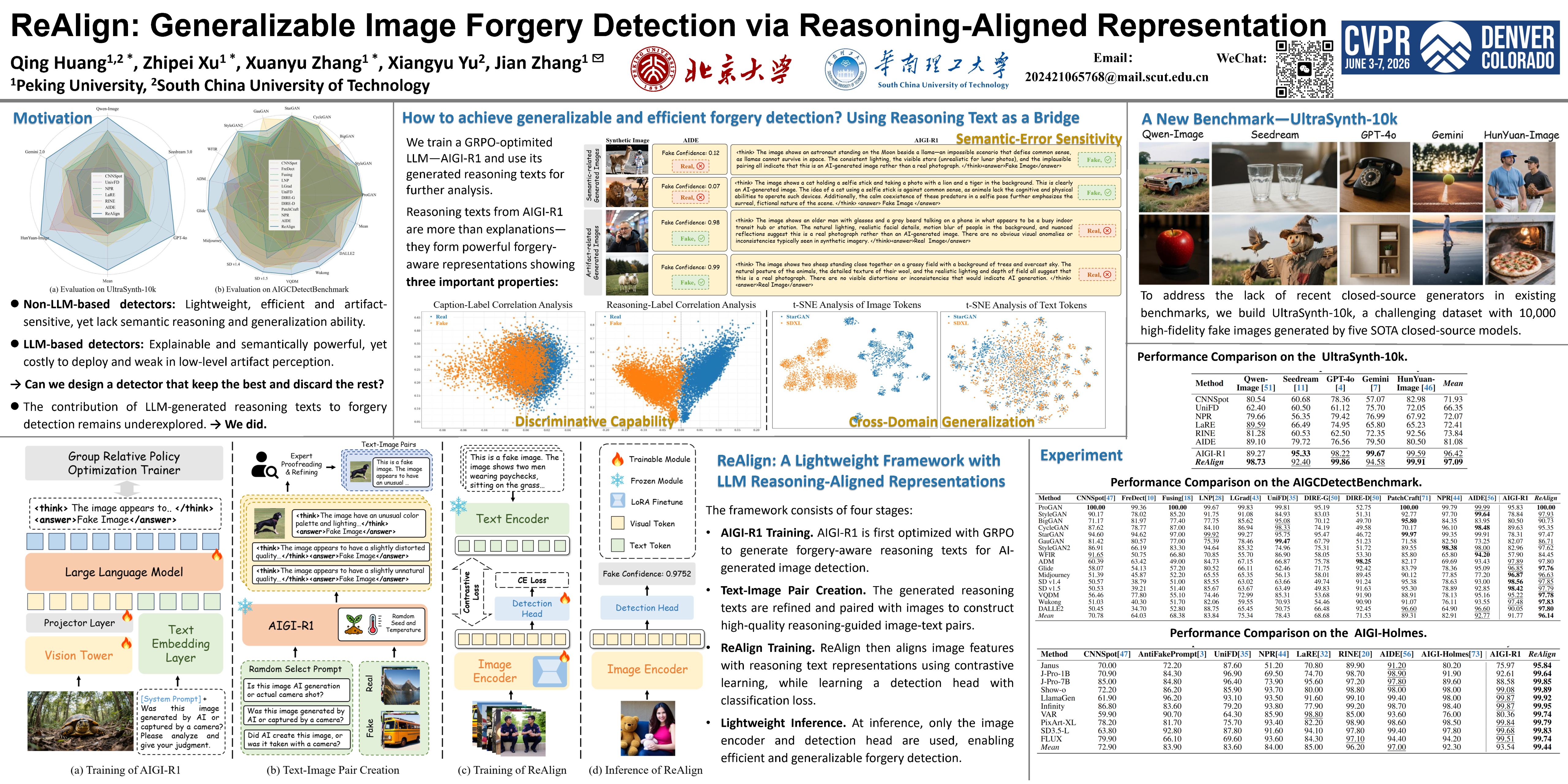
The rise of AI-generated images (AIGIs) poses growing challenges for digital authenticity, prompting the need for efficient, generalizable image forgery detection systems. Existing methods, whether non-LLM-based or LLM-based, exhibit distinct advantages and limitations. While non-LLM-based models offer efficient low-level artifact detection, they often lack semantic understanding. Conversely, LLM-based methods provide strong semantic reasoning and explainability but are computationally intensive and less sensitive to subtle visual artifacts. Moreover, the true contribution of explanatory reasoning texts to forgery detection performance remains unclear. In this work, we investigate the intrinsic value and potential of LLM-generated reasoning texts, considering it a source of generalization and semantic-error sensitivity. Based on these findings, we propose ReAlign, a novel framework that distills high-quality reasoning texts generated by a GRPO-optimized LLM into a lightweight AIGI detector via contrastive learning. ReAlign effectively inherits the generalization ability and semantic sensitivity capability of reasoning textual representations, while remaining efficient and lightweight for deployment. Moreover, ReAlign adopts a tailored joint optimization strategy that integrates contrastive loss for image-text alignment and classification loss for accurate forgery discrimination. Experimental results on AIGCDetectBenchmark, AIGI-Holmes, and our newly constructed UltraSynth-10k demonstrate that ReAlign consistently outperforms existing state-of-the-art detectors in both accuracy and generalization, particularly when facing complex, high-fidelity forgeries from modern generative models.