
Rethinking Knowledge Transfer in Image Quality Assessment: A Perceptual Preference Structure Alignment Perspective
Aobo Li ⋅ Jinjian Wu ⋅ Yongxu Liu ⋅ Jupo Ma ⋅ Weisheng Dong
Abstract
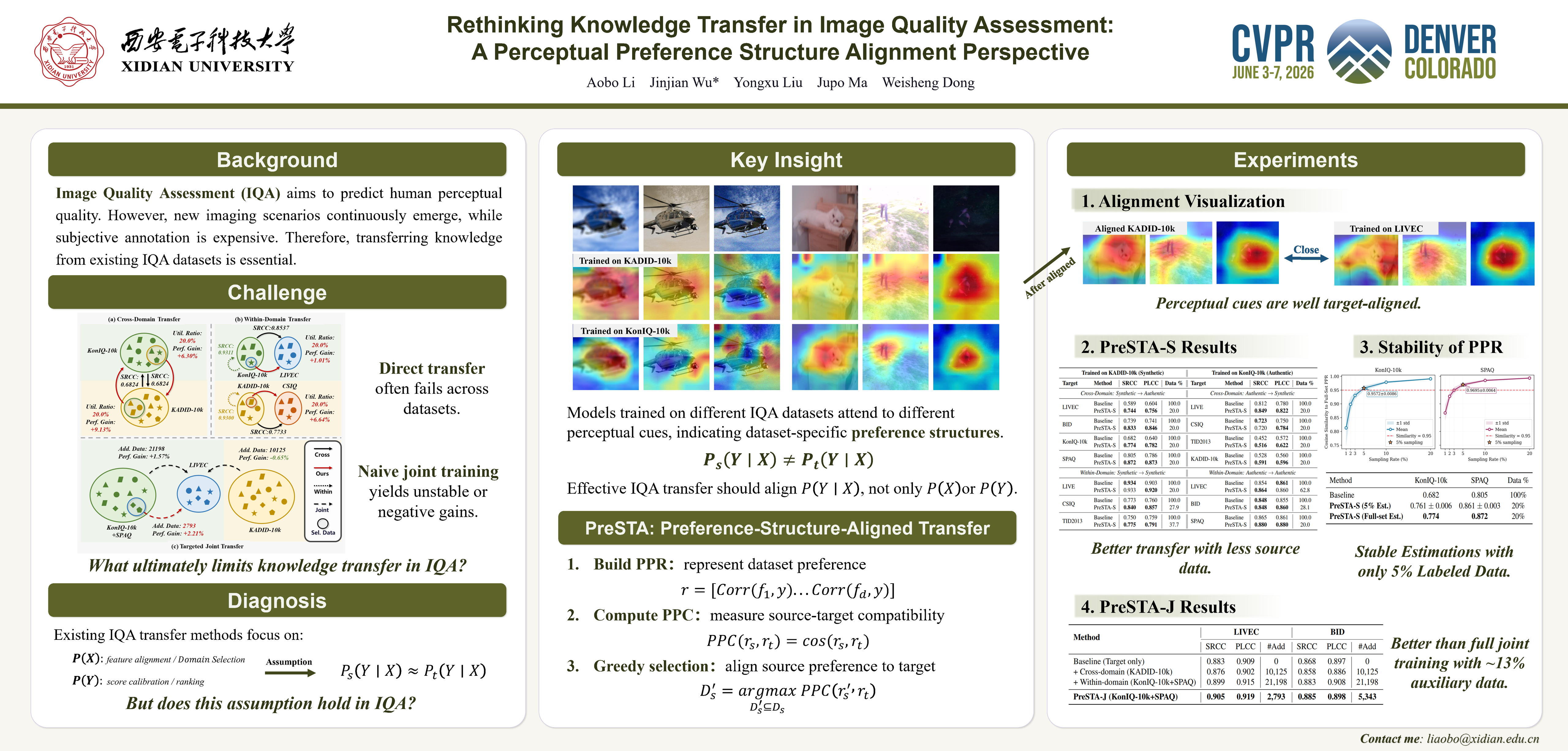
As imaging scenarios diversify rapidly, Image Quality Assessment (IQA) faces a key challenge: how to effectively transfer perceptual knowledge from existing annotated datasets to ensure reliable quality prediction in new scenarios. However, current IQA models struggle to generalize. Direct transfer often leads to severe performance degradation, while multi-dataset joint training rarely yields stable gains and can even harm target performance. We identify the root cause as inconsistent perceptual preference structures across datasets, where models trained on different sources rely on distinct perceptual cues, leading to mismatched conditional distributions $P(Y|X)$ that fundamentally limit transferability.To address this, we propose Perceptual Preference Representation (PPR), which quantifies dataset-specific perceptual preference structures by analyzing correlations between visual features and quality scores. PPR enables training-free assessment of cross-dataset perceptual preference consistency, offering a systematic and interpretable way to analyze transferability.Building on this, we develop Preference-Structure-Aligned Transfer (PreSTA), which iteratively selects samples whose perceptual preferences align with the target domain. Across both cross- and within-domain scenarios, PreSTA achieves superior transfer performance with only a small fraction of data. In the targeted joint transfer setting, PreSTA consistently attains better performance with only a limited portion of the combined data. These results demonstrate that aligning perceptual preference structures, rather than simply increasing dataset size, is the key to effective knowledge transfer in IQA.
Chat is not available.
Successful Page Load