
From Feature Learning to Spectral Basis Learning: A Unifying and Flexible Framework for Efficient and Robust Shape Matching
Abstract
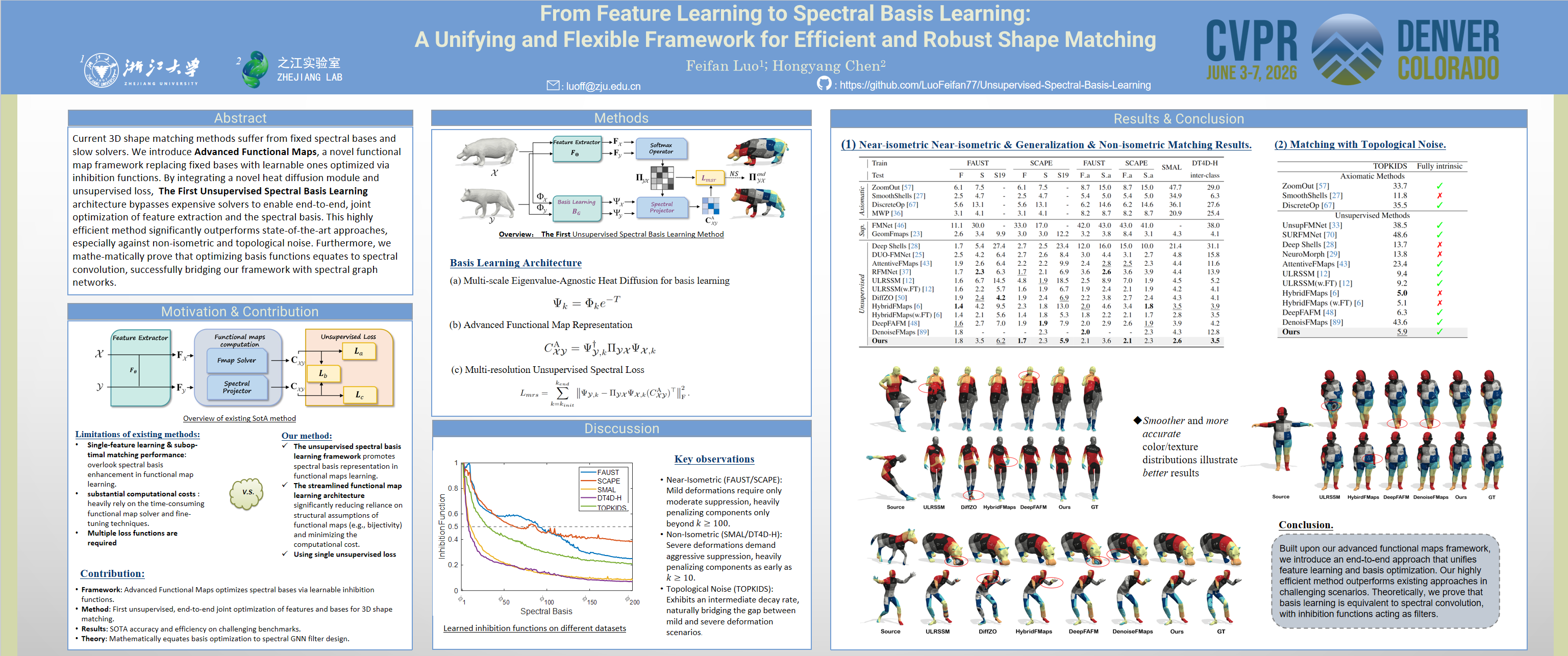
Shape matching is a fundamental task in computer graphics and vision, with deep functional map methods emerging as a preferred solution. However, existing approaches primarily focus on learning informative feature representations by constraining both pointwise and functional maps, while overlooking the optimization of a crucial component: the spectral basis, which plays a key role in the (deep) functional maps pipeline. This oversight leads to suboptimal matching performance. Furthermore, these approaches mostly rely on conventional functional map techniques, such as time-consuming functional map solvers, which incur substantial computational overhead. To address those, we introduce Advanced Functional Maps, which generalizes standard functional maps from fixed basis functions to learnable basis functions, supported by rigorous theoretical guarantees. In this framework, the spectral basis is optimized by learning a set of inhibition functions. Building on this foundation, we propose the first unsupervised spectral basis learning method for efficient and robust non-rigid 3D shape matching, simultaneously optimizing feature extraction and basis functions in an end-to-end manner. A novel heat diffusion module and a new unsupervised loss function are introduced for basis learning, along with a simple yet efficient architecture that eliminates the need for computationally expensive functional map solvers and multiple auxiliary losses. Extensive experiments demonstrate that our method significantly outperforms current state-of-the-art feature-learning-based functional map approaches, especially in challenging non-isometric and topological noise matching scenarios, all while maintaining high computational efficiency. Finally, we demonstrate that optimizing basis functions is equivalent to spectral convolution, with inhibition functions acting as filters. This insight enables enhanced spectral basis representations by designing novel inhibition functions inspired by spectral graph/manifold convolutional networks, opening new avenues for future research.