
HiSpatial: Taming Hierarchical 3D Spatial Understanding in Vision-Language Models
Abstract
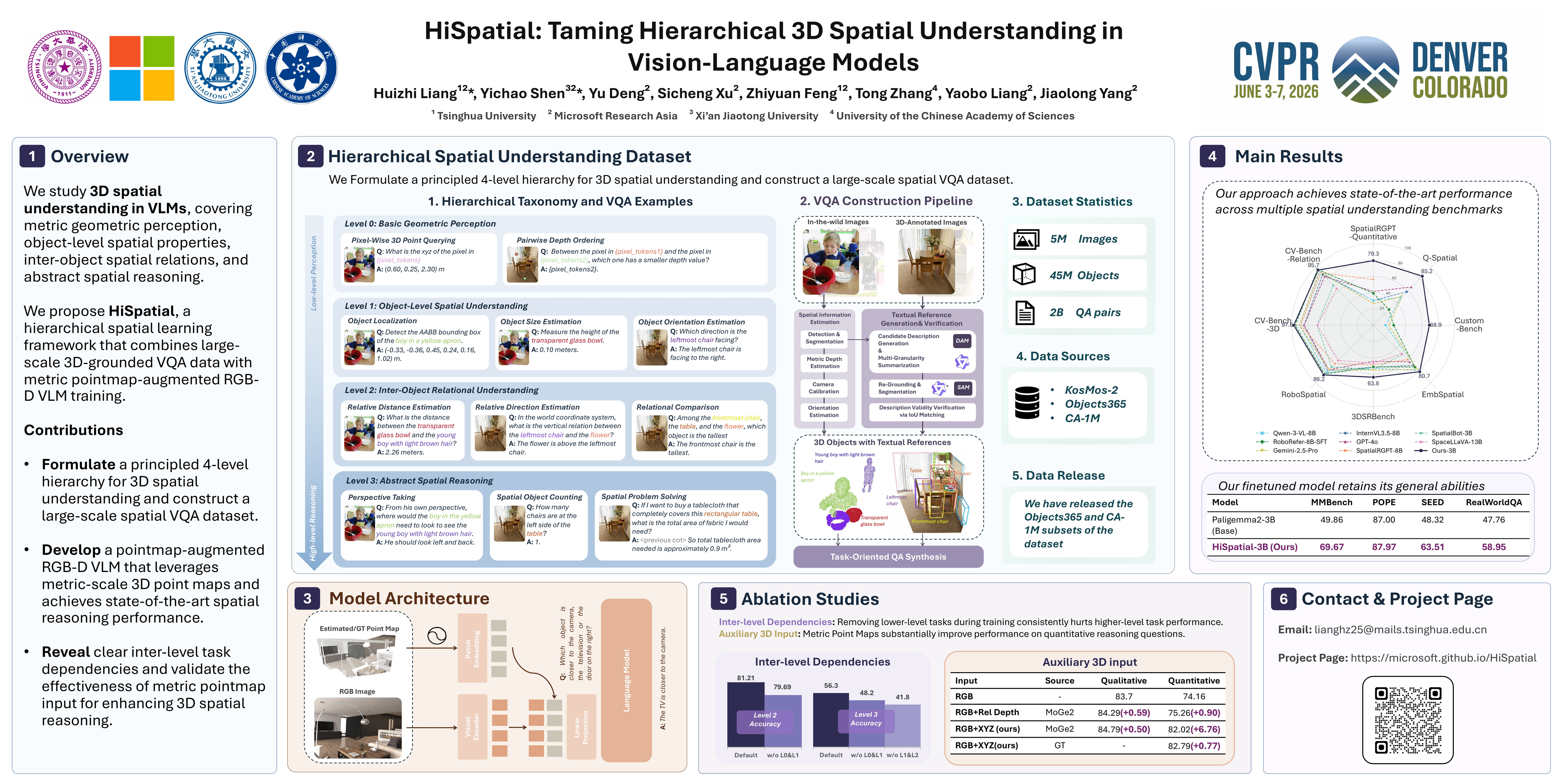
Achieving human-like spatial intelligence for vision-language models (VLMs) requires inferring 3D structures from 2D observations, recognizing object properties and relations in 3D space, and performing high-level spatial reasoning. In this paper, we propose a principled hierarchical framework that decomposes the learning of 3D spatial understanding in VLMs into four progressively complex stages, from geometric perception to abstract spatial reasoning. Guided by this framework, we construct an automated pipeline that generates over 1 billion 3D spatial VQA pairs across diverse tasks and scenes for VLM supervised finetuning. We also develop an RGB-D VLM that incorporates metric-scale point maps as auxiliary inputs to further enhance spatial understanding. Extensive experiments demonstrate that our approach achieves state-of-the-art performance on multiple spatial understanding and reasoning benchmarks, surpassing specialized spatial models and large proprietary systems such as Gemini-2.5-pro and GPT-5. Moreover, our analysis reveals clear dependencies among hierarchical task levels, offering new insights into how multi-level task design facilitates the emergence of 3D spatial intelligence in future VLMs.