
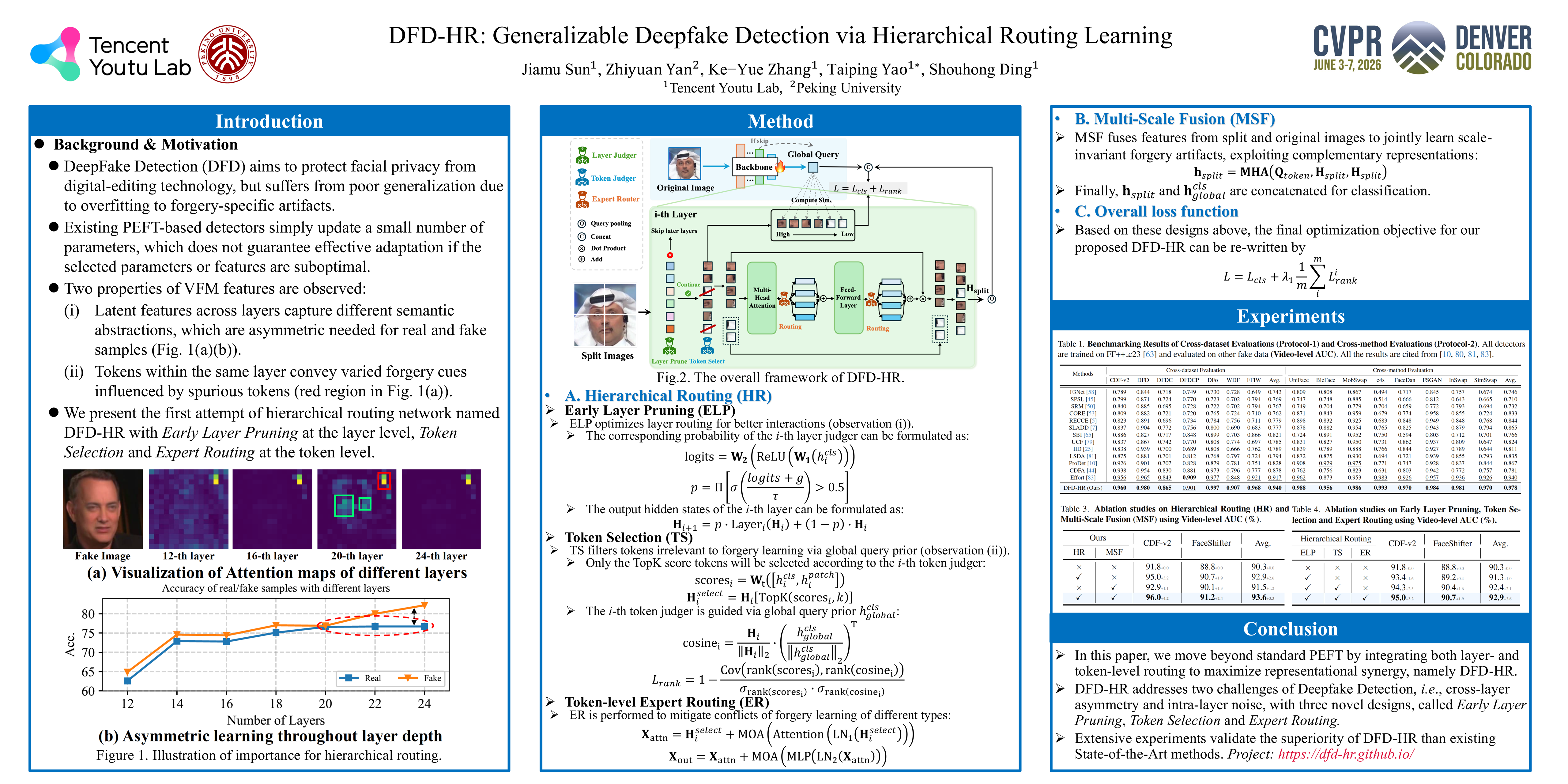
DFD-HR: Generalizable Deepfake Detection via Hierarchical Routing Learning
Abstract
Developing generalizable deepfake detectors has become increasingly important with the rapid advancement of generative models. Adapting visual foundation models (VFMs), e.g., CLIP, through parameter-efficient finetuning (PEFT), with only a small subset of parameters updated, has been proven highly effective for generalizable detection. However, the success of “fewer-parameters” training raises an important question: although only a few parameters are tuned, have existing PEFT-based detectors truly exploited the most informative ones while eliminating redundant parameters for better generalization? In this work, we move beyond standard PEFT by proposing a joint optimization strategy that operates at both the layer and token levels. Since latent features across layers capture different semantic abstractions and tokens within the same layer convey varied forgery cues, we propose integrating both layer-level and token-level routing to maximize representational synergy. Specifically, at the layer level, we introduce "Early Layer Pruning", an adaptive truncation mechanism that enables the model to adaptively learn distinct forward depths for different types of instances. At the token level, "Token Selection" is guided by the Spearman rank loss to filter tokens irrelevant to forgery learning, enabling the model to focus on the most discriminative cues. Furthermore, a unified MoE architecture is applied that encourages diversity and thus reduces the potential model's overfitting to specific forgery types. Extensive benchmarking results demonstrate the effectiveness of our designs and show the superior performance of our method over existing state-of-the-arts.