
SANER: Switchable Adapter with Non-parametric Enhanced Routing for Person De-Reidentification
Abstract
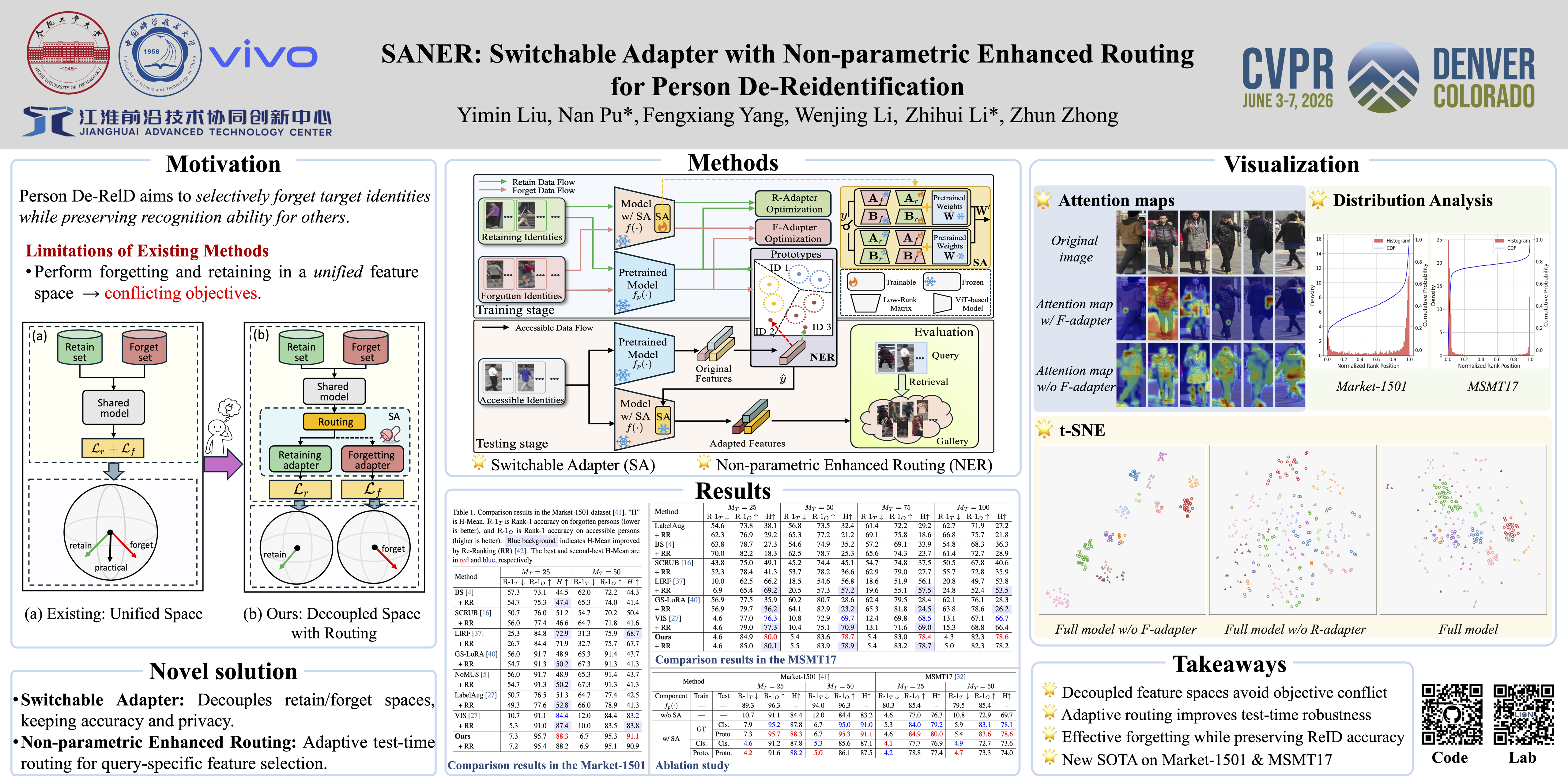
Person De-Reidentification (De-ReID) is an emerging and safety-critical task that aims to selectively forget specific individuals in surveillance systems while preserving the recognition capability for others. Existing methods typically learn both forgetting and retaining objectives within a unified feature space, which leads to conflicting optimization goals and may cause unexpected performance degradation on novel retaining identities. Although decoupling pre-trained feature space for forgetting or retaining purpose is a promising solution, discriminating which feature space should be used for the given novel query remain unsolved. To alleviate these challenges, we propose SANER, advancing De-ReID with switchable adapter (SA) and test-time non-parametric enhanced routing (NER) algorithm. SA decouples the pre-trained feature space into two task-specific subspaces with forgetting adapter (F-Adapter) and retaining adapter (R-Adapter). The former suppresses identity-specific semantics for de-identification, while the latter preserves discriminative cues for accurate re-ID. Moreover, SA is further enhanced with NER to adaptively analyze optimal feature space routing for the given novel query at test-time. Specifically, NER compares queries with pre-computed prototypes in the original feature space, mitigating the potential training–testing gap and thus ensures accurate routing for De-ReID. Extensive experiments on multiple De-ReID benchmarks demonstrate SANER's efficacy, providing a new perspective for privacy-preserving visual perception.