
HamiPose: Hamiltonian Optimization for Unsupervised Domain Adaptive Pose Estimation
 Highlight
Abstract
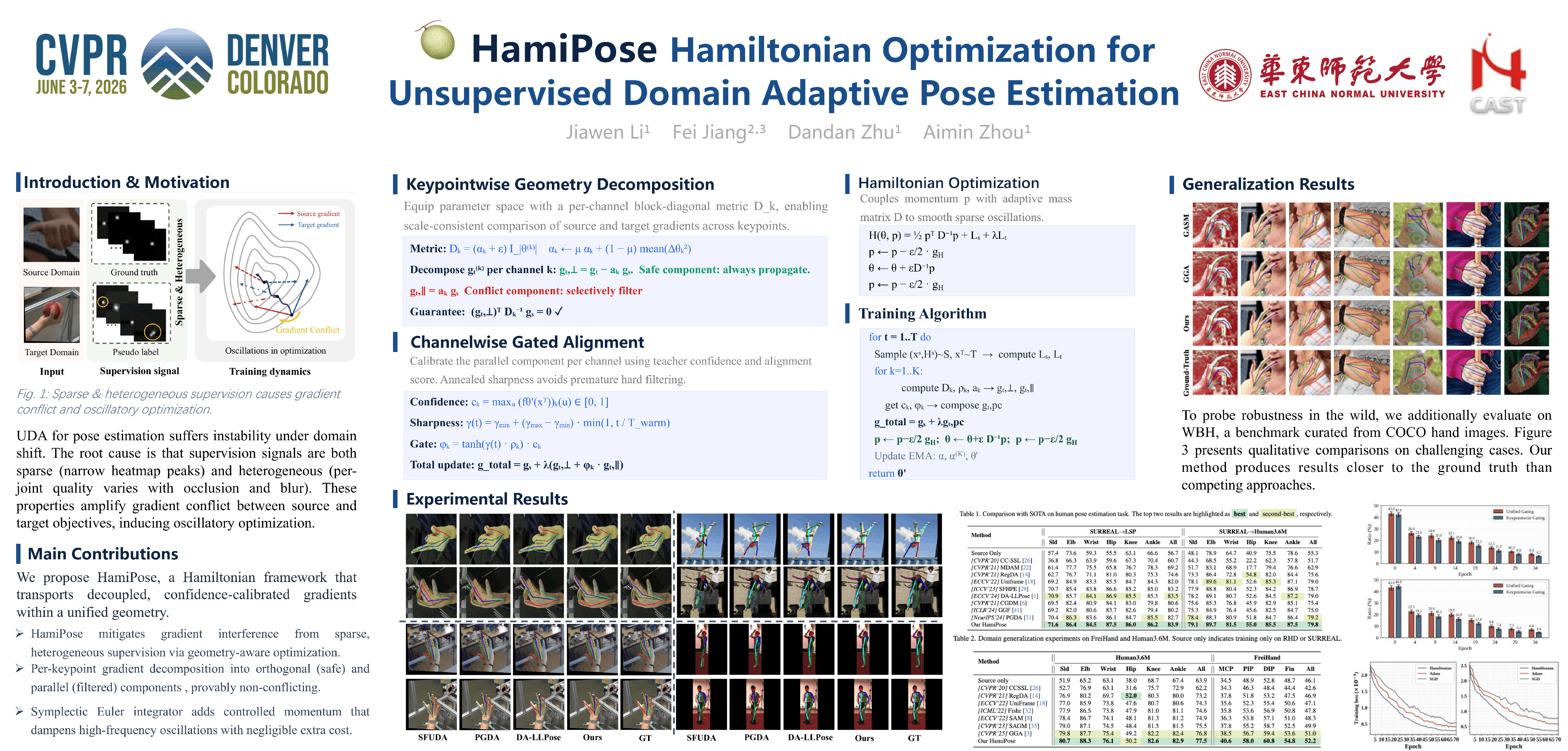
Unsupervised domain adaptation (UDA) for pose estimation promises transfer from synthetic to real domains but often suffers instability under domain shift. Prior work attributes this deterioration to gradient interference between source supervision and target consistency. This conflict is distinct in pose estimation, where sparse and heterogeneous supervision signals cause gradients to be highly sensitive to small localization errors and lead to unstable updates. To address these challenges, we propose HamiPose, a Hamiltonian optimization framework that transports decoupled and confidence-calibrated gradients within a unified geometry to mitigate instability. HamiPose first refines gradient interaction through keypointwise geometry decomposition, orthogonally projecting target gradients to preserve nonconflicting component. Channelwise gated alignment then calibrates the parallel component with confidence and alignment, producing decoupled, confidence-calibrated gradients. These gradients are advanced by a Hamiltonian optimizer with a symplectic integrator, providing controlled momentum that stabilizes updates. Extensive experiments demonstrate that HamiPose achieves state-of-the-art performance in UDA pose estimation while maintains strong performance under domain generalization settings.