
The Missing GAP: From Solving Square Jigsaw Puzzles to Handling Real World Archaeological Fragments
Abstract
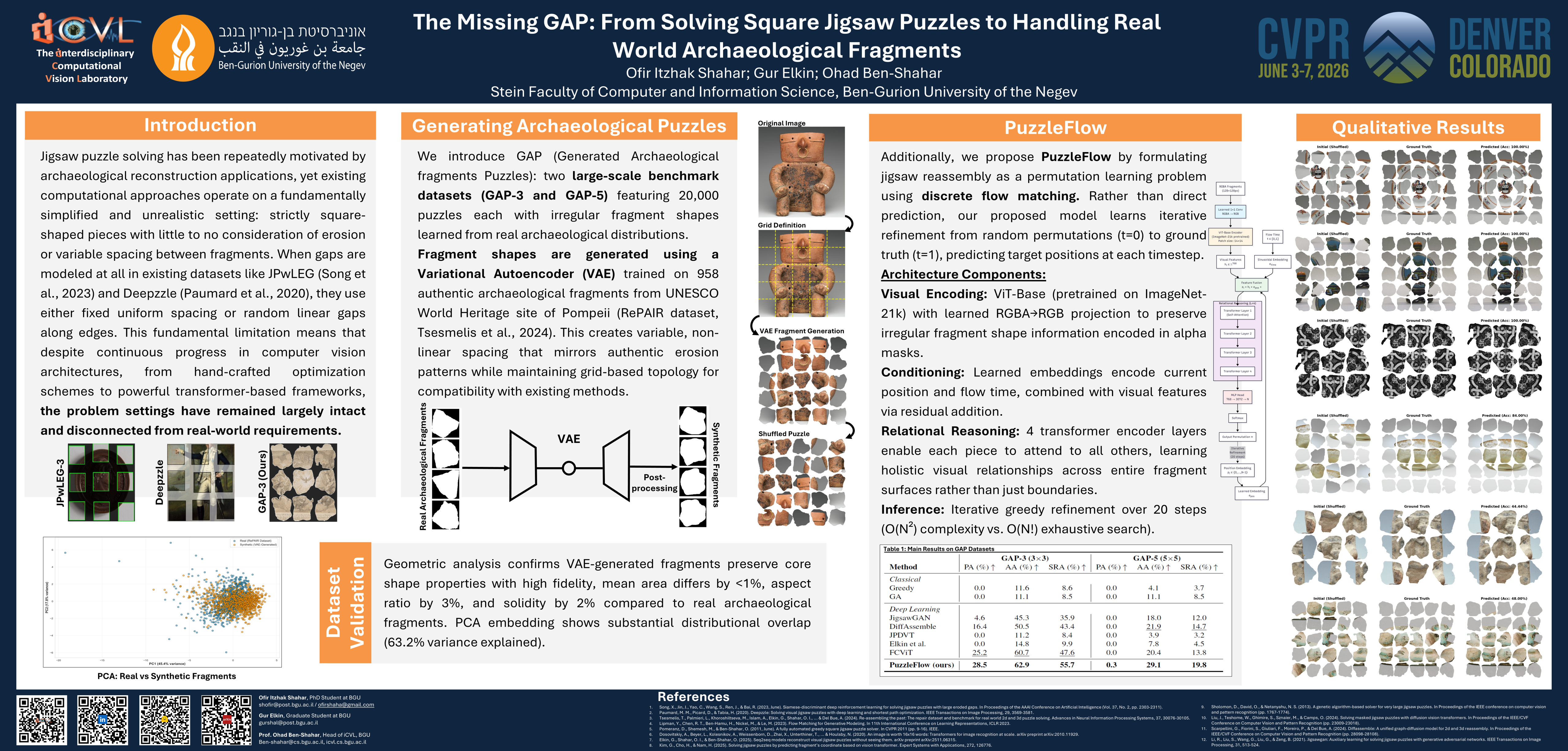
Jigsaw puzzle solving has been an increasingly popular task in the computer vision research community. Recent works have utilized cutting-edge architectures and computational approaches to reassemble groups of pieces into a coherent image, while achieving increasingly good results on well established datasets. However, most of these approaches share a common, restricting setting: operating solely on strictly square puzzle pieces. In this work, we introduce GAP, a set of novel jigsaw puzzles datasets containing synthetic, heavily eroded pieces of unrestricted shapes, generated by a learned distribution of real-world archaeological fragments. We also introduce PuzzleFlow, a novel ViT and Flow-Matching based framework for jigsaw puzzle solving, capable of handling complex puzzle pieces, demonstrating superior performance on GAP, comparing to both classic and recent prominent works in this domain.