
AMusE: Audio-Visual Benchmark and Alignment Framework for Agentic Multi-Speaker Understanding
Sanjoy Chowdhury ⋅ Karren Dai Yang ⋅ Xudong Liu ⋅ Fartash Faghri ⋅ Pavan Kumar Anasosalu Vasu ⋅ Oncel Tuzel ⋅ Dinesh Manocha ⋅ Chun-Liang Li ⋅ Raviteja Vemulapalli
Abstract
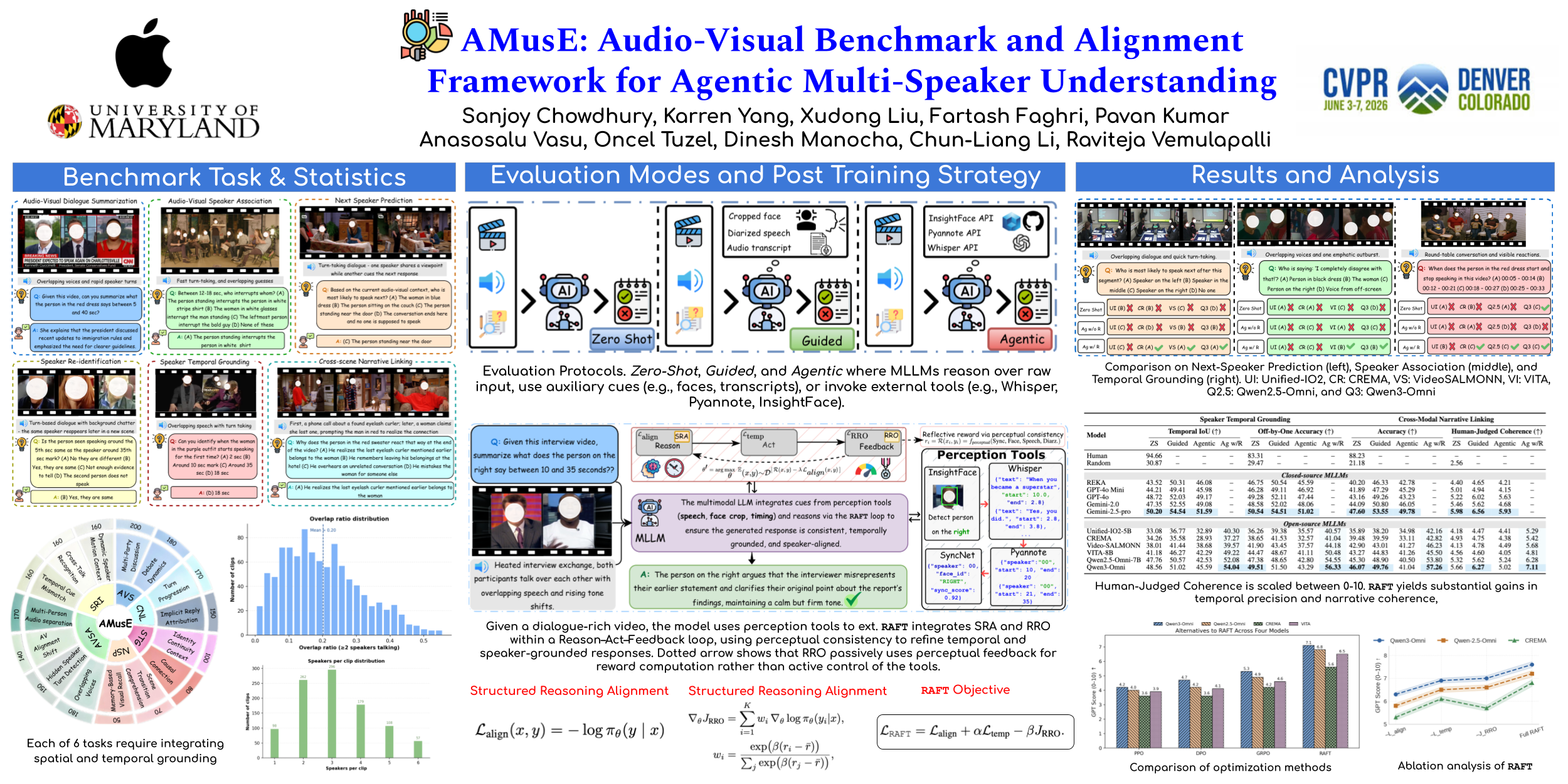
Recent multimodal large language models (MLLMs) such as GPT-4o and Qwen3-Omni show strong perception but struggle in multi-speaker, dialogue-centric settings that demand agentic reasoning tracking who speaks, maintaining roles, and grounding events across time. These scenarios are central to multimodal audio-video understanding, where models must jointly reason over audio and visual streams in applications such as conversational video assistants and meeting analytics. We introduce $AMusE$, a benchmark designed around tasks that are inherently agentic, requiring models to decompose complex audio-visual interactions into planning, grounding, and reflection steps. It evaluates MLLMs across three modes zero-shot, guided, and agentic and six task families, including spatio-temporal speaker grounding and multimodal dialogue summarization. Across all modes, current models exhibit weak multi-speaker reasoning and inconsistent behavior under both non-agentic and agentic evaluation. Motivated by the inherently agentic nature of these tasks and recent advances in LLM agents, we propose $RAFT$, a data-efficient agentic alignment framework that integrates reward optimization with intrinsic multimodal self-evaluation as reward and selective parameter adaptation for data and parameter efficient updates. Using $RAFT$, we achieve up to $39.52\%$ relative improvement in accuracy on our benchmark. Together, $AMusE$ and $RAFT$ provide a practical platform for examining agentic reasoning in multimodal models and improving their capabilities. To facilitate further research we will publicly release our code and benchmark.
Chat is not available.
Successful Page Load