
Minimal Constraint Relaxation for Multiview Autocalibration
Abstract
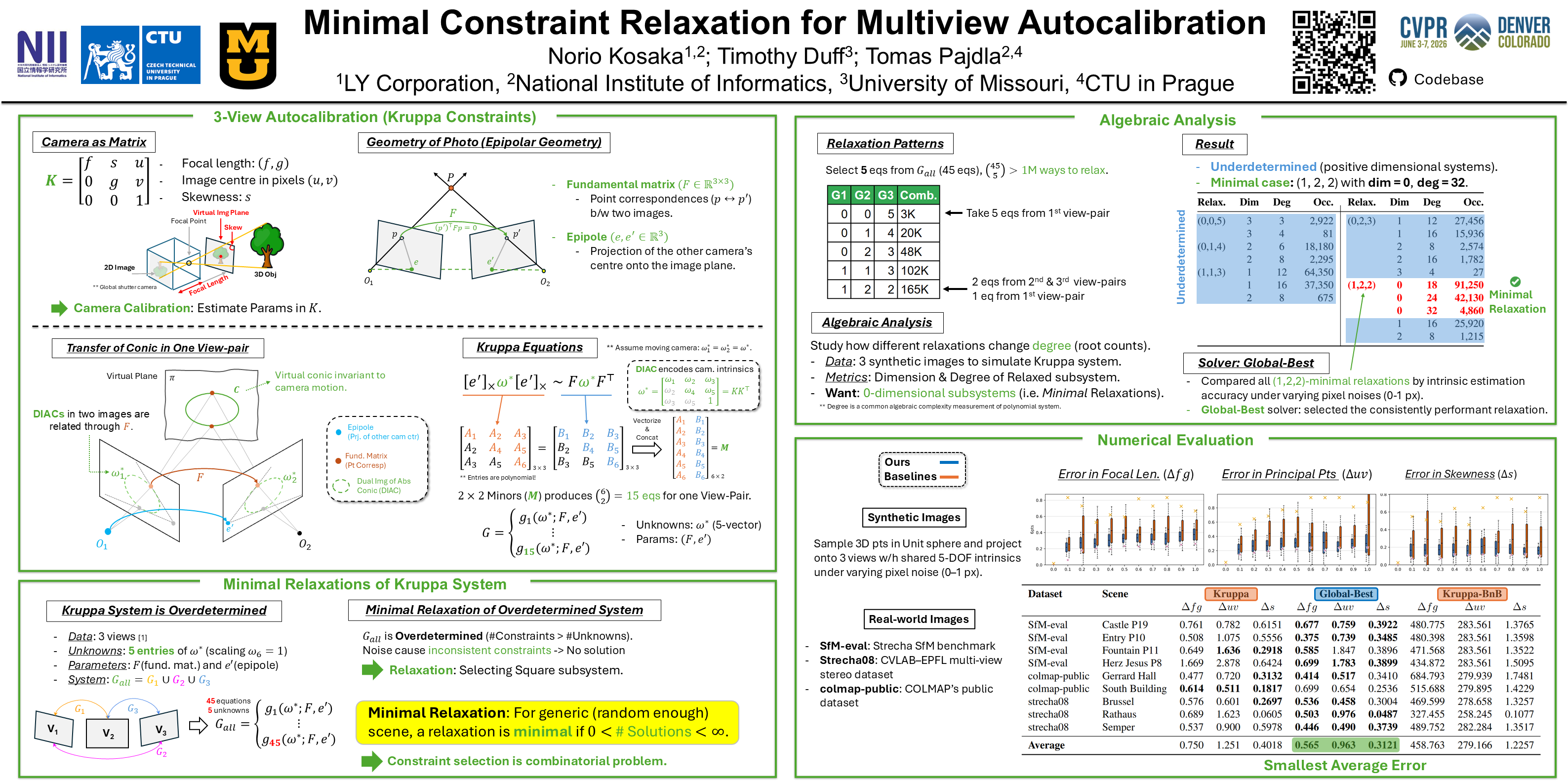
Polynomial systems in multiview geometry are often highly over-constrained, and naïve subsampling or elimination can lead to unstable or inconsistent estimation. We revisit this issue through the lens of \emph{constraint relaxation}—the selective removal of equations to recover a finite and well-conditioned solution space. Focusing on the Kruppa equations for camera autocalibration, we introduce the notion of \emph{minimal relaxation}, a principled framework for identifying constraint subsets that preserve geometric validity while restoring solvability. Through symbolic analysis of the full three-view Kruppa system, we enumerate and classify all relaxation patterns, revealing algebraically minimal families that yield finite, well-conditioned problems.Comprehensive experiments validate this analysis across symbolic and numerical settings.Using homotopy continuation and synthetic perturbations, we show that specific relaxations remain stable under noise and permutation.Experiments with synthetic and real images further demonstrate that these relaxations consistently outperform the classical SVD-based Kruppa formulation in both robustness and calibration accuracy, establishing algebraic relaxation as a powerful paradigm for stable multiview autocalibration.