
IDESplat: Iterative Depth Probability Estimation for Generalizable 3D Gaussian Splatting
Abstract
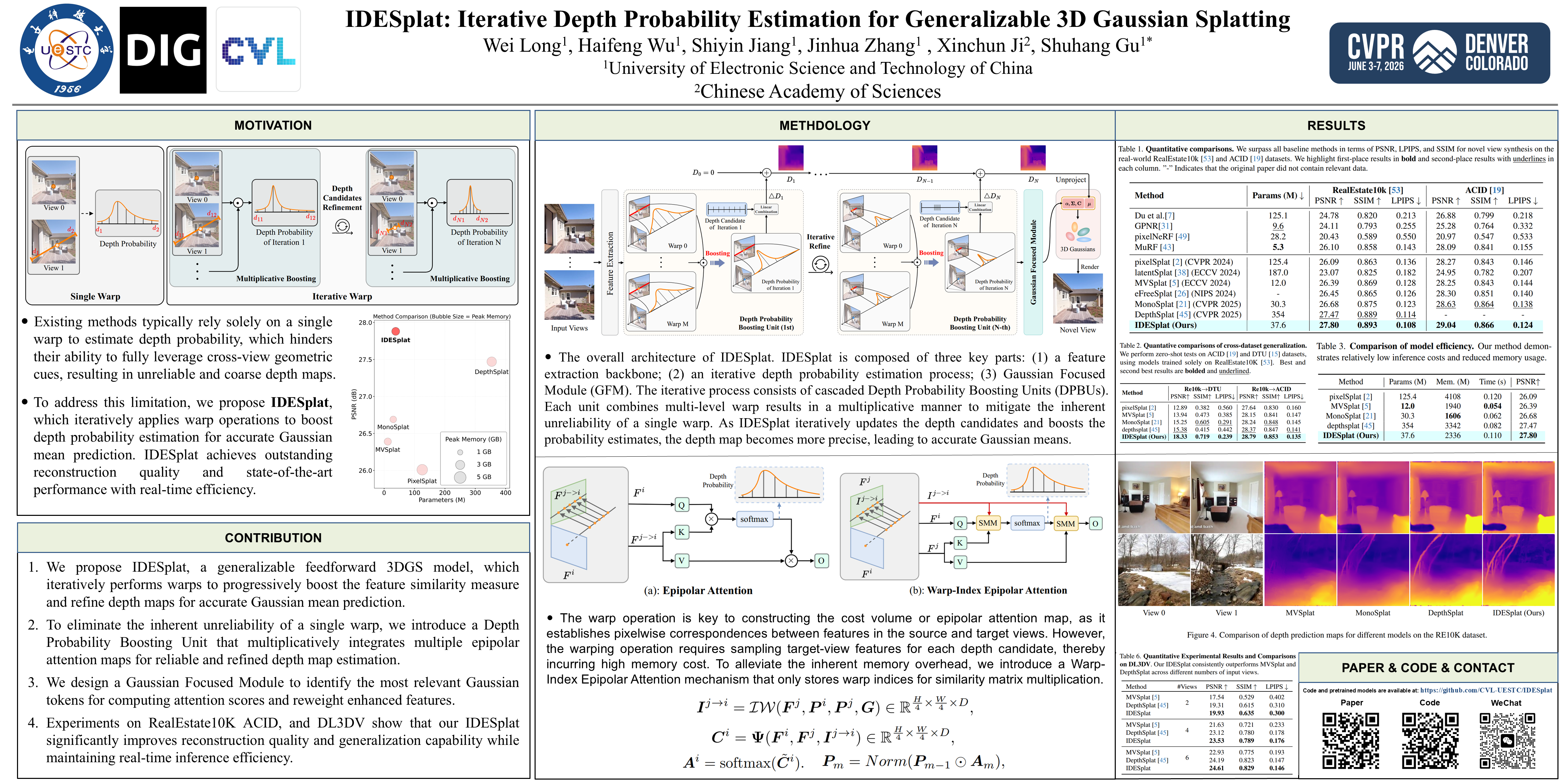
Generalizable 3D Gaussian Splatting aims to directly predict Gaussian parameters using a feed-forward network for scene reconstruction. Among these parameters, Gaussian means are particularly difficult to predict, so depth is usually estimated first and then unprojected to obtain the Gaussian sphere centers. Existing methods typically rely solely on a single warp to estimate depth probability, which hinders their ability to fully leverage cross-view geometric cues, resulting in unstable and coarse depth maps. To address this limitation, we propose IDESplat, which iteratively applies warp operations to boost depth probability estimation for accurate Gaussian mean prediction. First, to eliminate the inherent instability of a single warp, we introduce a Depth Probability Boosting Unit (DPBU) that integrates multi-level epipolar attention maps in a multiplicative manner. Next, we construct an iterative depth estimation process by stacking multiple DPBUs, progressively identifying potential depth candidates with high likelihood. As IDESplat iteratively updates the depth candidates and boosts probability estimation, the depth map is refined, resulting in accurate Gaussian means. Finally, for the other Gaussian parameters, we design a Gaussian Focused Module (GFM) to determine the most relevant Gaussian tokens for feature interaction. We conduct experiments on RealEstate10K and ACID. IDESplat achieves outstanding reconstruction quality and state-of-the-art performance with real-time efficiency. On RE10K, it outperforms DepthSplat by 0.33 dB in PSNR, using only 10.7% of the parameters and 70% of the memory. Additionally, IDESplat improves PSNR by 2.95 dB over DepthSplat on the DTU dataset in cross-dataset experiments, demonstrating its strong generalization ability.