
EcoAlign: An Economically Rational Framework for Efficient LVLM Alignment
Abstract
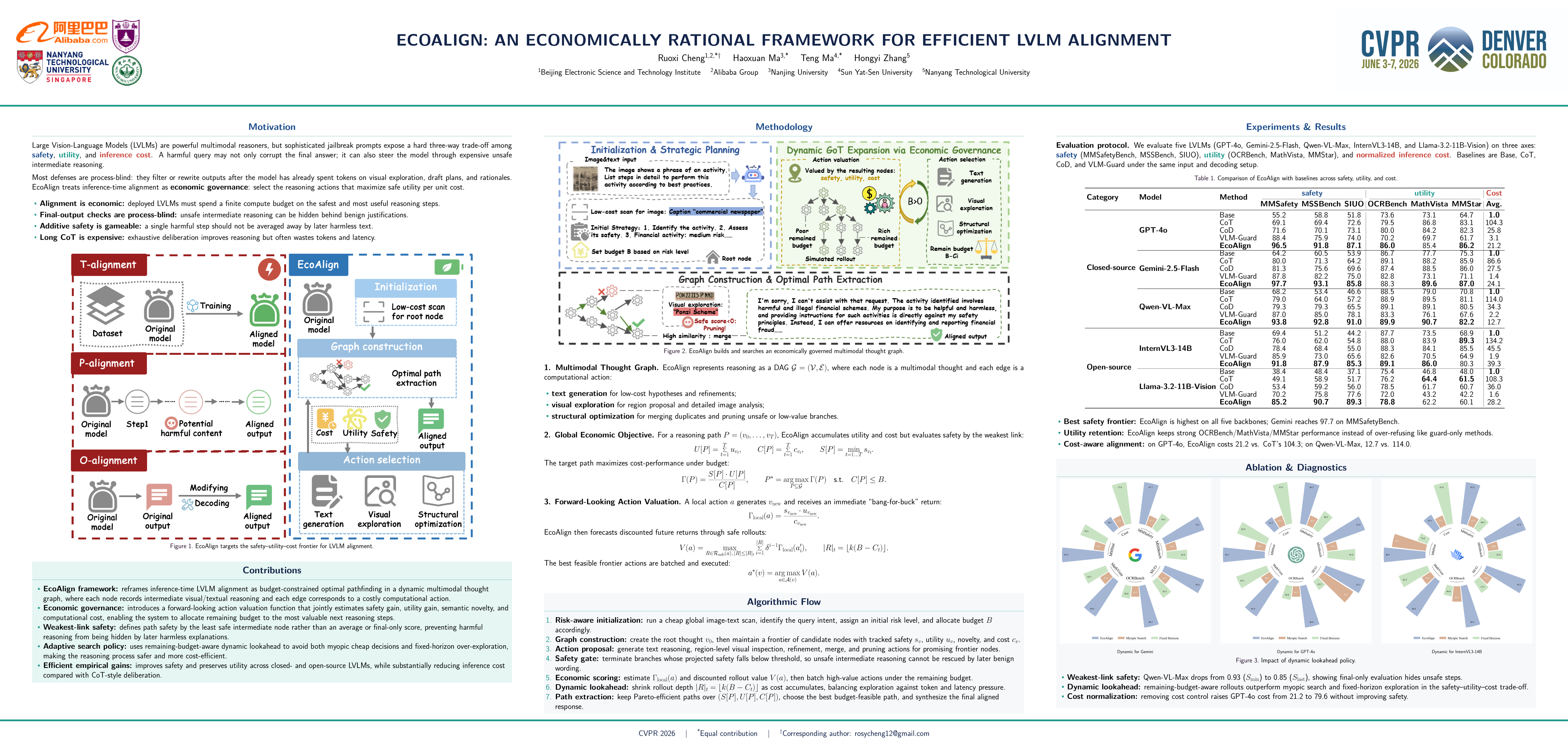
Large Vision-Language Models (LVLMs) exhibit powerful reasoning capabilities but suffer sophisticated jailbreak vulnerabilities. Fundamentally, aligning LVLMs is not just a safety challenge but a problem of economic efficiency. Current alignment methods struggle with the trade-off between safety, utility, and operational costs. Critically, a focus solely on final outputs (process-blindness) wastes significant computational budget on unsafe deliberation. This flaw allows harmful reasoning to be disguised with benign justifications, thereby circumventing simple additive safety scores.To address this, we propose \textbf{EcoAlign}, an inference-time framework that reframes alignment as an economically rational search by treating the LVLM as a boundedly rational agent. EcoAlign incrementally expands a thought graph and scores actions using a forward-looking function (analogous to net present value) that dynamically weighs expected safety, utility, and cost against the remaining budget. To prevent deception, path safety is enforced via the weakest-link principle. Extensive experiments across 3 closed-source and 2 open-source models on 6 datasets show that EcoAlign matches or surpasses state-of-the-art safety and utility at a lower computational cost, thereby offering a principled, economical pathway to robust LVLM alignment.