
Inside-Out: Measuring Generalization in Vision Transformers Through Inner Workings
 Highlight
Abstract
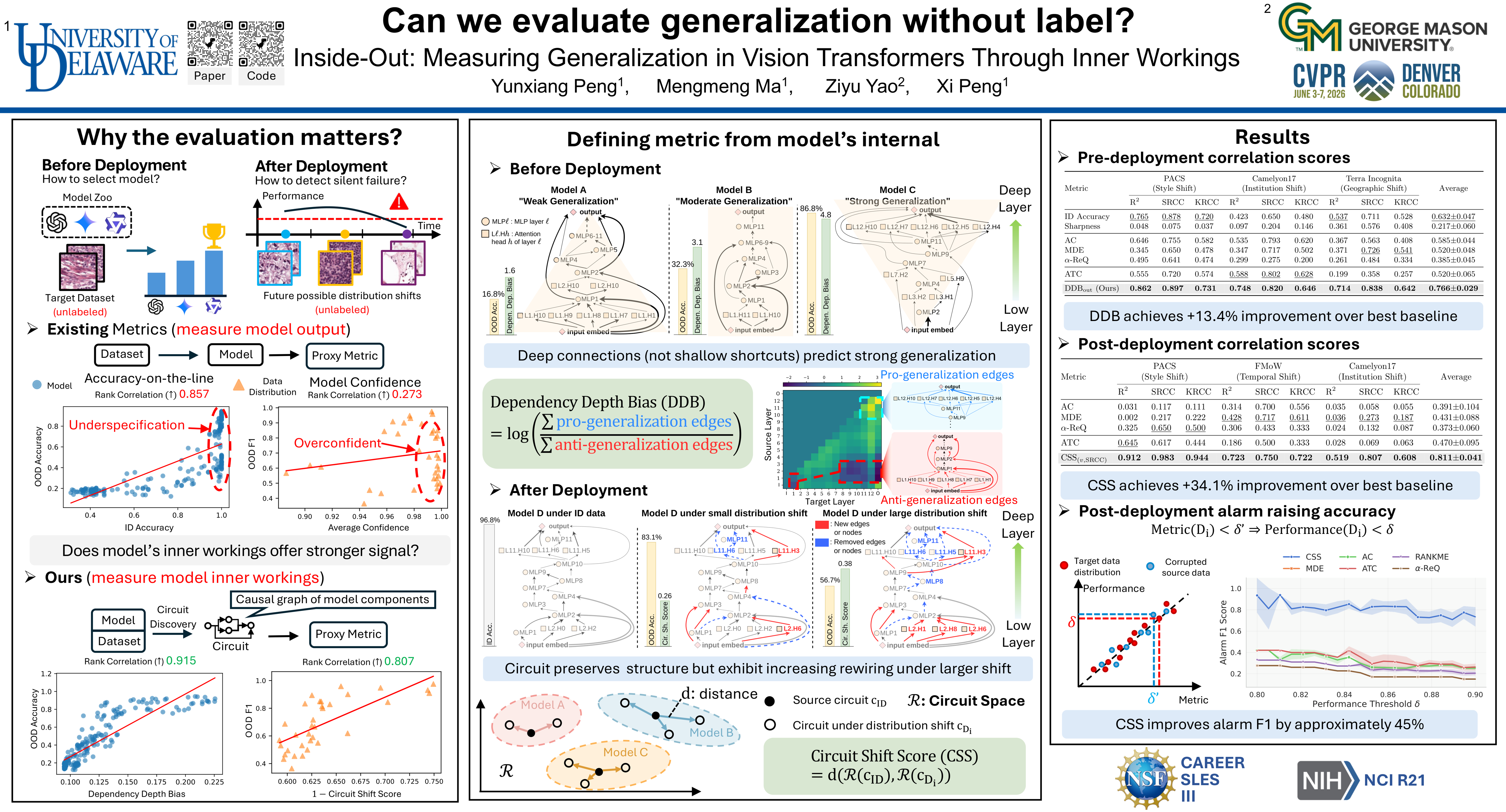
Reliable generalization metrics are fundamental to both the development and evaluation of machine learning models. Especially in high-stakes applications where labeled target data are scarce, evaluation of models' generalization performance under distribution shift is a pressing need. We focus on two practical scenarios: (1) Before deployment, how to select the best model for unlabeled target data? (2) After deployment, how to monitor model performance under distribution shift? The central need in both cases is a reliable, label-free proxy metric. Yet existing proxy metrics, such as model confidence or accuracy-on-the-line, are often unreliable as they only assess model outputs while ignoring the internal mechanisms that produce them. We address this limitation by introducing a new perspective: using a model’s inner working, i.e. circuits, as a predictive metric of generalization performance. Leveraging circuit discovery, we extract the causal interactions between internal representations as a circuit, from which we derive two metrics tailored to the two practical scenarios. (1) Before deployment, we introduce Dependency Depth Bias, which measures different models' generalization capability on target data. (2) After deployment, we propose Circuit Shift Score, which predicts a model's generalization under different distribution shifts. Across diverse tasks, both metrics demonstrate significantly improved correlation with generalization performance, outperforming existing proxies by an average of 11.0% and 45.3%, respectively.