
RAP: Fast Feedforward Rendering-Free Attribute-Guided Primitive Importance Score Prediction for Efficient 3D Gaussian Splatting Processing
Abstract
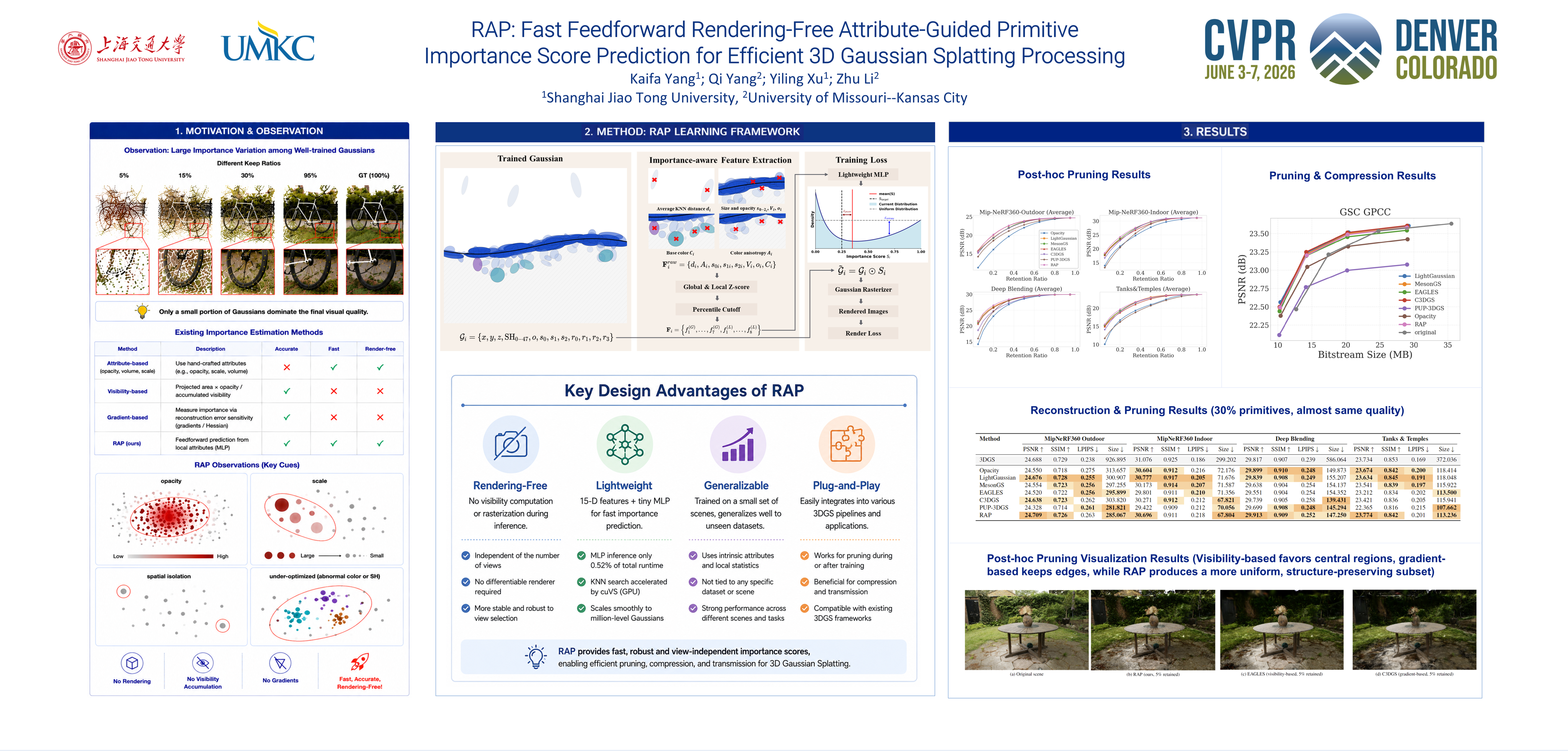
3D Gaussian Splatting (3DGS) has emerged as a leading technology for high-quality 3D scene reconstruction. However, the iterative refinement and densification process leads to the generation of a large number of primitives, each contributing to the reconstruction to a substantially different extent. Estimating primitive importance is thus crucial, both for removing redundancy during reconstruction and for enabling efficient compression and transmission.Existing methods typically rely on rendering-based analyses, where each primitive is evaluated through its contribution across multiple camera viewpoints. However, such methods are 1) sensitive to the number and selection of views; 2) rely on specialized differentiable rasterizers; and 3) have long calculation times that grow linearly with view count, making them difficult to integrate as plug-and-play modules, as well as resulting in limited scalability and generalization.To address these issues, we propose RAP — a fast feedforward Rendering-free Attribute-guided method for efficient importance score Prediction in 3DGS. RAP infers primitive significance directly from intrinsic Gaussian attributes and local neighborhood statistics, avoiding any rendering-based or visibility-dependent computations. A compact MLP is trained to predict per-primitive importance scores using a combination of rendering loss, pruning-aware loss, and significance distribution regularization loss. After being trained on a small set of scenes, RAP generalizes effectively to unseen data and can be seamlessly integrated into reconstruction, compression, and transmission pipelines, providing a unified and efficient pruning solution.