
SaPaVe: Towards Active Perception and Manipulation in Vision-Language Action Models for Robotics
Mengzhen Liu ⋅ Enshen Zhou ⋅ Cheng Chi ⋅ Yi Han ⋅ Shanyu Rong ⋅ Liming Chen ⋅ Pengwei Wang ⋅ Zhongyuan Wang ⋅ Shanghang Zhang
 Highlight
Abstract
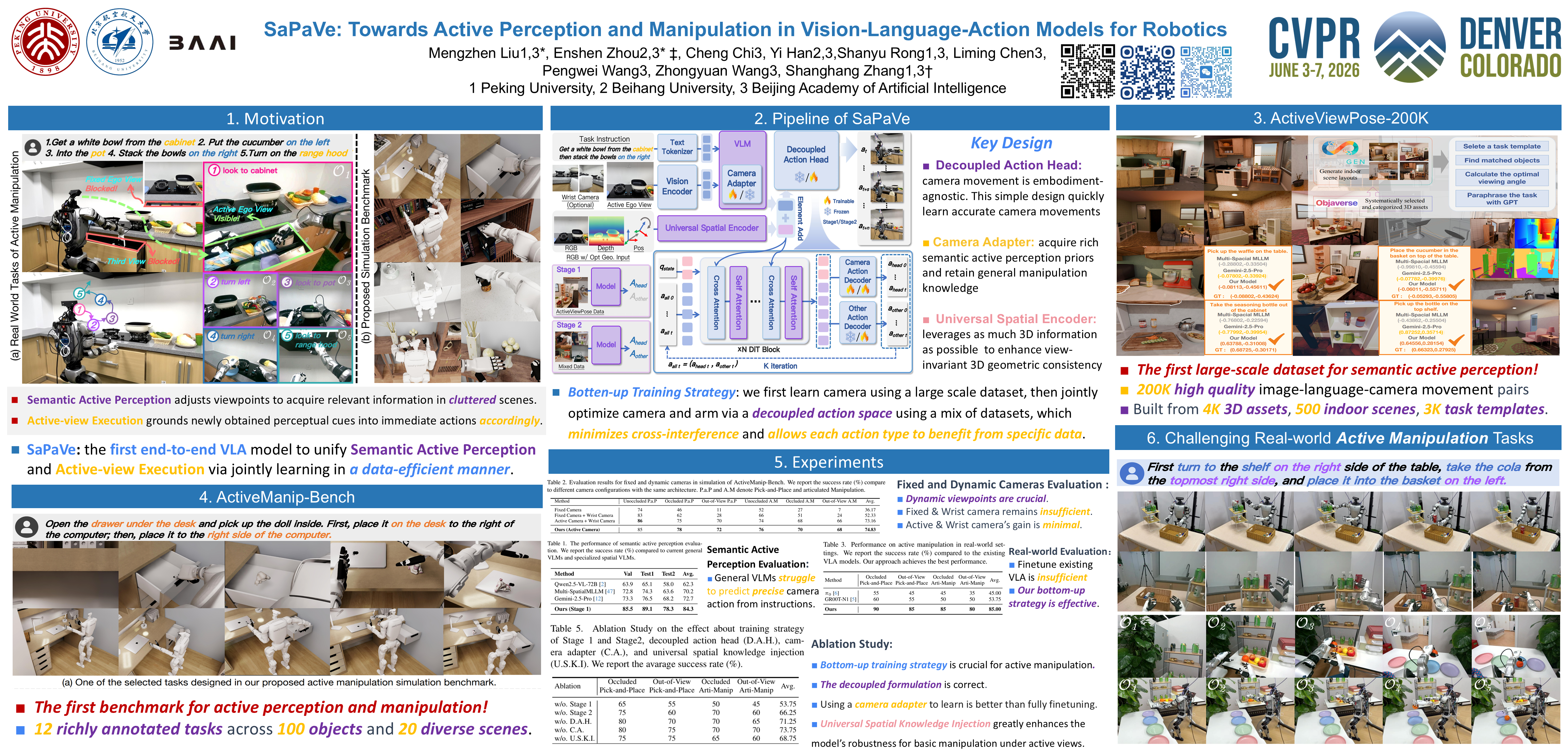
Active perception and manipulation are crucial for embodied robots to interact with complex scenes. Existing methods struggle to unify semantic-driven perception actively with robust, viewpoint-invariant execution accordingly. To this end, we propose SaPaVe, an end-to-end framework that jointly learns these capabilities in a data-efficient manner. Central to our approach is a decoupling of camera and manipulation actions, contrary to shared-action-space, and learning in a bottom-up strategy: we first train semantic camera control on our proposed large-scale dataset, then jointly optimize both action types via hybrid data. To support this learning, we introduce ActiveViewPose-200K, comprising 200k image-language-camera movement pairs for semantic camera movement learning, and a 3D geometry-aware module that improves execution robustness under dynamic viewpoints. We further present ActiveManip-Bench, the first benchmark filling the gap to evaluate active manipulation. Extensive experiments in both simulation and real-world settings show that SaPaVe outperforms recent VLA models such as GR00T and $\pi_0$, achieving up to 31.25\% higher success rates in real-world tasks. Our results show that tightly coupled perception and execution, when trained with decoupled yet coordinated strategies, enable efficient and generalizable active manipulation.
Chat is not available.
Successful Page Load