
Perception Characteristics Distance: Measuring Stability and Robustness of Perception System in Dynamic Conditions under a Certain Decision Rule
Abstract
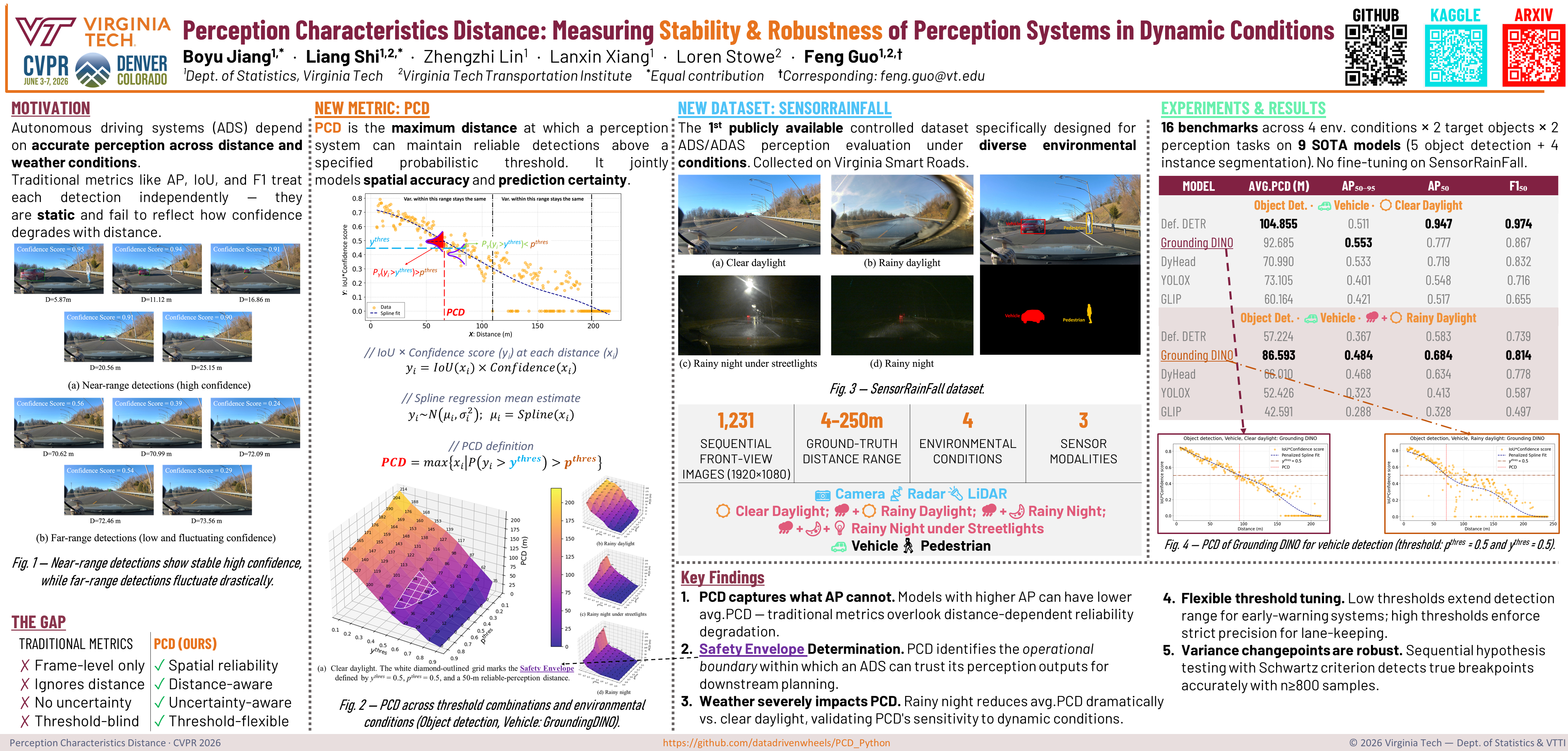
The safety of autonomous driving systems (ADS) depends on accurate perception across distance and driving conditions. The outputs of AI perception algorithm are stochastic, which have a major impact on decision making and safety outcomes, including time-to-collision estimation. However, current perception evaluation metrics do not reflect the stochastic nature of perception algorithms. We introduce the Perception Characteristics Distance (PCD), a novel metric incorporating model output uncertainty as represented by the farthest distance at which an object can be reliably detected. To represent a system’s overall perception capability in terms of reliable detection distance, we used the averaging PCD values across multiple detection quality and probabilistic thresholds produces the average PCD (aPCD). For empirical validation, we present the SensorRainFall dataset, collected on the Virginia Smart Road using a sensor-equipped vehicle (cameras, radar, and LiDAR) controlled under different weather (clear and rainy) and illumination conditions (daylight, streetlight, and nighttime). The dataset includes ground-truth distances, bounding boxes, and segmentation masks for target objects. Experiments with state-of-the-art models show that aPCD captures meaningful differences across weather, daylight, and illumination conditions, which traditional evaluation metrics fail to reflect. PCD provides an uncertainty-aware measure of perception performance, supporting safer and more robust ADS operation, while the SensorRainFall dataset offers a valuable benchmark for evaluation.