
MSCD-GS: Motion-Separated Cooperative Deblurring Dynamic Reconstruction via Gaussian Splatting
Abstract
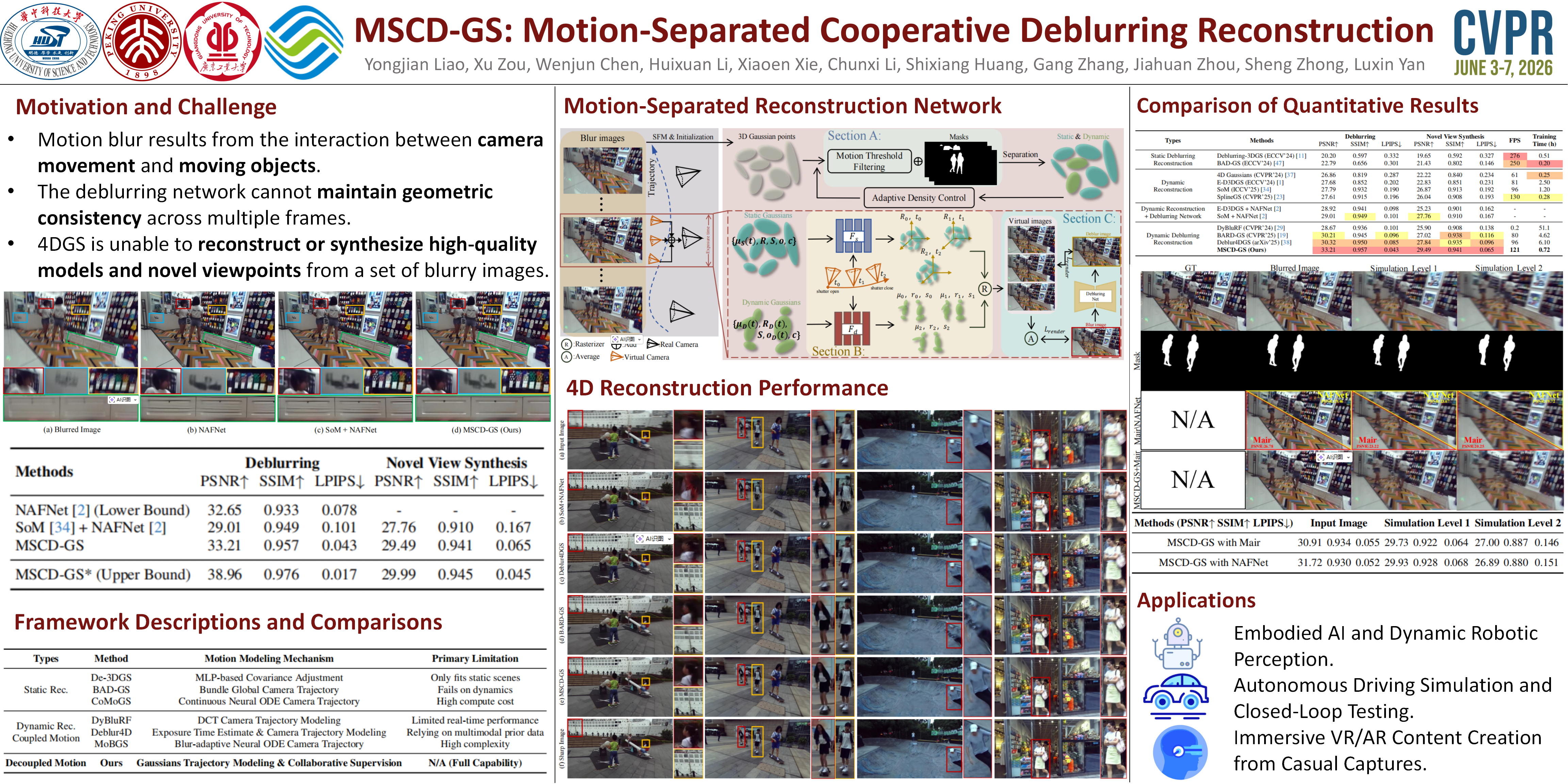
Although 4D reconstruction based on Gaussian Splatting has achieved many impressive results, reconstructing real-world images captured by a casual monocular camera remains a significant challenge. In dynamic scenes, as the camera and objects move during the exposure time, these input images inevitably contain a considerable amount of motion blur, which severely compromises the quality of reconstruction and new viewpoint synthesis. The existing deblurring 3D Gaussian models still cannot handle motion blur issues in real dynamic scenes. To address these challenges, we propose MSCD-GS—a novel method for motion-separated collaborative deblurring 4D reconstruction via Gaussian Splatting, capable of effectively handling motion-blurred inputs. Specifically, due to the distinct motion characteristics of static and dynamic Gaussians, we perform separate motion modeling to achieve dynamic scene reconstruction. To predict Gaussian changes during the exposure time, we designed motion-aware networks for static and dynamic Gaussians, thereby synthesizing virtual blurred images. Finally, we utilize the results from the deblurring network and the synthesized images to supervise 4D reconstruction collaboratively. Extensive experiments demonstrate that MSCD-GS can effectively reconstruct high-quality dynamic scenes from blurred image inputs, with performance surpassing existing methods.