
Detecting AI-Generated Forgeries via Iterative Manifold Deviation Amplification
Abstract
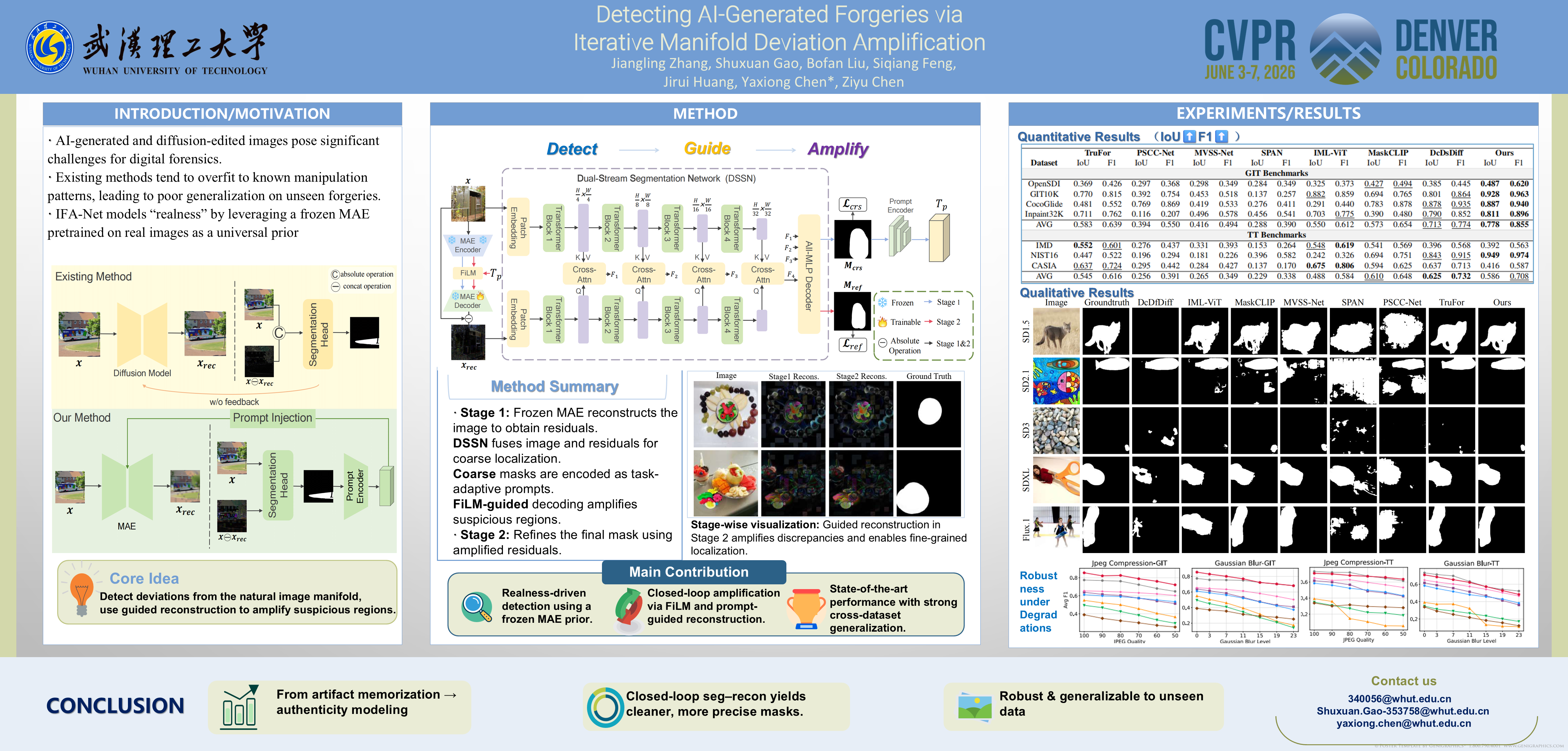
The proliferation of highly realistic AI-generated images poses critical challenges for digital forensics, demanding precise pixel-level localization of manipulated regions. Existing methods predominantly learn discriminative patterns of specific forgeries, struggling with novel manipulations as editing techniques evolve. We propose the Iterative Forgery Amplifier Network (IFA-Net), which shifts from learning "what is fake" to modeling "what is real". Grounded in the principle that all manipulations deviate from the natural image manifold, IFA-Net leverages a frozen Masked Autoencoder (MAE) pretrained on real images as a universal realness prior. Our framework operates through a two-stage closed-loop process: an initial Dual-Stream Segmentation Network (DSSN) fuses the original image with MAE reconstruction residuals for coarse localization, then a Task-Adaptive Prior Injection (TAPI) module converts this coarse prediction into guiding prompts that steer the MAE decoder to amplify reconstruction failures in suspicious regions, enabling precise refinement. Extensive experiments on four diffusion-based inpainting benchmarks show that IFA-Net achieves an average improvement of 6.5% in IoU and 8.1% in F1-score over the second-best method, while demonstrating strong generalization to traditional manipulation types.