
Disco-GS: Gaussian Splatting in Dynamic Color Lighting
Abstract
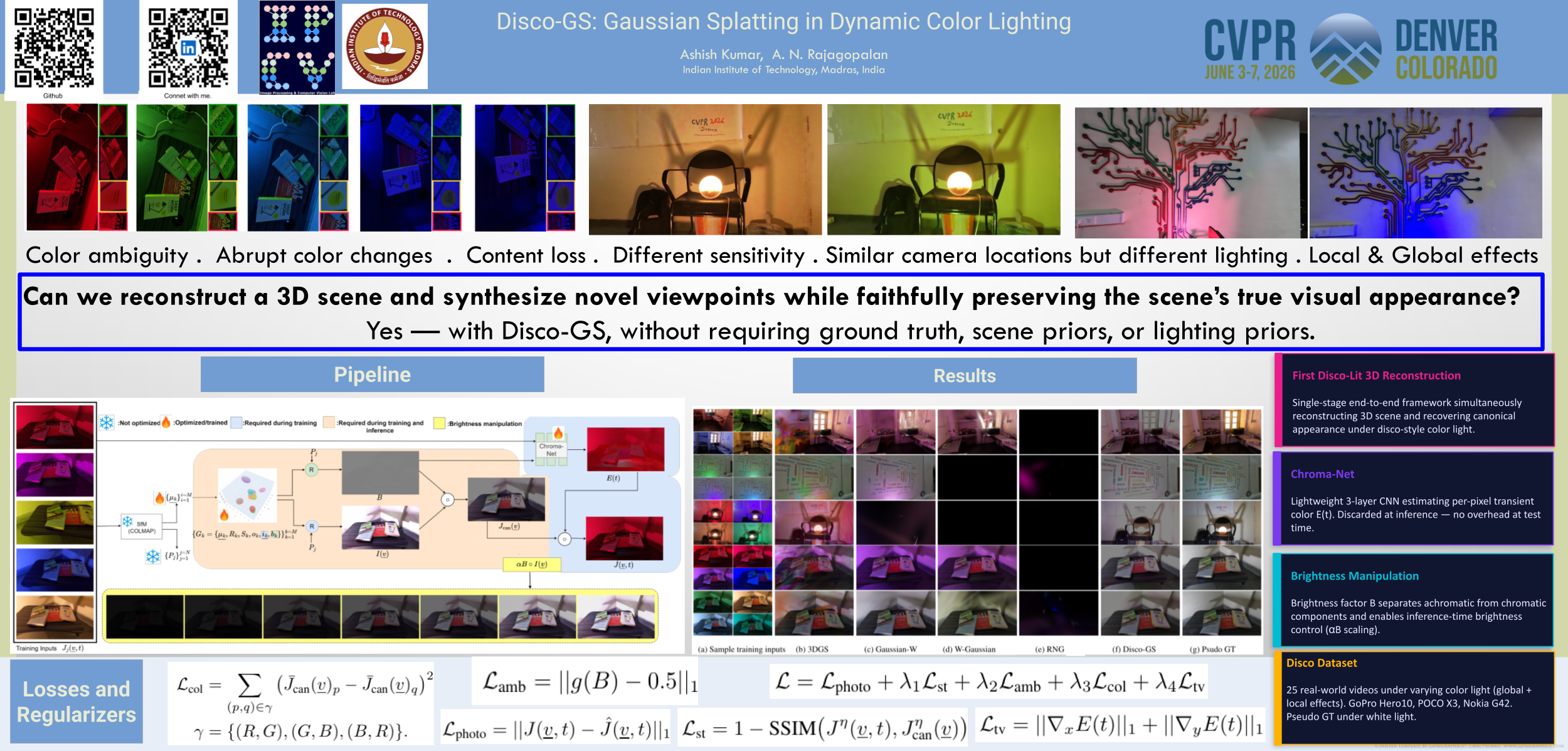
Recent advances in Gaussian Splatting (GS) have significantly improved 3D scene reconstruction and novel view synthesis. However, most existing methods typically assume that training inputs are captured under stable lighting conditions and achromatic light. In contrast, scenes recorded under temporally varying color light, as in “disco lights” commonly seen in events, performances, and decorative settings, introduce severe ambiguities in both scene photometry and geometry. We propose Disco-GS, a framework that leverages GS for reconstructing the 3D scene while simultaneously recovering the underlying canonical appearance from videos captured under dynamic lighting conditions. Disco-GS estimates the effective per-pixel transient light, which, when applied to the canonical image, results in the observed color image of the scene, thereby enabling self-supervised learning. Disco-GS is an end-to-end framework that does not rely on any prior knowledge, such as color values, ambient lighting conditions, or scene properties. It effectively handles both global and spatially localized transient color variations. It also enables controllable brightness manipulation of the canonical scene, facilitating applications such as simulating low-light and well-lit scene conditions. To the best of our knowledge, Disco-GS is the first method to simultaneously perform 3D scene reconstruction and canonical appearance recovery from inputs captured under artificially varying, disco-style colored light. To enable quantitative and qualitative evaluations, we also introduce the Disco dataset, a collection of 25 videos of real-world scenes exhibiting diverse and random color variations. The dataset will be released. Extensive experiments demonstrate the robustness and fidelity of Disco-GS.