
Temporal Representation Enhancement (TRE): Learning to Forget Dominant Patterns for Enhanced Temporal Spiking Features
 Highlight
Abstract
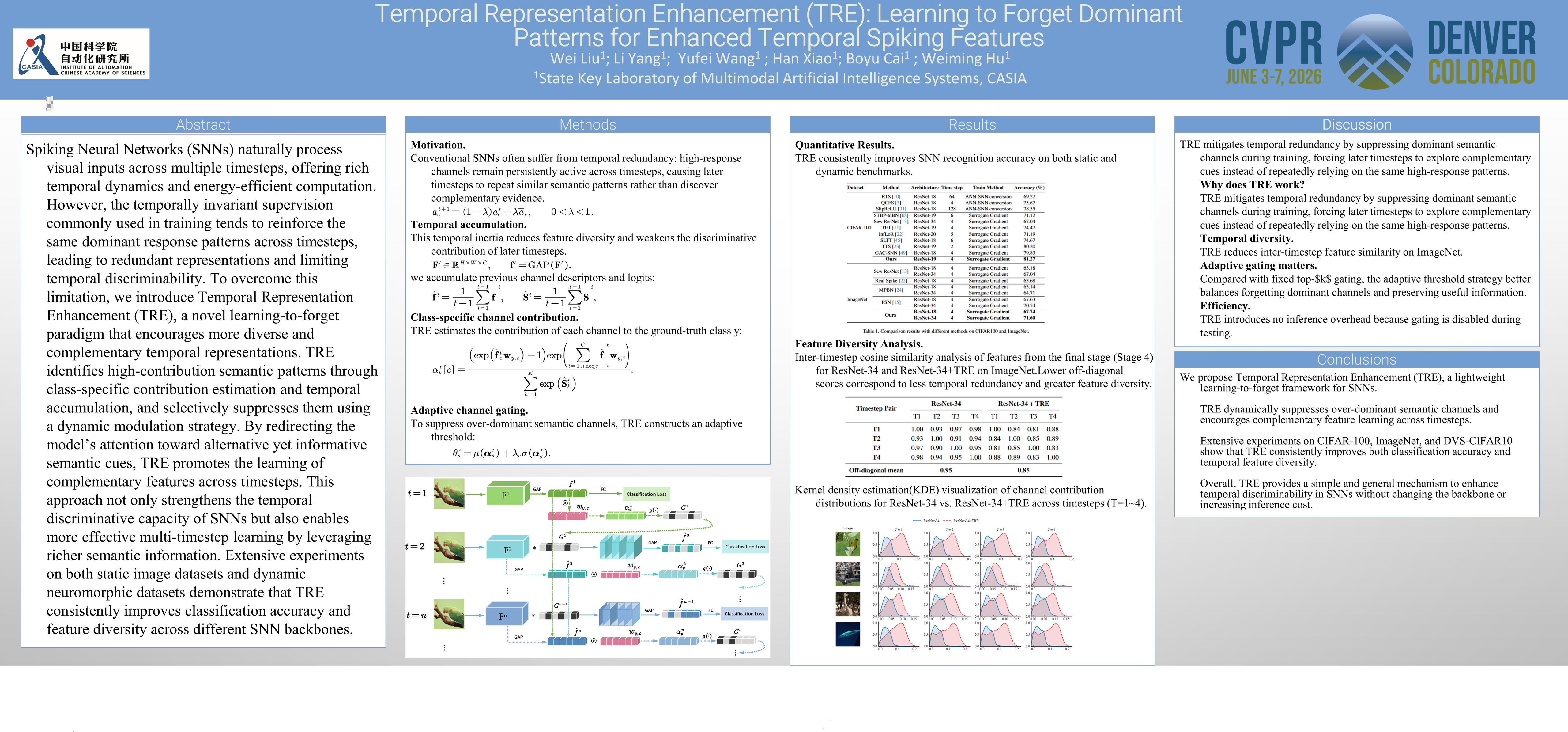
Spiking Neural Networks (SNNs) naturally process visual inputs across multiple timesteps, offering rich temporal dynamics and energy-efficient computation. However, the temporally invariant supervision commonly used in training tends to reinforce the same dominant response patterns across timesteps, leading to redundant representations and limiting temporal discriminability.To overcome this limitation, we introduce \emph{Temporal Representation Enhancement} (TRE), a novel learning-to-forget paradigm that encourages more diverse and complementary temporal representations. TRE identifies high-contribution semantic patterns through class-specific contribution estimation and temporal accumulation, and selectively suppresses them using a dynamic modulation strategy. By redirecting the model’s attention toward alternative yet informative semantic cues, TRE promotes the learning of complementary features across timesteps.This approach not only strengthens the temporal discriminative capacity of SNNs but also enables more effective multi-timestep learning by leveraging richer semantic information. Extensive experiments on both static image datasets and dynamic neuromorphic datasets demonstrate that TRE consistently improves classification accuracy and feature diversity across different SNN backbones.