
PAUL: Uncertainty-Guided Partition and Augmentation for Robust Cross-View Geo-Localization under Noisy Correspondence
Abstract
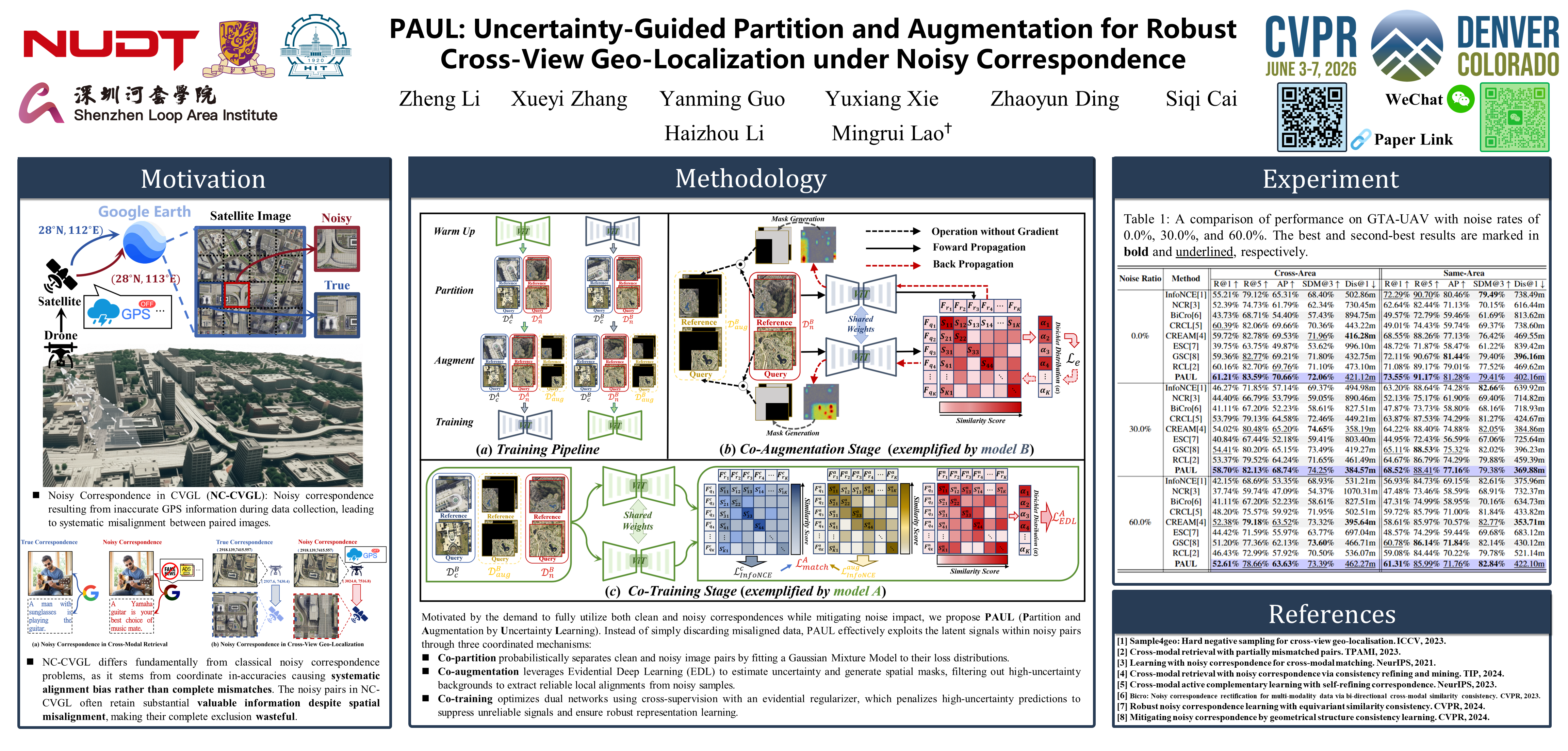
Cross-view geo-localization is a critical task for UAV navigation, event detection, and aerial surveying, which establish correspondence between drone-captured and satellite imagery. Most existing approaches embed cross-view data into a joint feature space to maximize similarity between paired images. However, these methods typically assume perfect alignment of image pairs in training data, an assumption that rarely holds in practical scenarios. In real-world conditions, factors such as urban canyon effects, electromagnetic interference, and adverse weather frequently induce GPS drift, resulting in systematic alignment shifts where only partial correspondences exist between image pairs. Despite its prevalence, this source of noisy correspondence has received limited attention in current research.To our best knowledge, this work presents the first systematic investigation of the Noisy Correspondence in Cross-View Geo-Localization (NC-CVGL) problem, specifically addressing the practical scenario where a significant portion of training pairs exhibit spatial misalignment due to GPS inaccuracies. To this end, we propose PAUL (Partition and Augmentation by Uncertainty Learning), a framework that achieves noise-robust learning through three coordinated mechanisms: Co-partition separates noisy from clean samples using data uncertainty and loss patterns; Co-augmentation enhances high-confidence regions via local assessment; and Co-training refines learning through mutual supervision between dual networks.Unlike conventional noise-handling methods that filter or relabel noisy samples, PAUL effectively utilizes noisy data through this triple collaborative mechanism. Comprehensive experiments validate the effectiveness of individual components in PAUL, which consistently achieves superior performance over other competitive noisy-correspondence-driven methods in various noise ratios.