
Envisioning the Future, One Step at a Time
Abstract
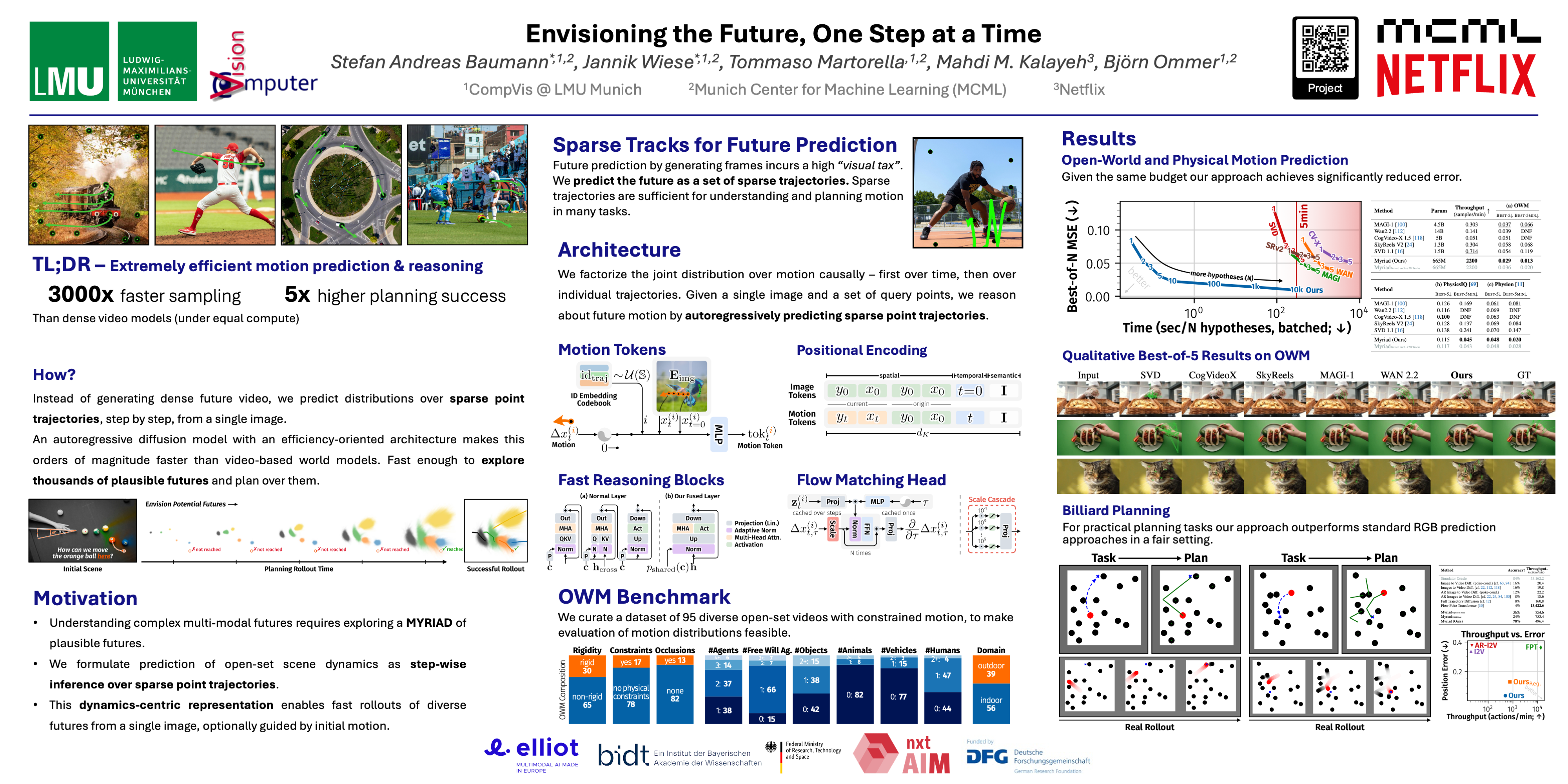
Accurately anticipating how complex, open-world scenes will evolve requires models that represent uncertainty, simulate along extended interaction chains, and efficiently explore many plausible futures. Yet most existing approaches rely on dense video or latent-space prediction, expending substantial capacity on dense appearance rather than on the underlying sparse trajectories of points in the scene. This makes large-scale exploration of future hypotheses costly and limits performance when long-horizon, multi-modal motion is essential. We address this by formulating the prediction of open-set future scene dynamics as step-wise inference over sparse point trajectories. Our autoregressive diffusion model advances these trajectories through short, locally predictable transitions, explicitly modeling the growth of uncertainty over time. This dynamics-centric representation enables fast rollout of thousands of diverse futures from a single image, optionally guided by initial constraints on motion, while maintaining physical plausibility and long-range coherence.We further introduce OWM, a benchmark for open-world motion prediction based on diverse in-the-wild videos, to evaluate accuracy and variability of predicted trajectory distributions under real-world uncertainty. Our method matches or surpasses dense simulators in predictive accuracy while achieving orders-of-magnitude higher sampling speed, making open-world future prediction both scalable and practical.