
MRI Contrast Enhancement Kinetics World Model
Abstract
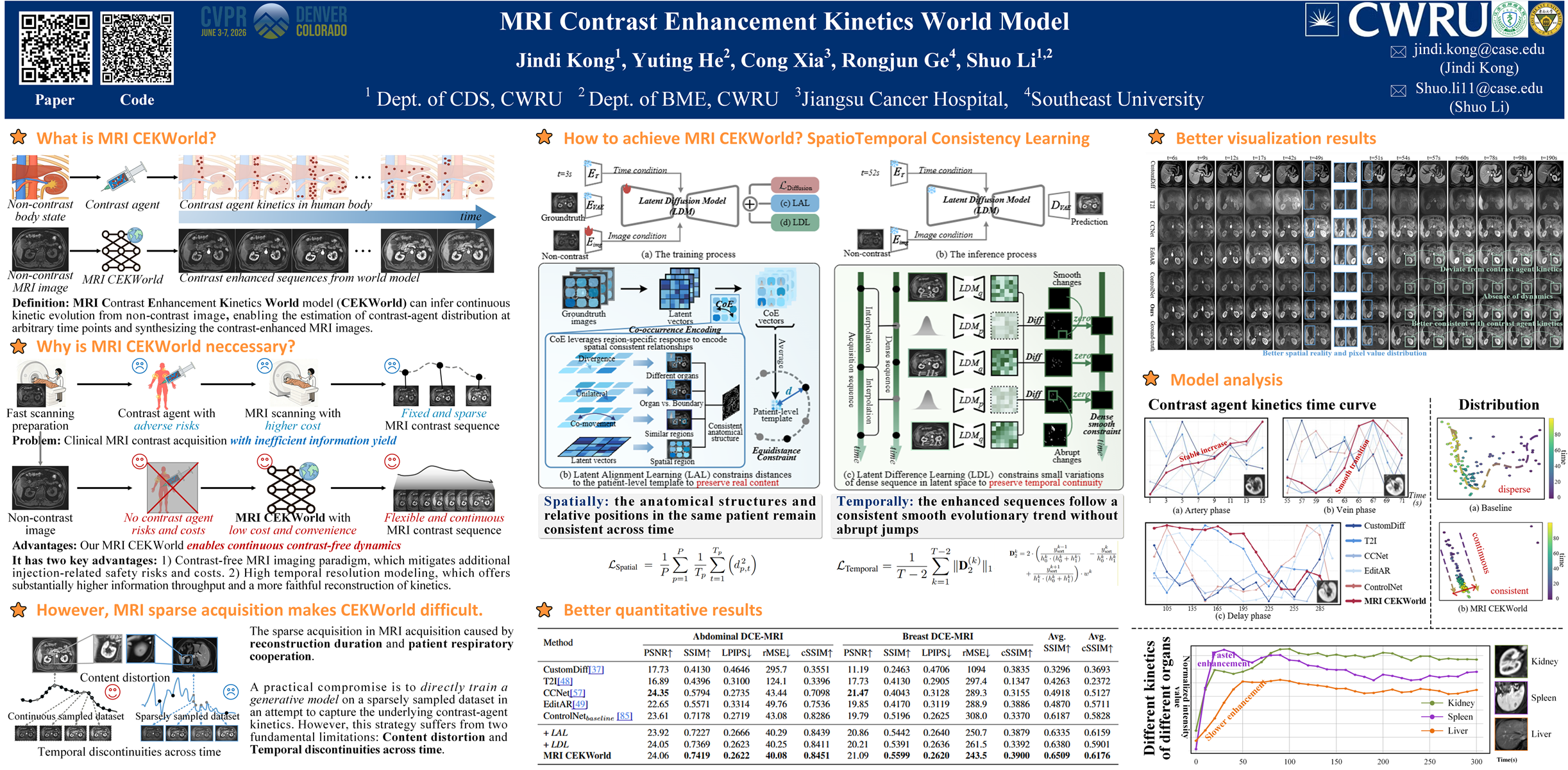
Clinical MRI contrast acquisition suffers from inefficient information yield, which presents as a mismatch between the risky and costly acquisition protocol and fixed and sparse acquisition sequence. Applying world models to simulate the contrast enhancement kinetics in human body enables continuous contrast-free dynamics. However, the low temporal resolution in MRI acquisition restricts the training of world models, leading to the sparsely sampled dataset. Directly training a generative model to capture the kinetics leads to two limitations: (a) Due to the absence data on missing time, the model tends to overfit to irrelevant features, leading to content distortion. (b) Due to the lack of continuous temporal supervision, the model fails to learn the continuous kinetics law over time, causing temporal discontinuities. For the first time, we propose MRI Contrast Enhancement Kinetics World model (MRI CEKWorld) with SpatioTemporal Consistency Learning (STCL). For (a), guided by spatial law that patient-level structures remain consistent during enhancement, we propose Latent Alignment Learning (LAL) that constructs a patient-specific template to constrain contents to align with this template. For (b), guided by the temporal law that the kinetics follows a consistent smooth trend, we propose Latent Difference Learning (LDL) which extends the unobserved intervals by interpolation and constrain smooth variations in the latent space among interpolated sequence. Extensive experiments on two datasets show our MRI CEKWorld achieves better realistic contents and kinetics. Codes will be available.