
Stealing Split Learning Bottom Models by Recovering Embedding Geometry
Abstract
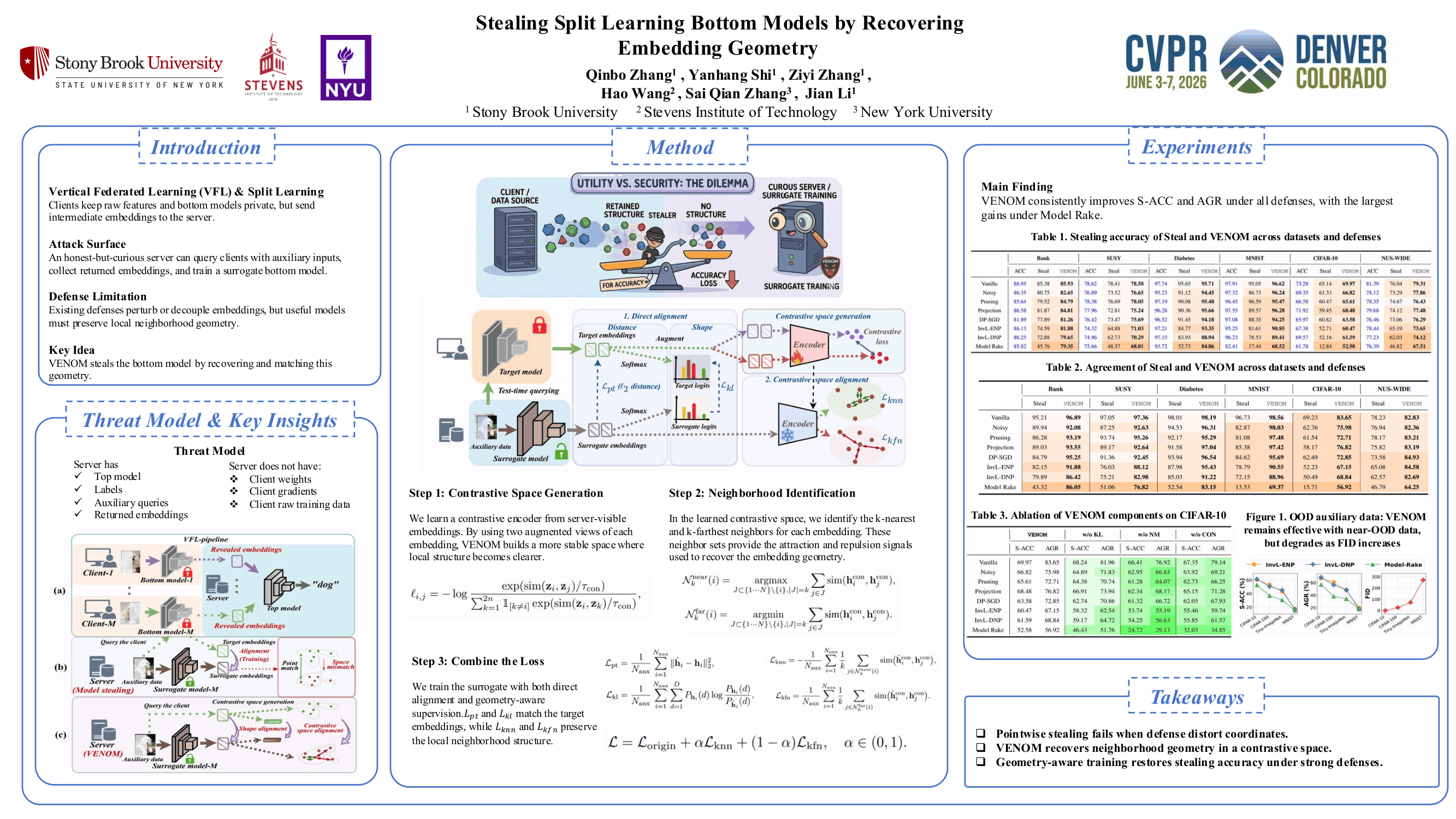
Vertical federated learning (VFL) trains models by splitting computation across clients and a server that only exchange intermediate embeddings. Recent work shows that a server even if honest-but-curious can steal a client’s bottom model by querying the system and regressing on the returned embeddings, and in response, defenses perturb or decouple the embedding channel. We show these defenses remain vulnerable. We propose VENOM, a geometry-aware stealing attack. VENOM first learns a contrastive space over server-observed embeddings, then builds a neighborhood graph and trains a surrogate bottom model to match targets and respect local geometry via a neighbor-matching loss alongside pointwise and feature-shape alignment. This strategy preserves the relational structure that defenses fail to erase, effectively recoupling the embeddings produced by multi-branch and noise-based defenses. Across six datasets, VENOM consistently outperforms standard stealing methods under no defense and multiple defenses, and remains effective with out-of-distribution (OOD) auxiliary data.