
Gyro-based Deep Video Deblurring
Abstract
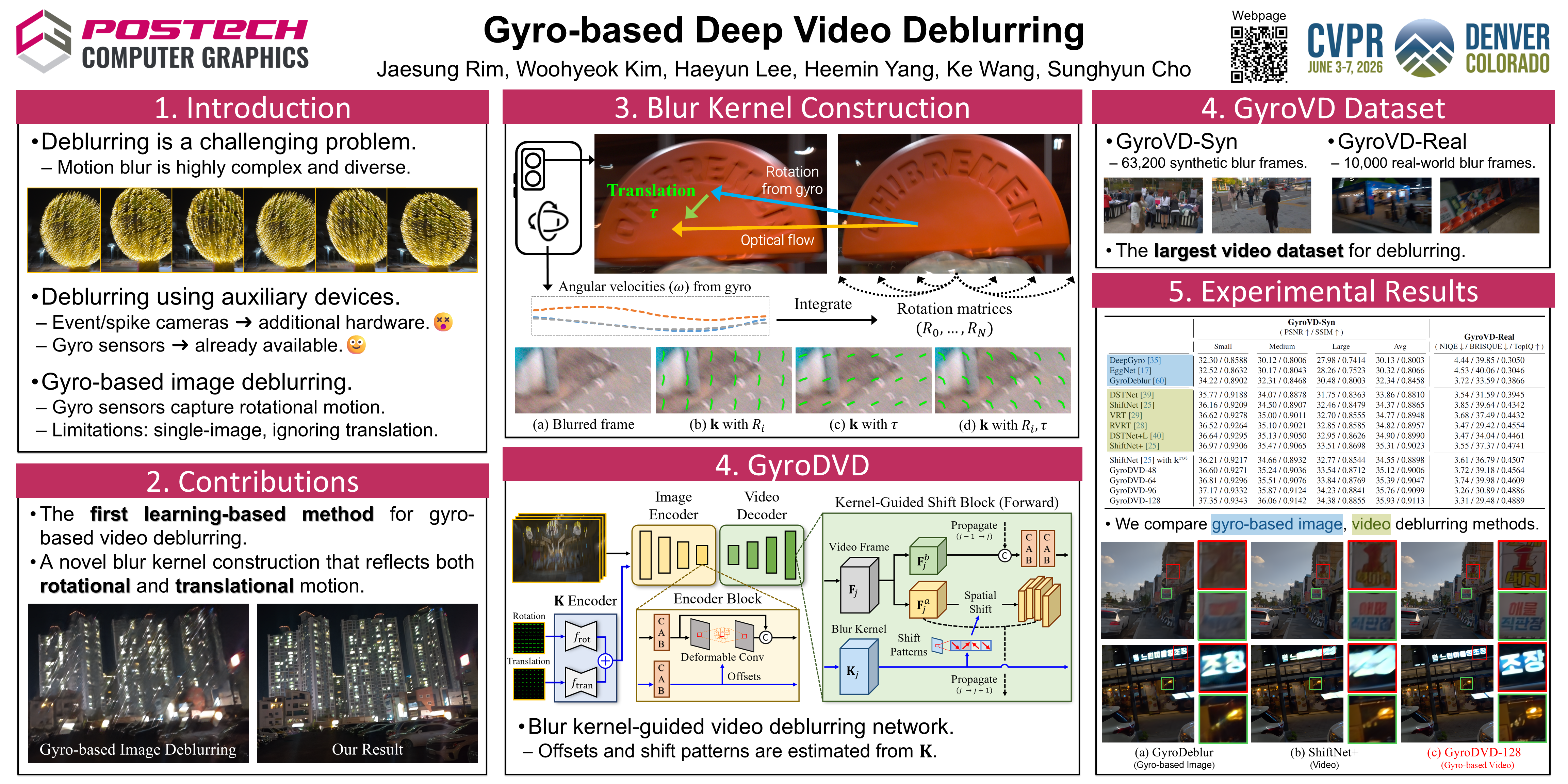
Modern cameras, such as smartphone cameras and DSLRs, are equipped with gyro sensors that measure motion of the camera. While the motion information is valuable for deblurring, gyro-based deblurring has not been widely studied, particularly for video. A few gyro-based video deblurring methods have been proposed, but they exhibit inherent limitations. First, gyro sensors capture only rotational motion, leading these methods to ignore translational motion. Second, their dependence on simplified blur models and deconvolution-based solutions restricts overall performance. To address these limitations, we introduce GyroDVD, the first learning-based framework for gyro-based video deblurring. We propose a novel blur kernel construction scheme that jointly accounts for rotational and translational motion. A video deblurring network then restores sharp videos by exploiting the constructed kernels together with the video frames. For training and evaluation, we introduce the GyroVD dataset, a large-scale and realistic dataset specifically designed for gyro-based deblurring. Extensive experiments demonstrate that our method significantly outperforms prior gyro-based image and video deblurring methods. Code and dataset will be made publicly available on our project page.