
FE2E: From Editor to Dense Geometry Estimator
jiyuan WANG ⋅ Chunyu Lin ⋅ Lei Sun ⋅ Rongying Liu ⋅ Lang Nie ⋅ Mingxing Li ⋅ Kang Liao ⋅ Xiangxiang Chu
Abstract
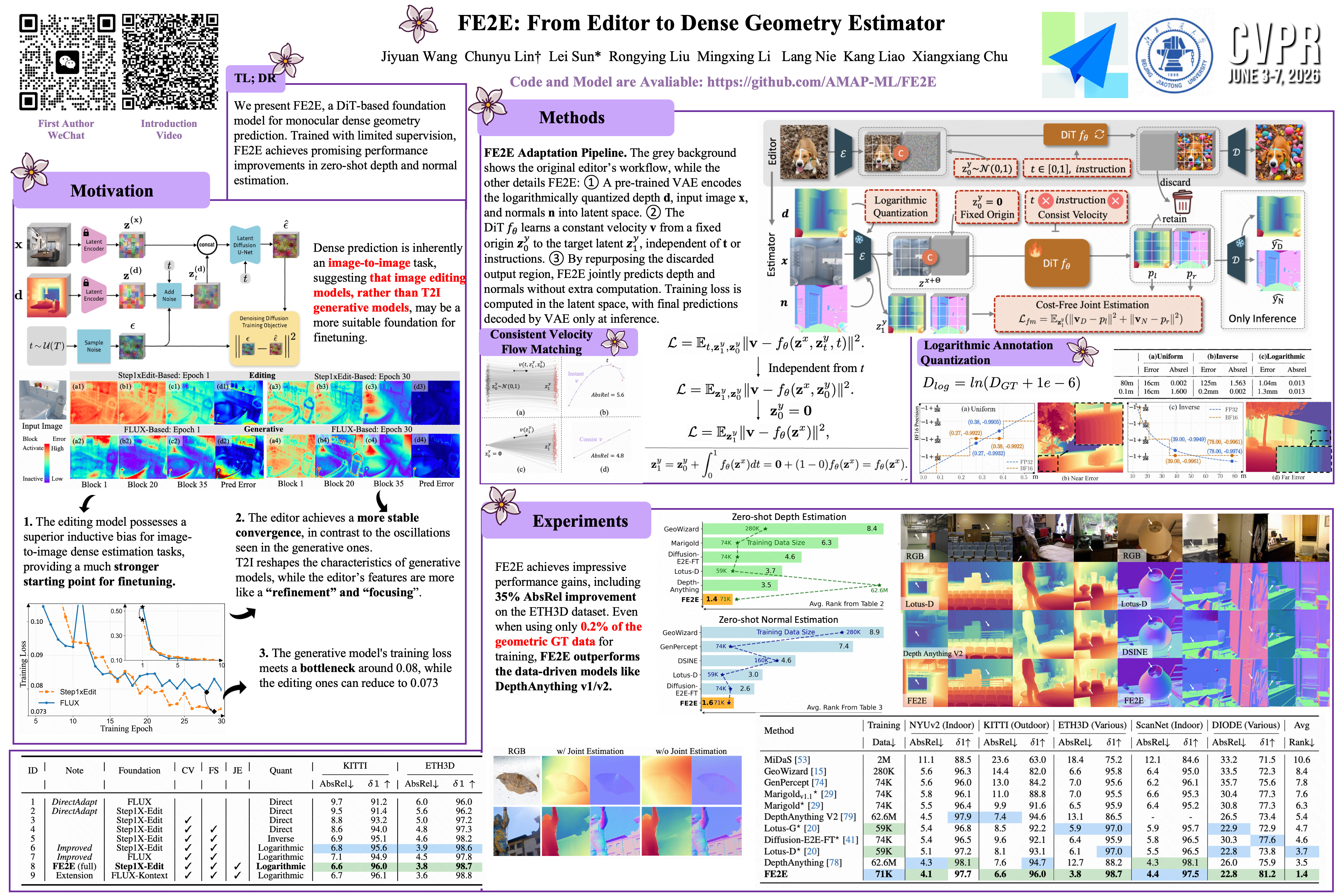
Pre-trained text-to-image (T2I) generative priors have shown success in depth and normal prediction. However, dense prediction is inherently an image-to-image task, suggesting that image editing models, rather than T2I generative models, may be a more suitable foundation for fine-tuning. Motivated by this, we conduct a systematic analysis of the fine-tuning behaviors of both editors and generators for dense geometry estimation. Our findings show that editing models possess inherent structural priors, which enable them to converge more stably by "refining" their innate features, and ultimately achieve higher performance than their generative counterparts. Based on these findings, we introduce \textbf{FE2E}, a framework that pioneeringly adapts an advanced editing model based on Diffusion Transformer (DiT) architecture for dense geometry prediction. Specifically, to tailor the editor for this deterministic task, we reformulate the editor's original flow matching loss into the "consistent velocity" training objective. And we use logarithmic quantization to resolve the precision conflict between the editor's native BFloat16 format and the high precision demand of our tasks. Additionally, we repurpose the editor's discarded region for a cost-free joint estimation of depth and normals, which improves the inference efficiency. Without scaling up the training data, FE2E achieves impressive performance improvements in zero-shot monocular depth and normal estimation across multiple datasets. Notably, it achieves over 35\% performance gains on the ETH3D dataset and outperforms the DepthAnything series, which is trained on 100$\times$ data.
Chat is not available.
Successful Page Load