
Learning from Semantic Dictionaries: Discriminative Codebook Contrastive Learning for Unified Visual Representation and Generation
Abstract
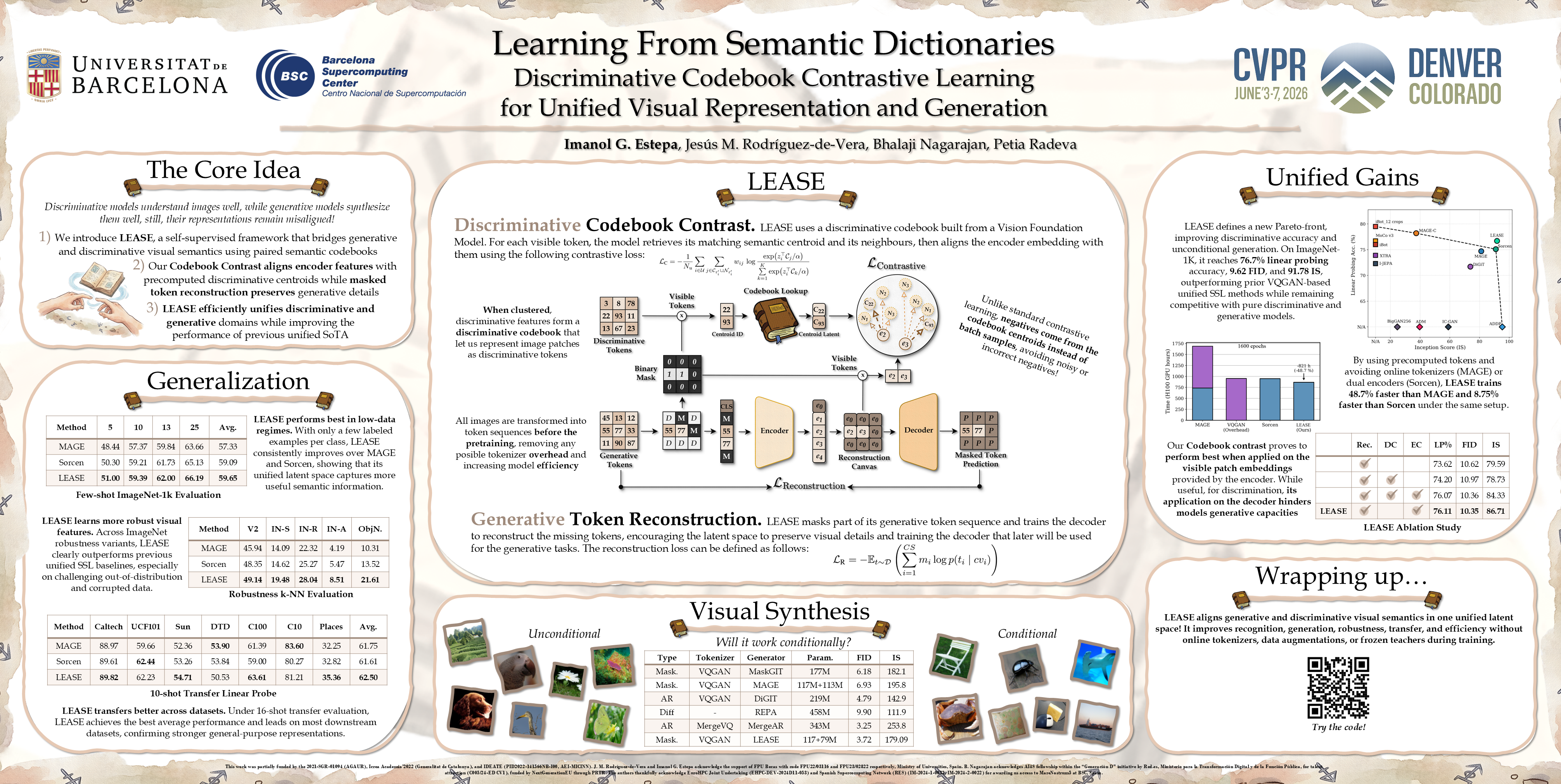
Discriminative and generative vision models excel in their respective domains but remain semantically misaligned, hindering progress toward unified visual learning. We introduce LEASE (LEArning from SEmantic Dictionaries), a self-supervised framework that bridges this gap using a paired generative–discriminative codebook design. LEASE operates entirely in a discrete token space produced through a one-time precomputation step, enabling efficient training without data augmentations, teacher models, or online tokenizers.LEASE integrates two complementary objectives: a masked token reconstruction loss that captures fine-grained generative detail, and a codebook contrast loss that aligns encoder features with discriminative semantics via adaptive centroid weighting. This dual supervision yields a unified latent space that supports both high-quality generation and strong representation learning.On ImageNet-1K, LEASE achieves state-of-the-art unified performance, outperforming prior VQGAN-based methods such as MAGE and Sorcen across linear probing (up to +1.7%), unconditional generation (-1.26 FID and +10.19 IS w.r.t MAGE), few-shot learning (+0.56% on average against Sorcen), transfer (+0.75% average improvement against MAGE and Sorcen), and robustness benchmarks (+5.86% and +4.25% average improvement against MAGE and Sorcen, respectively). It also competes favorably with domain-specialized contrastive and generative models while surpassing previous MIM methods. The unsupervised LEASE model can also be extended to conditional generation by building upon its learned representations, proving competitive with specialized baselines.Overall, LEASE provides an efficient and effective step toward general-purpose vision models that jointly understand and generate visual content. Code will be released upon acceptance.