
Test-time Sparsity for Extreme Fast Action Diffusion
Kangye Ji ⋅ Yuan Meng ⋅ Jianbo Zhou ⋅ Ye Li ⋅ Chen Tang ⋅ Zhi Wang
Abstract
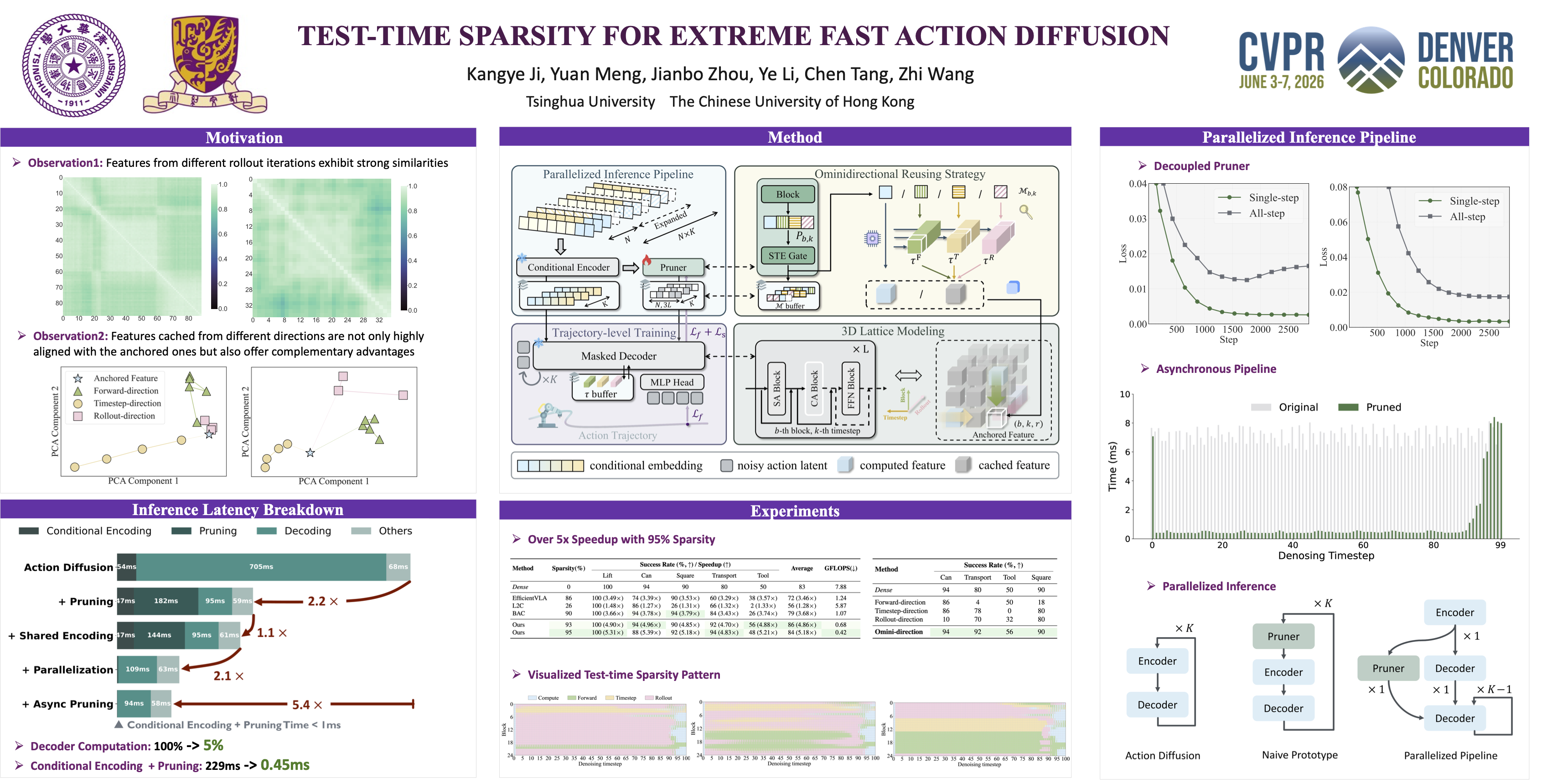
Action diffusion excels at high-fidelity action generation but incurs heavy computational costs owing to its iterative denoising nature. Despite current technologies showing promise in accelerating diffusion transformers by reusing the cached features, they struggle to adapt to policy dynamics arising from diverse perceptions and multi-round rollout iterations in open environments. We propose test-time sparsity to tackle this challenge, which aims to accelerate action diffusion by dynamically predicting prunable residual computations for each model forward at test time.However, two bottlenecks remain in this paradigm: 1) repetitive conditional encoding and pruning offset most potential speed gains, and 2) the features cached from previous denosing timeteps cannot constrain large pruning errors under aggressive sparsity. To address the first bottleneck, we design a highly parallelized inference pipeline that minimizes the non-decoder delay to milliseconds. Specifically, we first design a lightweight pruner that shares the encoder with the diffusion transformer. Then, we decouple the encoding and pruning from the autoregressive denoising loop by processing all denoising timesteps in parallel, and overlap the pruner with the decoder forward inference through asynchronism. To overcome the second bottleneck, we introduce an omnidirectional reusing strategy, which achieves 95\% sparsity by selectively reusing the features cached from the current forward, previous denoising timesteps, and earlier rollout iterations. To learn the rollout-level reusing strategies, we sample a few action trajectories to supervise the actions generated by the sparsified diffusion step by step.Extensive experiments demonstrate that our method reduces FLOPs by 92\% and accelerates action generation by 5$\times$, achieving lossless performance with an inference frequency of 47.5 Hz.
Chat is not available.
Successful Page Load