
Turning Pre-Trained Vision Transformers into End-to-End Histopathology Whole Slide Image Models for Survival Prediction
Abstract
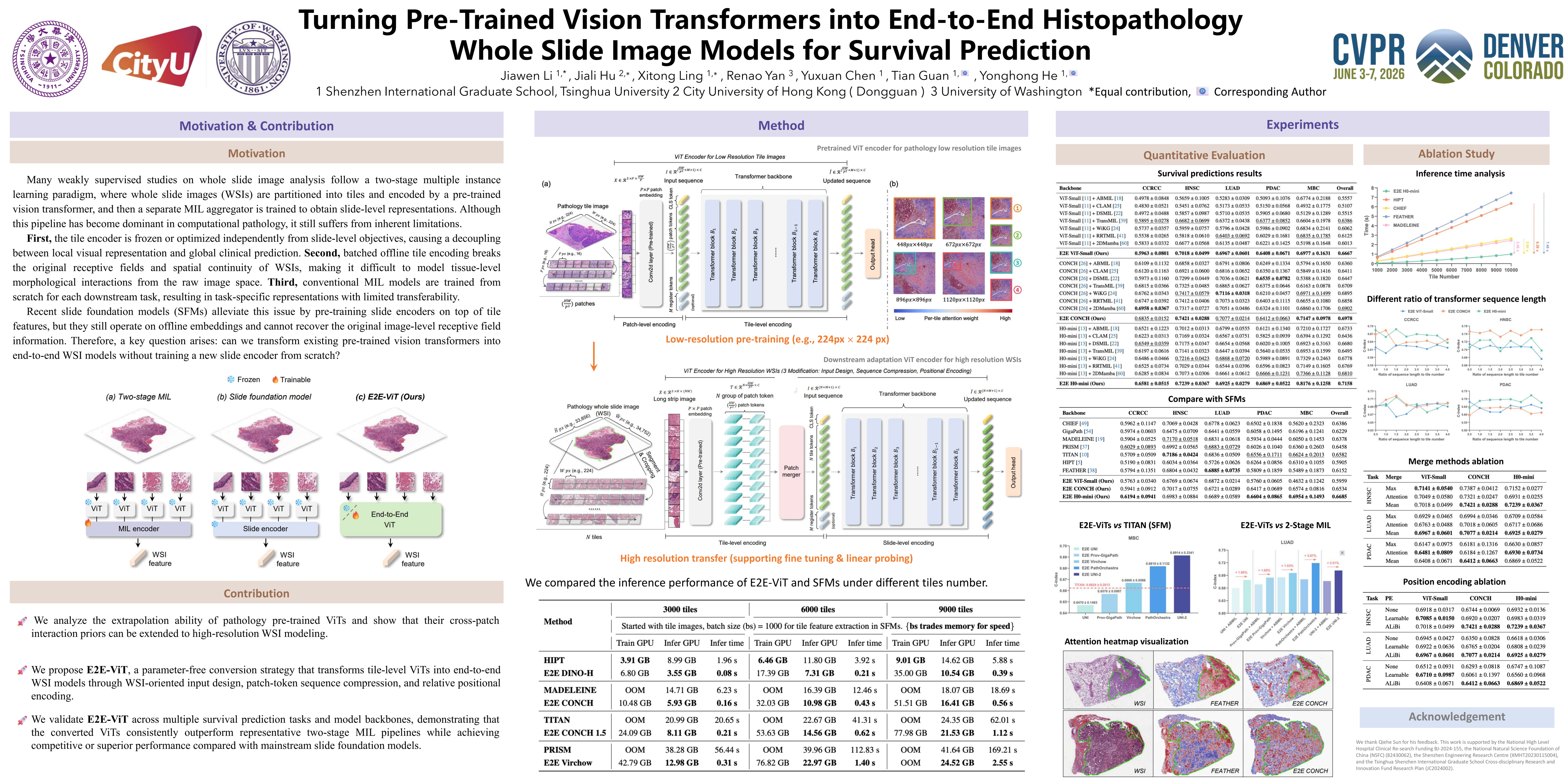
Conventional whole slide image (WSI) analysis pipelines follow a two-stage process. First, an image encoder, such as a vision transformer (ViT), is used to perform batched offline feature extraction on a series of tiles cropped from the WSI. Second, a multiple instance learning (MIL) model is trained with slide-level labels to obtain task-specific slide embeddings. However, several limitations exist: strong reliance on pre-trained weights of the tile encoder, the absence of receptive fields from the original image, and a lack of task-independent WSI representations. An ideal improvement would be to develop an end-to-end pre-trained WSI model, but training it from scratch will face challenges such as high training costs and computational complexity. In this work, we deconstruct the key steps of ViT-based pathology image representation and propose a conversion strategy called E2E-ViT, which transforms a vanilla ViT into an end-to-end pre-trained WSI model without introducing additional parameters. E2E-ViT directly inputs the entire tissue region in WSIs to efficiently feed image sequences into the transformer backbone, achieving information interaction from the original receptive fields and generating slide features. Through multiple survival prediction tasks, we demonstrate that transformed pre-trained ViTs outperform two-stage MIL models and slide foundation models (SFM). Our work presents a new end-to-end learning paradigm that provides a promising direction for the next generation of computational pathology models.