
PhysIR-Splat: Physically Consistent Thermal Infrared Radiative Transfer in 3D Gaussian Splatting
Abstract
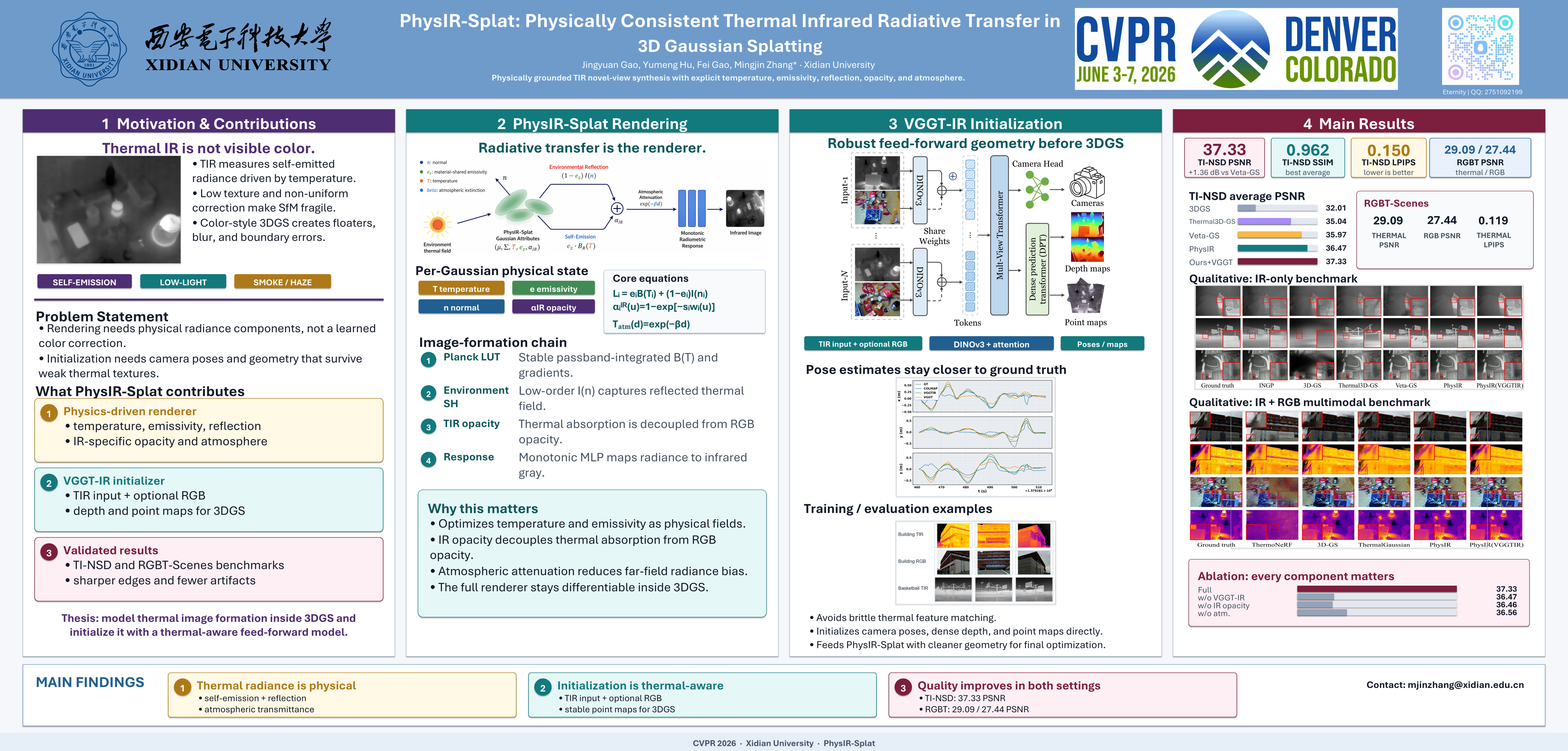
Thermal infrared (TIR) 3D reconstruction provides geometry that is intrinsically coupled to the temperature field, even in low-light, nighttime, and smoke-obscured environments. TIR imaging measures self-emitted thermal radiation driven by object temperature and is largely independent of external illumination; therefore, simply carrying over visible-spectrum assumptions to TIR-based 3D reconstruction and novel view synthesis (NVS) often results in floating artifacts and blurred edges. In addition, radiometric inconsistency and low contrast in TIR weaken structure-from-motion (SfM) initialization, which in turn hinders subsequent 3D Gaussian Splatting (3DGS) optimization. We present PhysIR-Splat, a 3DGS framework that follows infrared radiative transfer: we explicitly model temperature, emissivity, and environmental irradiance on Gaussian primitives and, during rendering, jointly account for thermal emission, the reflected component, and atmospheric transmittance to produce physically consistent thermal synthesis. We also introduce VGGT-IR, a Transformer-based feed-forward initializer that takes TIR input with optional RGB and directly regresses camera poses and initial geometry, providing a modality-aligned and stable starting point for PhysIR-Splat. Extensive experiments demonstrate that our method significantly surpasses existing approaches in thermal reconstruction quality and cross-view consistency, effectively suppressing floating artifacts and enhancing boundary sharpness. The code will be made publicly available upon acceptance of the paper.