
Dual Graph Regularized Deep Unfolding Network for Guided Depth Map Super-resolution
Zhiwei Zhong ⋅ Peilin CHEN ⋅ Qiangqiang Shen ⋅ Bo Li ⋅ Shiqi Wang
Abstract
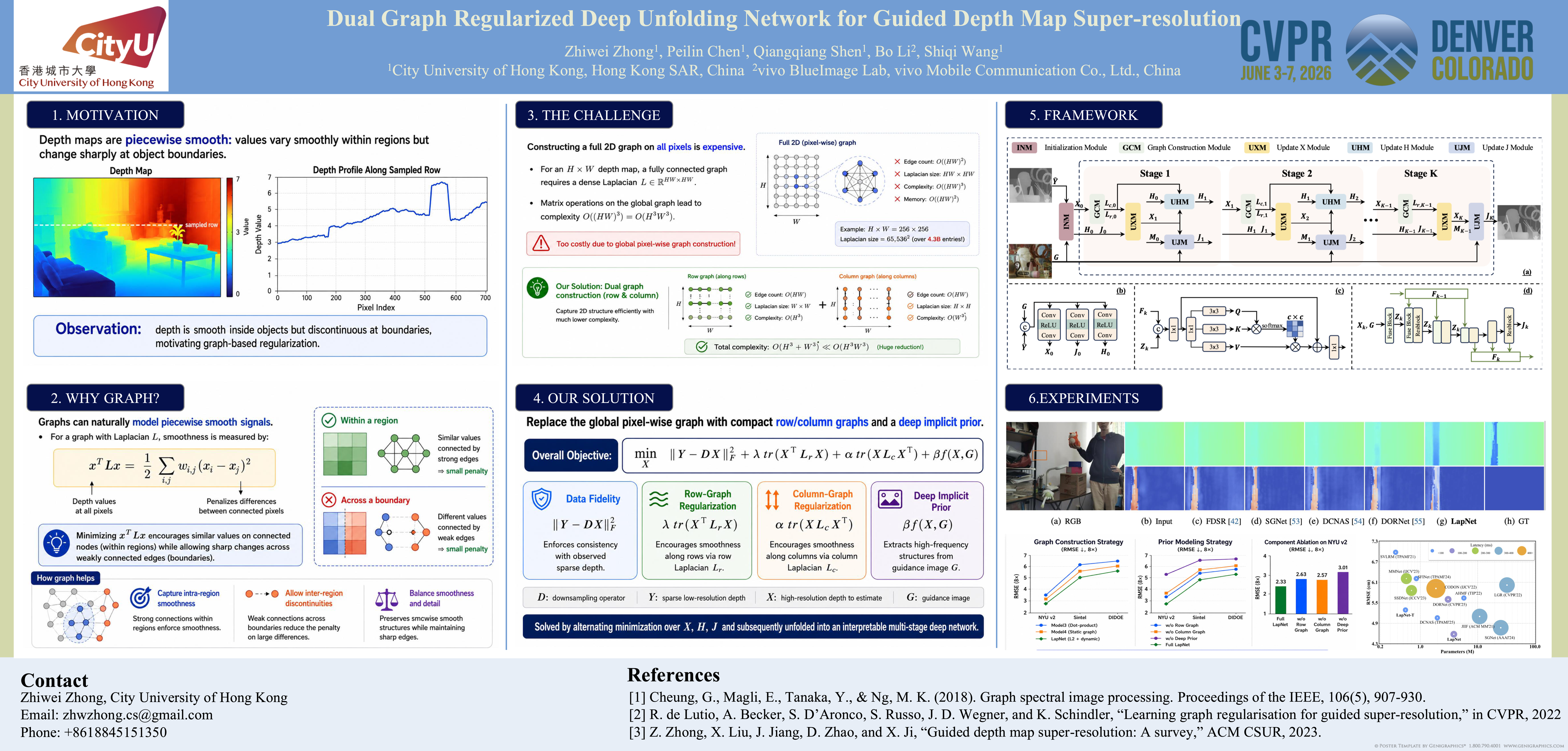
Depth map super-resolution with color guidance is a fundamental task in computer vision that aims to reconstruct high-resolution depth maps by leveraging structural correlations from corresponding guidance images. Recently, with the development of deep learning techniques, the performance of guided depth super-resolution (GDSR) models has been significantly improved. However, most existing approaches rely on black-box architectures that lack theoretical interpretability. Although graph optimization has been explored to integrate model-driven and data-driven frameworks, it remains computationally expensive and struggles to preserve the intrinsic structures of the depth maps. To overcome these limitations, we propose a novel GDSR framework based on a dual graph Laplacian prior, termed LapNet, which efficiently unfolds graph optimization into a deep neural network. Specifically, we first formulate a dual graph Laplacian prior that separately models structural dependencies along the row and column dimensions of the depth maps. This formulation explicitly enforces piecewise smoothness while reducing computational complexity from $\mathcal{O}(H^3W^3)$ to $\mathcal{O}(H^3 + W^3)$ by avoiding the construction of global affinity graph. Furthermore, we develop a deep implicit prior to extract high-frequency structural cues from the guidance image, serving as a complementary component to the manually designed prior. Finally, we integrate these complementary priors into a unified variational optimization framework, which is efficiently solved through alternating minimization and subsequently unfolded into an interpretable multi-stage deep network. Extensive experiments on both synthetic and real-world datasets demonstrate that LapNet achieves state-of-the-art performance while maintaining low computational complexity.
Chat is not available.
Successful Page Load